
Introducing
Are debt collectors calling you incessantly?
Do they insult or threaten you in the name of debt recovery?
If so, that is not only immoral, but the Consumer Protection Act of 2019 has also made it illegal.
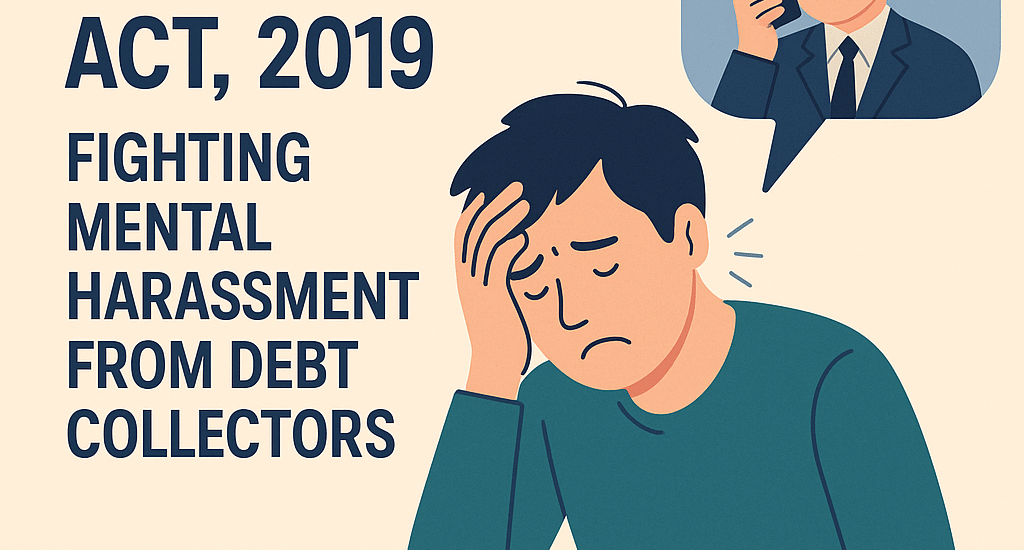
Debt recovery has become common in this fast world of finance, and so have the reports of psychological abuse by the debt collectors. The Consumer Protection Act of 2019 protects customers against such unethical practices and, at the same time, provides them with an opportunity to sue. In this article, we discuss how this Act works, what harassment is, and how one can seek justice based on Indian law.
⚖️ Comprehending the 2019 Consumer Protection Act
To improve consumer rights in India, the 1986 Act was superseded by the Consumer Protection Act, 2019.
It encompasses a broad spectrum of unfair trade practices, such as deception, harassment, and unethical corporate activities.
Customers are shielded by this Act from:
- False advertising
- Trade practices that are unfair or restrictive
- Inadequate products or services
- Deceptive billing or overcharging
- Financial firms’ aggressive recovery methods and mental harassment
- The Act expedites and simplifies legal remedies by enabling customers to file complaints both offline and online via the E-Daakhil site.
Understanding the 2019 Consumer Protection Act
The Consumer Protection Act, 2019, replaced the 1986 Act in a bid to update consumer rights in India.
It includes a wide range of unfair trade practices: from deception and harassment to unethical corporate activities.
This Act protects the customers from the following:
- False advertising
- Unfair trade practices and restrictive business practices
- Poor products or services
- Deceptive billing or overcharging
- Financial firms’ aggressive recoveries and mental harassment. The Act has facilitated quicker and easier legal remedies by allowing customers to file complaints offline as well as online through the E-Daakhil website.
What Constitutes Debt Collectors’ Mental Harassment?
Collection of debt turns into harassment when recovery agents:
- Make threatening or excessive phone calls
- Make frequent visits to your house or place of employment.
- Use language that is demeaning, offensive, or abusive.
- Give family members or employers access to your personal loan information.
- Demand payment through coercion or at odd hours.
According to the Reserve Bank of India (RBI) and the Consumer Protection Act, such actions violate both consumer rights and ethical banking norms.
The 2019 Consumer Protection Act and Your Rights
You have a number of legal rights to safeguard yourself as a consumer:
- Protection from dangerous, immoral, or unfair actions is the right to safety.
- Right to Information: Complete openness regarding your financial commitments.
- Right to Choose: Unfair settlements cannot be imposed upon you.
- Right to Be Heard: Your grievances must be fairly handled.
- Right to Seek Redress: You have the option to file a lawsuit to stop harassment.
- Knowledge of your rights and remedies is part of your right to consumer education.
You can submit a legal complaint and request compensation for psychological distress and reputational damage if recovery agents harass you.
How to Combat Harassment by Debt Collectors
Here is a straightforward, step-by-step instruction to self-defence:
Step 1: Gather Proof
All calls, messages, and visits should be documented. Record abusive exchanges as evidence, if at all feasible.
Step 2: File a complaint with the bank
Send a formal grievance to the relevant bank or NBFC (Non-Banking Financial Company). They have thirty days to reply.
Step 3: Speak with the RBI Ombudsman
If your complaint is disregarded, escalate it to the Banking Ombudsman under the RBI’s grievance redressal procedure.
It is entirely online, quick, and free.
Step 4: Use the Consumer Protection Act to File a Case
You can register a complaint with the Consumer Dispute Redressal Commission in your area if the harassment persists.
Depending on the extent of the loss, you can:
District Commission (up to ₹1 crore)
State Commission: ₹1–10 crore
National Commission (more than ₹10 crore)
Step 5: Look for Legal Help
You can create complaints, explain your case, and seek compensation for mental harassment with the assistance of a consumer protection law company.
Available Legal Remedies
The Consumer Protection Act of 2019 allows harassed parties to:
- Seek damages for defamation or psychological distress
- Request a formal apology from the bank.
- Obtain a cease-and-desist injunction for abusive agents.
- File criminal charges under IPC Sections 506 (threats) and 503 (criminal intimidation).
- Justice is ensured, and future wrongdoing is discouraged.
In conclusion
Financial responsibilities are crucial, but nobody has the right to degrade or mentally abuse you when you’re trying to heal.
You have the authority to confront such wrongdoing and demand justice thanks to the Consumer Protection Act of 2019.
Seek legal assistance right away if you or someone you know is being harassed by debt collectors.
Recognise your rights. Make use of your voice. You have the support of the law.
Frequently Asked Questions (FAQ)
What evidence is needed to prove debt collector harassment?
Keep all call recordings, messages, emails, and CCTV footage (if available) as proof. Also, document the dates, times, and names of the agents involved. This evidence strengthens your consumer case.
. How can I complain about a debt recovery agent’s harassment?
You can take the following steps:
File a complaint under the Consumer Protection Act 2019 via the E-Daakhil portal or your nearest Consumer Commission.
File a written complaint with your bank or lender.
If ignored, approach the Banking Ombudsman under the RBI.
What other laws protect me from recovery agent abuse?
Besides the Consumer Protection Act 2019, the following laws can also help:
- Indian Penal Code (IPC) Sections 503 & 506 – Protection from criminal intimidation and threats.
- Information Technology Act, 2000 – Protection from online or digital harassment.
- RBI Guidelines on Recovery Agents – Define ethical practices for financial institutions.