Last Updated: April 2026 | Global Vision Law Firm — New Delhi | ~5 min read
The Chief Justice of India is not just the head of the Supreme Court.
They are the master of the roster. The guardian of the Constitution. The first among equals in India’s highest judicial body.
And in 2025 alone — India saw two Chief Justices hold office, with a third taking charge before the year ended.
Each with a distinct judicial philosophy. Each leaving a mark on Indian law that will influence courts, businesses, and citizens for years.
Whether you are a business owner, a litigant, a law student, or simply a citizen — knowing who leads the Supreme Court and what they stand for is essential.
This guide gives you the complete picture of the Chief Justices of India in 2025.
📌 Quick Answer
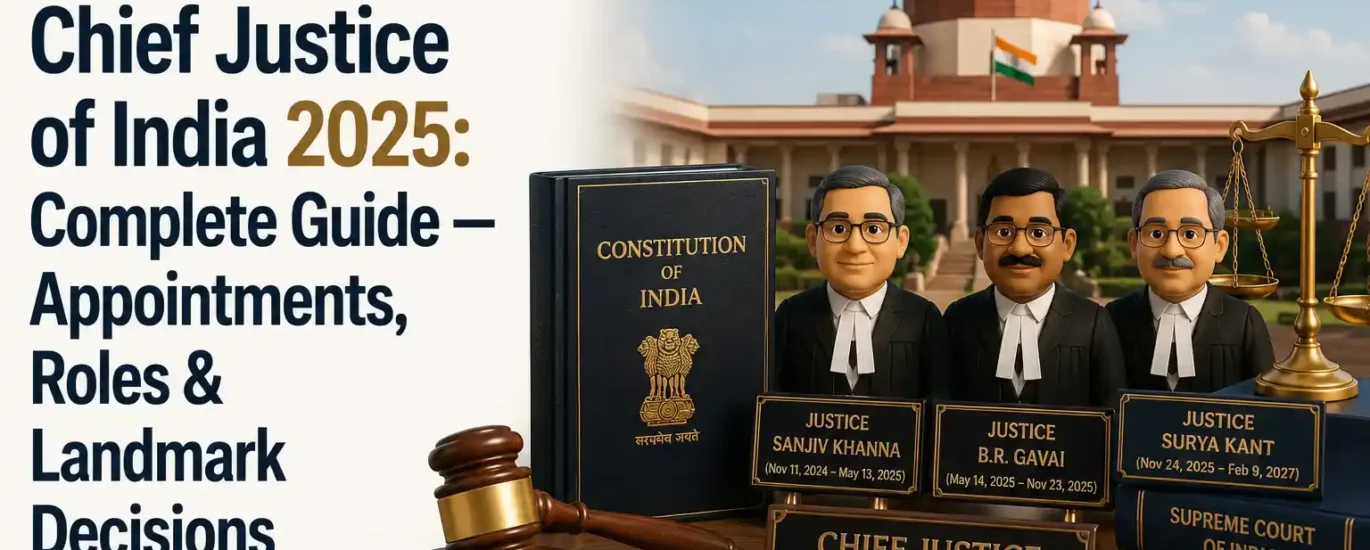
In 2025, India had two Chief Justices. Justice Sanjiv Khanna served as the 51st CJI from November 11, 2024 to May 13, 2025. He was succeeded by Justice B.R. Gavai — the 52nd CJI — who served from May 14 to November 23, 2025. Justice Surya Kant was sworn in as the 53rd Chief Justice on November 24, 2025. All three were appointed under Article 124(2) of the Constitution by President Droupadi Murmu, following the seniority convention established by the Second Judges Case (1993).
🏛️ How Is the Chief Justice of India Appointed?
The Constitutional Basis — Article 124(2)
The Chief Justice of India is appointed by the President of India under Article 124(2) of the Constitution. The appointment is made after consultation with such judges of the Supreme Court and High Courts as the President deems necessary.
The Seniority Convention
Since the Second Judges Case (1993), a firm convention has been followed: the senior-most judge of the Supreme Court is appointed as the next Chief Justice. The outgoing CJI recommends their successor to the Law Minister, who forwards it to the Prime Minister, who then advises the President.
The Collegium System
Supreme Court judges — and thereby future Chief Justices — are appointed through the Collegium system. The Collegium consists of the CJI and the four senior-most SC judges. Their recommendation is binding on the government, as established through the Three Judges Cases (1981, 1993, 1998).
Understanding how to approach the Supreme Court is critical for businesses and individuals. For a complete guide on filing matters, visit our Supreme Court practice page: Supreme Court — Global Vision Law Firm
⚖️ Justice Sanjiv Khanna — 51st Chief Justice of India
Tenure: November 11, 2024 — May 13, 2025
Background
Justice Sanjiv Khanna was born on May 14, 1960, in New Delhi. He is the nephew of the legendary Justice H.R. Khanna — who famously dissented in the ADM Jabalpur case during the Emergency, a dissent now celebrated as one of India’s greatest acts of judicial courage.
Justice Khanna enrolled as an advocate in 1983 and practised at the Delhi High Court for over two decades — handling civil, criminal, taxation, arbitration, and constitutional matters. He was elevated as a Judge of the Delhi High Court in June 2005 and to the Supreme Court in January 2019.
Appointment as CJI
Justice Sanjiv Khanna was appointed as the 51st CJI on November 11, 2024, succeeding Justice D.Y. Chandrachud. His tenure was exactly six months — he retired on May 13, 2025, on attaining the mandatory retirement age of 65.
Before retirement, Justice Khanna confirmed he would not accept any post-retirement government assignment — widely noted as a statement of judicial independence.
Key Judicial Contributions
Electoral Bonds Judgment — Justice Khanna was part of the five-judge Constitution Bench that unanimously struck down the Electoral Bonds Scheme as unconstitutional, holding it violated the right to information under Article 19(1)(a).
Bail Jurisprudence — he authored landmark rulings emphasising that bail is the rule and jail is the exception, reinforcing Article 21 rights in criminal cases.
Personal Liberty — his consistent judicial record upheld the primacy of personal liberty, individual autonomy, and robust democratic participation.
⚖️ Justice Bhushan Ramkrishna Gavai — 52nd Chief Justice of India
Tenure: May 14, 2025 — November 23, 2025
Background
Justice B.R. Gavai was born on November 24, 1960. He enrolled as an advocate in 1985 and practised before the Bombay High Court — specialising in constitutional law, administrative law, and service matters. He was elevated as a permanent Judge of the Bombay High Court in 2003 and to the Supreme Court in May 2019.
Justice Gavai is the second judge from the Scheduled Caste community to become Chief Justice of India — a historic milestone in the Indian judiciary.
Appointment as CJI
Justice Gavai was appointed as the 52nd CJI effective May 14, 2025, succeeding Justice Sanjiv Khanna. He served until November 23, 2025 — approximately six months.
Key Judicial Contributions
Constitutional Equality — his most notable observations related to the creamy layer within SC/ST reservations. He held that children of SC/ST parents who have reached high positions through reservation benefits should not be treated the same as those doing manual work in villages — a position that generated significant legal and public debate.
Access to Justice — Justice Gavai was a vocal proponent of making justice accessible and affordable, particularly for marginalised communities.
Environmental Law — he was part of benches delivering significant judgments on environmental protection and forest rights under Article 21.
Historical Significance
Justice Gavai’s elevation as the second Dalit Chief Justice of India is a landmark moment — reflecting the gradual broadening of representation at the apex of India’s legal system.
⚖️ Justice Surya Kant — 53rd Chief Justice of India
Tenure: November 24, 2025 — February 9, 2027 (expected)
Background
Justice Surya Kant was born on September 24, 1962. He practised before the Punjab and Haryana High Court before being appointed as a Judge of that court in January 2004. He subsequently served as Chief Justice of the Himachal Pradesh High Court before being elevated to the Supreme Court in May 2019 — the same batch as Justice Gavai.
Appointment as CJI
Justice Surya Kant was sworn in as the 53rd CJI on November 24, 2025. His tenure runs until February 9, 2027 — over a year, making him one of the longer-serving recent CJIs.
Notable Constitution Bench Experience
Article 370 — he was on the Constitution Bench that upheld the abrogation of Article 370 and the reorganisation of Jammu & Kashmir.
Citizenship Act — he was on the bench that upheld the validity of Section 6A of the Citizenship Act.
Aligarh Muslim University — he was on the AMU minority status bench, where he authored a notable dissent.
What His Tenure Means
Justice Surya Kant’s extended tenure offers Indian courts and litigants a period of greater stability at the apex level. Extended CJI tenures historically allow for more consistent docket management, roster continuity, and longer-term judicial reforms.
📊 Chief Justices of India — 2025 at a Glance
| CJI | Number | Tenure | Key Focus |
|---|---|---|---|
| Justice Sanjiv Khanna | 51st | Nov 11, 2024 — May 13, 2025 | Personal liberty, electoral law, judicial independence |
| Justice B.R. Gavai | 52nd | May 14, 2025 — Nov 23, 2025 | Constitutional equality, access to justice, environment |
| Justice Surya Kant | 53rd | Nov 24, 2025 — Feb 9, 2027 | Constitution Bench experience, longer tenure, docket continuity |
🏛️ Role of the Chief Justice of India — Simply Explained
Master of the Roster
The CJI decides which judge hears which case. This power — called the Master of the Roster — is perhaps the most consequential administrative power in the Indian judiciary. The CJI constitutes benches and allocates cases across the Supreme Court’s multiple benches.
Head of the Collegium
The CJI heads the five-member Collegium that recommends appointments and transfers of judges across all High Courts and the Supreme Court — making the CJI arguably the most influential figure in determining who becomes a judge in India.
Constitutional Functions
The CJI administers the oath of office to the President of India, presides over impeachment proceedings for judges, and is consulted by the President on judicial appointments under Article 124(2).
Why It Matters for Your Legal Case
If you are approaching the Supreme Court — understanding the current CJI and their judicial priorities has practical implications:
Constitution Bench Matters — the CJI decides which five or more judge bench hears constitutional questions involving Article 32 petitions, fundamental rights, and substantial constitutional questions.
Urgent Mentioning — urgent matters are mentioned before the CJI’s court. If you need a stay of a government order or urgent interim relief — the CJI’s court is the first port of call.
Roster Allocation — the CJI decides which bench hears your SLP or appeal. Different benches have different expertise — commercial, criminal, constitutional, family.
For our complete guide on filing before the Supreme Court, including SLPs and urgent listings, visit: Supreme Court Practice — Global Vision Law Firm
For cases involving Arbitration and commercial disputes: Arbitration Services — Global Vision Law Firm
For Litigation matters across courts: Litigation Practice — Global Vision Law Firm
❓ FAQs — Chief Justice of India 2025
Q: Who was the Chief Justice of India in 2025?
A: India had two CJIs in 2025. Justice Sanjiv Khanna (51st CJI) served from November 2024 to May 13, 2025. Justice B.R. Gavai (52nd CJI) served from May 14 to November 23, 2025. Justice Surya Kant became 53rd CJI on November 24, 2025.
Q: Who is the current Chief Justice of India in 2026?
A: Justice Surya Kant is the current 53rd Chief Justice of India as of 2026. He was sworn in on November 24, 2025 and is expected to serve until February 9, 2027.
Q: How is the Chief Justice of India appointed?
A: Under Article 124(2), the CJI is appointed by the President on the recommendation of the outgoing CJI. By convention since 1993, the senior-most judge of the Supreme Court is appointed as CJI.
Q: What is the retirement age of the Chief Justice of India?
A: 65 years — the mandatory retirement age for all Supreme Court judges under Article 124(2).
Q: Who was the first Chief Justice of India?
A: Justice H.J. Kania — the first CJI, serving from January 26, 1950.
Q: Who was the first Dalit Chief Justice of India?
A: Justice K.G. Balakrishnan (2007–2010) was the first. Justice B.R. Gavai, 52nd CJI in 2025, is the second.
Q: What does “Master of the Roster” mean?
A: The CJI’s exclusive power to decide which judges sit on which benches and hear which cases. This administrative power has been upheld by the Supreme Court itself.
Q: Can I directly approach the Supreme Court for fundamental rights violations?
A: Yes — under Article 32 of the Constitution. See our Dispute Resolution practice page for how Global Vision Law Firm can assist: Dispute Resolution — Global Vision Law Firm
💼 How Global Vision Law Firm Can Help You Before the Supreme Court
Whether your matter requires filing before a Constitution Bench, seeking urgent relief from the CJI’s court, or navigating the complex roster and listing mechanism of the Supreme Court — the right legal team makes all the difference.
Global Vision Law Firm has been representing clients before the Supreme Court of India since 2013. Our Supreme Court and dispute resolution practice includes:
- Special Leave Petitions — civil and criminal: Supreme Court Practice
- Constitutional matters and fundamental rights
- Arbitration — domestic and international: Arbitration Services
- Intellectual Property Rights litigation: IPR Litigation
- MSME payment disputes: MSME Case Services
- Employment and service matters: Employment Law
- Insolvency and Bankruptcy: Bankruptcy & Insolvency
📞 Contact us today for a consultation.
👉 Visit: globalvisionlawfirm.com 📖 About our firm: About Us — Global Vision Law Firm 📬 Contact: Contact Us — Global Vision Law Firm
💡 Final Thought
Three Chief Justices. One year. Dozens of landmark decisions.
2025 was a remarkable year for India’s Supreme Court — marked by historic firsts, constitutional milestones, and decisions that will shape Indian law for decades.
Justice Khanna reinforced personal liberty and electoral transparency. Justice Gavai broke barriers and championed access to justice. Justice Surya Kant begins a longer, steadier tenure that will define the next phase of India’s apex court.
For anyone approaching the Supreme Court — understanding the court’s leadership, judicial philosophy, and institutional priorities is not optional. It is strategy.
Global Vision Law Firm brings that strategic awareness to every Supreme Court matter we handle — since 2013.
👉 Contact Global Vision Law Firm today → globalvisionlawfirm.com/contact-us-global-vision-law-firm
Meta Title: Chief Justice of India 2025: Appointments, Role & Key Decisions | Global Vision Law Firm Meta Description: Who was the CJI in 2025? Complete guide to CJI Sanjiv Khanna, CJI B.R. Gavai & CJI Surya Kant — appointments, key decisions, roles & how Global Vision Law Firm can help before the Supreme Court. Focus Keyword: Chief Justice of India 2025 URL Slug: /chief-justice-of-india-2025/