Last Updated: April 2026 | Global Vision Law Firm — New Delhi | ~6 min read
One Instagram story.
One viral tweet.
One fake LinkedIn post.
That is all it takes today to destroy a reputation built over 20 years.
A competitor posts false allegations.
An ex-employee uploads defamatory accusations.
A YouTube creator publishes misleading claims for views.
A WhatsApp message spreads through business groups overnight.
And suddenly — your clients stop calling.
Your company faces public embarrassment.
Your reputation becomes Google search material.
This is online defamation.
And in India — online defamation is not just unethical. It can trigger civil liability, criminal prosecution, injunctions, takedown orders, damages, cybercrime complaints, and even imprisonment.
But most people still do not understand:
- What legally counts as online defamation?
- Is social media defamation a crime in India?
- Does the new Bharatiya Nyaya Sanhita (BNS) change the law?
- Can anonymous accounts be traced?
- Can courts force Google, Instagram, YouTube, or X to remove defamatory content?
This guide explains everything — simply.
📌 Quick Answer
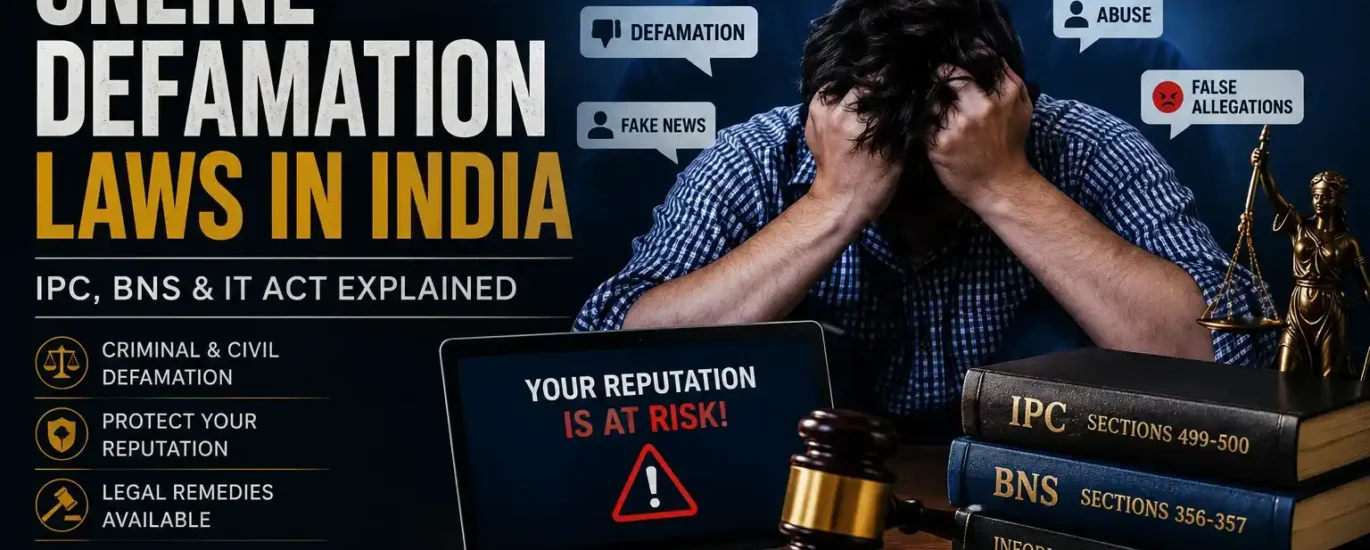
Online defamation in India occurs when false statements harming a person’s or company’s reputation are published through digital platforms such as social media, websites, YouTube, WhatsApp, blogs, or online news portals. Defamation can lead to both civil and criminal action under Indian law. Criminal defamation was earlier governed under Sections 499–500 IPC and now continues under Sections 356–357 of the Bharatiya Nyaya Sanhita (BNS), 2023. The Information Technology Act, 2000 also applies in cases involving electronic publication, intermediary liability, cyber harassment, fake accounts, and online takedown requests.
💔 Meet Rohan — One Viral LinkedIn Post Nearly Destroyed His Business
Rohan Mehta runs a logistics company in Gurugram.
In February 2025, a former employee uploaded a LinkedIn post accusing his company of fraud, salary theft, tax evasion, and fake invoices.
The post was completely false.
But within 48 hours:
- Clients began questioning ongoing contracts
- Vendors stopped extending credit
- Screenshots spread across WhatsApp groups
- Google search results started indexing the allegations
The damage was immediate.
Rohan initially ignored it — assuming the truth would eventually win.
It didn’t.
The post crossed 2 lakh impressions.
Only after legal action was initiated — including a criminal defamation complaint, platform takedown notice, and injunction application before the Delhi High Court — was the content removed.
By then, the reputational damage had already cost him two major contracts.
In online defamation cases, delay is expensive.
⚖️ What Is Online Defamation Under Indian Law?
Defamation means making or publishing a false statement that harms the reputation of another person or business.
When this happens through:
- X (Twitter)
- YouTube
- Telegram
- Online news websites
- Blogs
- Review platforms
- Emails
- Digital advertisements
…it becomes online defamation.
The law protects:
- Individuals
- Companies
- Professionals
- Celebrities
- Startups
- Influencers
- Law firms
- Doctors
- Educational institutions
- Brands and businesses
A defamatory statement does not need to be spoken publicly in a stadium or printed in a newspaper anymore.
A single WhatsApp forward can qualify.
🏛️ IPC vs BNS — What Changed in 2024?
Before July 2024, criminal defamation was governed under:
- Section 499 IPC — Definition of defamation
- Section 500 IPC — Punishment for defamation
After implementation of the Bharatiya Nyaya Sanhita (BNS), 2023:
- Section 356 BNS — Definition of defamation
- Section 357 BNS — Punishment provisions
The substance of the law remains largely similar.
The core principle is unchanged:
Publishing false statements intending to harm reputation is punishable.
Punishment may include:
- Imprisonment
- Fine
- Or both
📱 What Counts as Online Defamation?
The following commonly qualify:
False Social Media Allegations
Posting false accusations about fraud, cheating, harassment, corruption, or criminal conduct.
Fake Google Reviews
Competitors posting fabricated reviews to damage a business reputation.
Defamatory YouTube Videos
Publishing misleading videos targeting individuals or companies.
WhatsApp Defamation
Circulating false allegations in groups or broadcast lists.
Fake News Articles
Publishing unverified allegations on blogs or portals.
Morphed Images & Memes
Using edited visuals to humiliate or damage reputation.
Anonymous Accounts
Fake Instagram or X accounts impersonating or attacking individuals.
Employee Defamation
Ex-employees posting false allegations against employers online.
⚠️ The 3 Legal Requirements for Defamation in India
Not every criticism is defamation.
For a successful defamation case, these three elements generally must exist:
1. False Statement
The statement must be false — not merely unpleasant or critical.
Truth is a valid defence.
2. Publication to Third Parties
The statement must be communicated to others.
A private message seen only by the sender and recipient may not qualify the same way as a public post.
3. Reputation Damage
The statement must lower the person’s reputation in the eyes of society, clients, colleagues, or the public.
🔍 Civil Defamation vs Criminal Defamation
Civil Defamation
Purpose:
Financial compensation and injunctions.
You can seek:
- Monetary damages
- Permanent injunction
- Removal of defamatory content
- Public apology
- Restraining future publication
Civil defamation cases are usually filed before District Courts or High Courts depending on jurisdiction and valuation.
Criminal Defamation
Purpose:
Punishment for harming reputation.
Complaint filed before:
Magistrate Court.
Possible consequences:
- Criminal summons
- Trial
- Fine
- Imprisonment
Criminal defamation creates immediate legal pressure — especially in serious reputational attacks.
💻 Role of the Information Technology Act, 2000
The IT Act becomes important when online platforms are involved.
Intermediary Liability
Platforms like:
- Meta
- YouTube
- X (Twitter)
…may be directed to remove defamatory content after legal notice or court orders.
Section 79 IT Act
Intermediaries receive safe harbour protection only if they comply with due diligence and takedown obligations.
If platforms ignore lawful court directions, liability issues can arise.
Cybercrime Complaints
Fake accounts, impersonation, identity theft, and digital harassment may also involve:
- Cyber cells
- CERT-In
- IT Act provisions
- Data/privacy violations
For cyber law and digital dispute assistance, visit:
https://globalvisionlawfirm.com/dispute-resolution/
🛠️ Step-by-Step: What to Do If Someone Defames You Online
Step 1 — Preserve Evidence Immediately
Take:
- Screenshots
- URLs
- Post links
- Usernames
- Timestamps
- Comments
- Shares
- Video copies
Online content disappears quickly.
Evidence is everything.
Step 2 — Send a Legal Notice
A defamation legal notice typically demands:
- Immediate removal
- Public apology
- Retraction
- Compensation
- Cease-and-desist undertaking
Many matters settle at this stage itself.
Step 3 — File Platform Takedown Requests
Most platforms have grievance systems for:
- Defamation
- Fake impersonation
- Reputation attacks
- False allegations
A properly drafted legal notice significantly improves takedown success.
Step 4 — File Civil or Criminal Proceedings
Depending on severity:
- Civil suit for damages/injunction
- Criminal complaint for defamation
- Interim injunction for urgent removal
- John Doe orders against anonymous users
High Courts regularly grant urgent injunctions in severe online reputation cases.
Step 5 — Trace Anonymous Users
Courts can direct:
- Social media platforms
- ISPs
- Telecom operators
…to disclose user details linked to fake accounts.
Anonymous does not mean untraceable.
📊 Common Online Defamation Situations in India
| Situation | Legal Action Possible |
|---|---|
| Fake Instagram allegations | Criminal + civil defamation |
| False Google reviews | Injunction + takedown |
| YouTube smear campaign | Damages + removal |
| WhatsApp rumours | Criminal complaint |
| Fake LinkedIn accusations | Defamation suit |
| Anonymous parody account | Injunction + tracing |
| Defamatory news article | Damages + takedown |
| Morphed photos/videos | Cybercrime + defamation |
⚠️ 5 Mistakes People Make in Online Defamation Cases
1. Waiting Too Long
The longer defamatory content stays online, the more damage spreads.
2. Fighting Publicly Online
Emotional replies often worsen evidence against you.
3. Not Preserving Evidence
Deleted posts become difficult to prove later.
4. Filing Wrong Complaints
Cybercrime and defamation are related — but legally different.
5. Ignoring Anonymous Accounts
Courts can compel disclosure of user identities.
🏛️ Landmark Online Defamation Principles in India
Indian courts have repeatedly recognised:
- Reputation as part of Article 21
- Online publication as actionable defamation
- Social media liability
- Rights against digital harassment
- Power to issue takedown injunctions
Courts today take digital reputation extremely seriously — especially where businesses, professionals, and women are targeted online.
💼 How Global Vision Law Firm Helps in Online Defamation Cases
At Global Vision Law Firm, we assist clients across India in handling:
- Online defamation litigation
- Social media takedown notices
- Criminal defamation complaints
- High Court injunctions
- Anonymous account tracing
- Reputation management disputes
- Cybercrime complaints
- Digital evidence strategy
- Corporate reputation protection
Our dispute resolution and cyber law practice represents:
- Businesses
- Founders
- Professionals
- Influencers
- Corporates
- Public figures
- Startups
Explore our legal services:
- Supreme Court Practice: https://globalvisionlawfirm.com/hire-supreme-court-advocate-india/
- Litigation Practice: https://globalvisionlawfirm.com/litigation/
- Dispute Resolution: https://globalvisionlawfirm.com/dispute-resolution/
- Arbitration Services: https://globalvisionlawfirm.com/arbitration-services-global-vision-law-firm/
📞 Contact us for urgent legal assistance.
👉 Visit: https://globalvisionlawfirm.com/
📬 Contact: https://globalvisionlawfirm.com/contact-us-global-vision-law-firm/
❓ FAQs — Online Defamation in India
Q: Is online defamation a crime in India?
A: Yes. Criminal defamation continues under Sections 356–357 BNS (earlier Sections 499–500 IPC).
Q: Can I sue someone for false allegations on Instagram or LinkedIn?
A: Yes. Social media posts are fully actionable under Indian defamation law.
Q: Can anonymous fake accounts be traced?
A: Yes. Courts can direct platforms and ISPs to disclose account information.
Q: Can courts force YouTube or Instagram to remove content?
A: Yes. Courts regularly issue takedown and injunction orders.
Q: Is sharing defamatory WhatsApp messages illegal?
A: Yes. Forwarding defamatory content may also create liability.
Q: Can companies file defamation cases?
A: Absolutely. Businesses and brands can sue for reputational harm.
Q: What if the statement is true?
A: Truth made in public interest is generally a valid defence.
💡 Final Thought
Online defamation moves faster than traditional defamation ever did.
One viral post can destroy years of trust.
One fake allegation can permanently damage search results.
One anonymous account can impact business, employment, and reputation overnight.
But Indian law is not powerless against digital attacks.
The IPC evolved into the BNS.
The IT Act supports platform accountability.
Courts increasingly recognise reputation as a constitutional right.
And today — businesses and individuals have stronger legal tools than ever before to fight back.
The key is speed.
Preserve evidence early.
Act strategically.
Use the right legal remedy.
And escalate before the damage becomes permanent.
Global Vision Law Firm helps clients across India protect what takes years to build — reputation.
👉 Contact us today:
https://globalvisionlawfirm.com/contact-us-global-vision-law-firm/