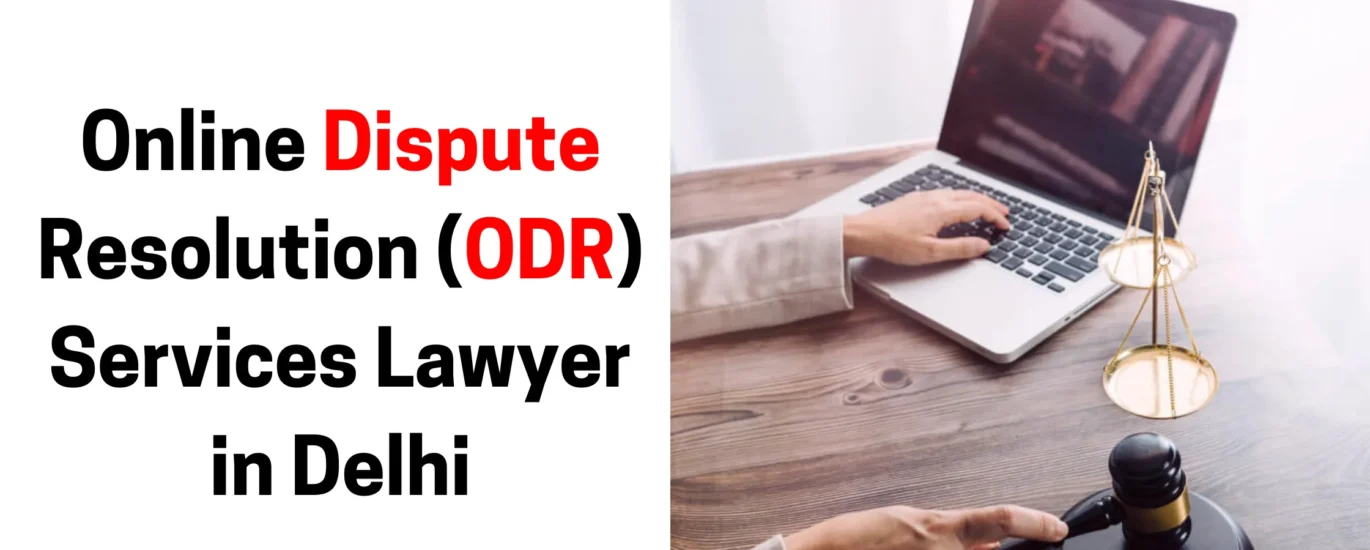
The traditional litigation process in Indian courts—burdened by procedural delays, endless adjournments, and high legal overheads—is no longer viable for modern commercial enterprises, MSMEs, e-commerce sellers, and financial institutions. Online Dispute Resolution (ODR) has emerged as the premier mechanism to resolve high-stakes commercial conflicts, recovery matters, and contractual breaches without setting foot in a physical courtroom.
For businesses and individuals seeking swift, cost-effective, and legally binding resolutions, working with a specialized Online Dispute Resolution (ODR) services lawyer in Delhi ensures your claims are filed, mediated, or arbitrated through digitally compliant frameworks that yield enforceable court-grade outcomes.
What is Online Dispute Resolution (ODR)?
Online Dispute Resolution (ODR) is the modern extension of Alternative Dispute Resolution (ADR) that leverages secure digital infrastructure, encrypted document exchange, and virtual hearing platforms to resolve legal disputes. ODR encompasses four primary methodologies:
- Online Negotiation: Direct, platform-assisted settlement discussions between disputing parties without a third-party neutral.
- Online Mediation: A confidential, neutral-facilitated virtual dialogue to reach a mutually agreeable settlement agreement.
- Online Conciliation: A structured digital procedure where a conciliator formulates and submits proposals for a binding settlement.
- Online Arbitration: A formal virtual proceeding where an independent arbitrator evaluates digital evidence, conducts virtual video hearings, and issues a legally binding Arbitral Award.
Legal Framework Governing ODR in India
ODR in India is backed by robust statutory laws, guaranteeing that digitally signed settlement agreements and online arbitral awards hold the exact same legal weight as civil court decrees.
- Mediation Act, 2023: Specifically legalizes and promotes online mediation, rendering Mediated Settlement Agreements (MSAs) final, binding, and enforceable under the law.
- Arbitration and Conciliation Act, 1996: Section 7 recognizes electronic arbitration agreements, and Section 36 ensures online arbitral awards are enforceable as court decrees.
- Information Technology (IT) Act, 2000: Section 4 and Section 5 validate electronic records, e-filings, and digital/electronic signatures.
- MSMED Act, 2006 & MSME ODR Portal: Streamlines delayed payment recovery for micro and small enterprises through virtual conciliation and arbitration platforms.
- Consumer Protection Act, 2019: Mandates e-filing via platforms like e-Daakhil and supports online mediation for consumer and e-commerce conflicts.
Key Practice Areas for ODR Services in Delhi
As a leading ODR lawyer in Delhi, legal strategic advice covers a broad spectrum of commercial and civil disputes:
1. MSME & B2B Debt Recovery
Micro, Small, and Medium Enterprises facing delayed payments can initiate fast-track digital arbitration or conciliation under the MSMED Act or commercial contract ODR clauses. ODR reduces recovery timelines from years to just 30–90 days.
2. E-Commerce & Tech Service Disputes
E-commerce vendors, SaaS providers, software developers, and digital marketplace platforms utilize ODR to resolve contract violations, SLA non-compliance, domain name conflicts, and user payment claims.
3. Corporate Contractual & Partnership Matters
Vendor agreements, cross-border supply contracts, shareholder disagreements, and service level defaults are handled smoothly through confidential online arbitration, avoiding reputational damage and business disruption.
4. Banking, Fintech & Financial Claims
Recovery of unpaid commercial loans, equipment finance disputes, payment gateway failures, and unauthorized transactions are efficiently managed via structured fintech ODR frameworks.
Traditional Court Litigation vs. Online Dispute Resolution (ODR)
| Feature | Traditional Court Litigation | Online Dispute Resolution (ODR) |
| Timeline | 3 to 7+ years | 30 to 90 days |
| Physical Appearance | Mandatory physical presence in court | 100% Remote / Virtual Video Hearings |
| Costs | High court fees, travel expenses, recurring legal fees | 60%–80% lower overall cost |
| Confidentiality | Public court records | Strictly confidential proceedings |
| Enforceability | Civil Court Decree | Enforceable as a Court Decree under Act of 1996 / Mediation Act 2023 |
Step-by-Step ODR Lifecycle
[1. Case Initiation & E-Filing]
              │
              ▼
[2. Registration & Counterparty Consent]
              │
              ▼
[3. Appointment of Qualified Neutral (Mediator/Arbitrator)]
              │
              ▼
[4. Virtual Document Submission & Digital Evidence Exchange]
              │
              ▼
[5. Online Hearing / Asynchronous Moderation]
              │
              ▼
[6. Binding Settlement / Arbitral Award Execution]
- Initiation & E-Filing: The claimant registers the dispute on an institutional ODR platform, uploading digital contracts, invoices, and notice proof.
- Consent & Triage: The respondent receives digital notice via email/WhatsApp and registers consent to participate.
- Appointment of Neutral: An independent, certified mediator or arbitrator is assigned to the matter.
- Virtual Hearings: Proceedings take place via encrypted video conferencing or asynchronous digital portals.
- Execution of Award/Settlement: A digitally signed Mediated Settlement Agreement or Arbitral Award is issued, which can be directly enforced in court.
Why Choose Global Vision Law Firm for ODR in Delhi?
Navigating ODR requires a legal partner who blends traditional legal mastery with modern digital litigation tools. Global Vision Law Firm, led by experienced legal advisors in Delhi, provides:
- ODR Clause Drafting: Structuring bulletproof ODR arbitration and mediation clauses in your commercial contracts.
- Platform Navigation: Expertise across leading institutional Indian ODR platforms (Sama, Presolv360, CADRE, MSME Samadhaan, SMART ODR).
- Representation in Virtual Arbitration: Formulating aggressive digital claims, evidence matrices, and argument briefs for virtual hearings.
- Execution & Enforcement: Rapid enforcement of online arbitral awards and settlement agreements in the High Court of Delhi and district courts.