Last Updated: October 2026 | Global Vision Law Firm — New Delhi | ~6 min read
Quick Summary
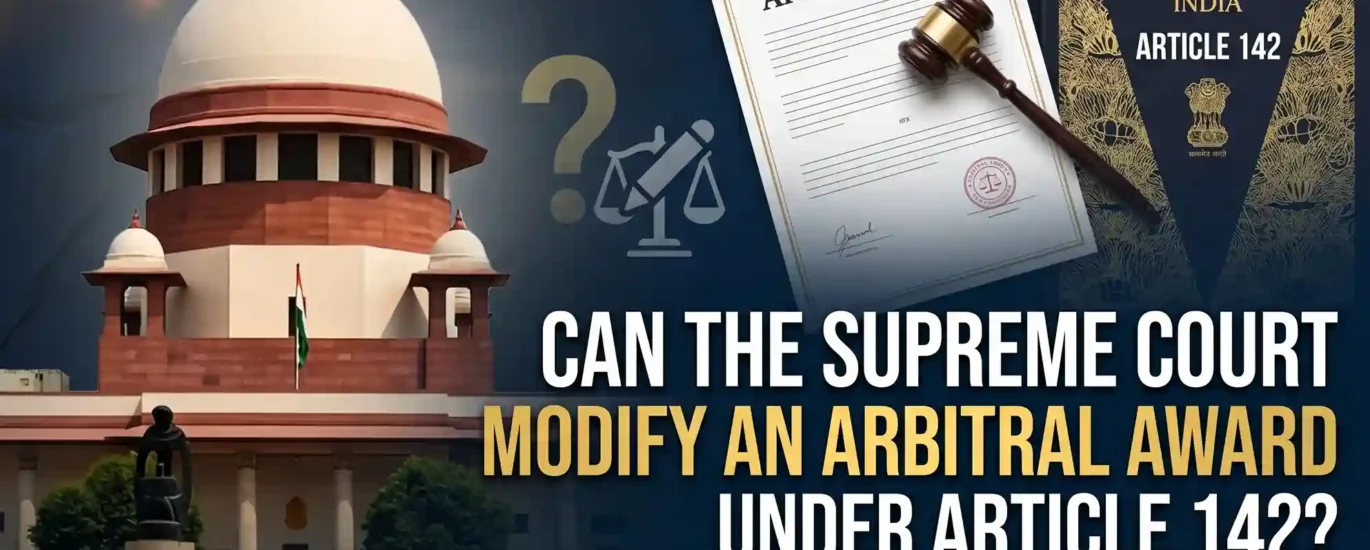
For decades, Indian courts operated under a settled position: a court hearing a challenge under Section 34 of the Arbitration and Conciliation Act, 1996 can set aside an arbitral award or remit it back to the tribunal — but it cannot modify the award. That position was disrupted by a line of High Court decisions that used their equitable and inherent powers to correct award figures, add interest, and partially alter outcomes. The Supreme Court’s Constitution Bench answered the question definitively in Gayatri Balasamy v. ISG Novasoft Technologies Ltd. (30 April 2025): courts do have a limited power to modify arbitral awards — but the scope is narrow, the conditions are strict, and the use of Article 142 to do “complete justice” comes with clear boundaries. This guide explains what the judgment held, what it means for parties challenging or defending arbitral awards in India, and how Global Vision Law Firm can assist with arbitration-related litigation before the Supreme Court and High Courts.
The Background: Why the Question Arose
Section 34 of the Arbitration and Conciliation Act, 1996 sets out the grounds on which a court may “set aside” an arbitral award. The section is precise about what courts can do: set aside. There is no reference to modifying, varying, altering, or correcting the award. The section also provides, under Section 34(4), that a court may adjourn the proceedings and give the arbitral tribunal an opportunity to resume arbitration or take other action to eliminate the grounds for setting aside — effectively a remittal power.
This framework was designed deliberately. India’s 1996 Arbitration Act is modelled on the UNCITRAL Model Law, which embodies the principle of minimal court interference with the arbitration process. Once parties have chosen to resolve their dispute by arbitration, the role of courts is limited: enforce the award or, in narrow circumstances, set it aside. Courts are not to become a second round of adjudication on the merits.
The trouble was that courts — particularly High Courts — encountered situations where this binary felt unjust. An arbitrator makes an award of ₹10 crore but commits an obvious arithmetic error: the correct calculation yields ₹12.5 crore. Should the entire award be set aside — forcing the parties to re-arbitrate a fully decided dispute — just to correct a calculation? Or can the court simply correct the figure and uphold the rest? Some High Courts, particularly the Madras High Court, began modifying awards in such cases. Others refused, citing the plain text of Section 34.
The Supreme Court in Kinnari Mullick v. Ghanshyam Das Damani (2018) and The Project Director, NHAI v. M. Hakeem (2021) had held that courts could not modify arbitral awards under Section 34 — they could only set aside. The 2021 M. Hakeem judgment was emphatic on this point. But inconsistency in application persisted.
Gayatri Balasamy brought the question to a Constitution Bench — the highest level of judicial authority — for a final answer.
The Gayatri Balasamy Case: Facts and Constitution Bench Reference
Gayatri Balasamy v. ISG Novasoft Technologies Ltd. arose from a workplace dispute. Gayatri, who served as Vice President of ISG Novasoft, alleged sexual harassment by the company’s CEO and brought arbitration proceedings claiming approximately ₹28.88 crore across twelve heads of relief. The sole arbitrator awarded approximately ₹2 crore on one claim — severance — and rejected the remaining eleven.
When the matter reached the Madras High Court, the single judge added ₹1.68 crore on the twelfth head of claim. The Division Bench then reduced this to ₹50,000. The case reached the Supreme Court on the further question of whether the High Court had the power to make those modifications at all under Section 34.
A three-judge bench of the Supreme Court recognised that the question was of substantial importance — touching both the interpretation of Section 34 and the use of Article 142 in the arbitration context — and referred it to a five-judge Constitution Bench. The Constitution Bench was led by Chief Justice Sanjiv Khanna and delivered its judgment on 30 April 2025.
What the Constitution Bench Held: The Five Core Rulings
Ruling 1 — Section 34 Does Not Bar Modification in All Cases
The majority (4:1) held that the word “set aside” in Section 34 does not exhaustively define the court’s powers in every conceivable situation. A strict reading that permits only total annulment of the award or remittal leads to outcomes that undermine the efficiency of the arbitration process itself — particularly where a severable and obvious defect exists in an otherwise sound award.
The majority drew a distinction between: (a) modification on the merits — which Section 34 does not permit; and (b) correction of clear, obvious errors that are apparent on the face of the award — which courts may undertake in limited circumstances.
Ruling 2 — Severable Portions Can Be Set Aside Independently
Courts have the power to partially set aside an arbitral award — striking out only the severable portion that is invalid, beyond scope, or otherwise defective — while upholding the rest of the award intact. This was not a new principle, but the Constitution Bench confirmed it as settled and available under Section 34.
This is significant in practice: if an award decides five issues and only the decision on the fifth issue is vitiated by the grounds under Section 34, the court need not set aside all five. It can set aside only the fifth and direct re-arbitration on that issue alone if needed.
Ruling 3 — Limited Modification for Manifest and Obvious Errors
Courts can modify arbitral awards — but only to correct errors that are:
- Computational: Arithmetic mistakes, addition or subtraction errors, incorrect application of agreed formulas
- Typographical: Clear typographical errors that do not reflect the arbitrator’s actual decision
- Clerical: Obvious clerical slips in the award document
- Manifest errors apparent on the face of the award: Errors that require no inquiry into the merits and are self-evidently wrong from reading the award itself
The court’s power of modification does not extend beyond this. It cannot re-evaluate the evidence, reassess the credibility of witnesses, revisit findings of fact, or reach a different conclusion on a legal question the arbitrator decided. The moment the “correction” requires any judgment on the merits, the court must stop — its only options are then to set aside (if the grounds under Section 34 are made out) or to remit under Section 34(4).
Ruling 4 — Complex Errors Must Go Back to the Tribunal
Where a defect in the award requires substantive reconsideration — not merely a mathematical correction — the court should use the remittal power under Section 34(4). The award goes back to the arbitral tribunal with directions to reconsider the specific issue. This preserves the primacy of the arbitral tribunal on matters of substance while giving the court a meaningful role in correcting the process.
The Constitution Bench was clear: modification by the court is the exception. Remittal is the appropriate remedy for anything that requires the arbitrator’s judgment to re-apply.
Ruling 5 — Post-Award Interest Can Be Modified; Pre-Award Interest Cannot
The Constitution Bench drew a specific and important line on interest:
Post-award interest (future interest): Under Section 31(7)(b) of the Arbitration Act, courts can modify the rate and period of post-award interest when the award is before them under Section 34. This is because future-looking interest is not a determination of the merits of the dispute — it is a procedural and compensatory mechanism for delay in realisation of the award amount.
Pre-award interest (pendente lite interest): Interest that the arbitral tribunal has awarded for the period of the dispute — up to the date of the award — cannot be altered by the court. That figure represents the arbitrator’s determination of what compensation is due. Changing it would be a modification on the merits.
Article 142: What Powers Does the Supreme Court Actually Have?
Article 142 of the Constitution gives the Supreme Court the power to pass such decree or make such order as is necessary for doing “complete justice” in any matter before it. It is a unique and extraordinary power — available only to the Supreme Court, not to High Courts.
The question before the Constitution Bench was: can the Supreme Court use Article 142 to modify an arbitral award on the merits — to do complete justice — even where Section 34 would not otherwise permit it?
The Constitution Bench’s answer: Yes — but with strict limits.
Article 142 is available to the Supreme Court to prevent injustice in arbitration proceedings. But its use must be consistent with the objectives and scheme of the Arbitration Act. The Supreme Court cannot use Article 142 to rewrite an award, to substitute its judgment on the merits for that of the arbitrator, or to do what Section 34 explicitly does not permit.
What Article 142 can do in the arbitration context:
- Enable the Supreme Court to end protracted litigation where a limited modification avoids the need to set aside and re-arbitrate an otherwise sound award
- Allow the court to do justice in cases where the rigidity of the set-aside-or-remit binary would produce a clearly unjust result without adequate remedy
- Permit correction of obvious errors when the matter is before the Supreme Court at the appellate stage (Section 37 appeal)
What Article 142 cannot do:
- Override the fundamental principle that courts do not re-adjudicate the merits of arbitrated disputes
- Allow the Supreme Court to award what the arbitrator denied, or reduce what the arbitrator granted, based on the Supreme Court’s own view of the evidence
- Be used as a routine tool whenever a party finds the award unfavourable
The one-line principle: Article 142 enables complete justice — it does not make the Supreme Court a super-arbitrator.
The Dissent: Justice Viswanathan’s Position
The Constitution Bench was 4:1. Justice K.V. Viswanathan dissented strongly.
His position: Section 34 gives courts no power to modify, alter, or vary an arbitral award. The text says “set aside.” Parliament chose that word deliberately. If Parliament had intended courts to modify awards, it would have said so — as it did in other legislative contexts. In the absence of express statutory authority, courts cannot arrogate modification powers to themselves, however well-intentioned.
On Article 142: Justice Viswanathan also rejected using Article 142 to modify awards. Article 142 can supplement the law — it cannot override or bypass the statutory framework that Parliament has deliberately put in place for arbitral proceedings.
The dissent is significant not just as a legal position but as a practical caution: the 4:1 majority is not unanimous, and the limits it imposes on modification must be interpreted narrowly to give effect to the majority’s own stated intention.
What Changed from M. Hakeem (2021) to Gayatri Balasamy (2025)
| Position | M. Hakeem (2021) | Gayatri Balasamy (2025) |
|---|---|---|
| Can courts modify awards under Section 34? | No — only set aside or remit | Yes — but only for manifest/clerical/computational errors |
| Can courts partially set aside awards? | Recognised, not elaborated | Confirmed — severable portions can be independently set aside |
| Can post-award interest be modified? | Not specifically addressed | Yes — Section 31(7)(b) allows it |
| Can pre-award interest be modified? | Not specifically addressed | No — that is a merits determination |
| Can Article 142 justify modification on merits? | Not addressed | No — Article 142 must be consistent with the Act’s scheme |
| Role of remittal | Available under Section 34(4) | Confirmed as the preferred remedy for complex corrections |
Practical Implications for Parties in Arbitration Proceedings
If you are the award holder defending your award: The Gayatri Balasamy framework strengthens your position. A party challenging an award cannot ask the court to simply substitute a lower or different figure based on a different reading of the evidence. Modification is only available for manifest errors — and the burden of showing that the error is manifest, computational, and apparent on the face of the award is on the challenging party. Remittal, not modification, is what the court should order if the issue is genuinely complex.
If you are challenging an award: You now have a limited but recognised pathway to seek modification of computational errors without having to set aside the entire award. This is useful where only one component of a multi-issue award is defective. You can seek partial set-aside of the severable portion, or targeted correction of a manifest error, without undoing everything the arbitrator decided.
On post-award interest: If the award grants a rate of interest that, in the circumstances of the case, appears excessive or insufficient, the Section 34 court has the power to modify it. This is worth arguing expressly — it is a recognised ground for court intervention that does not amount to interference with the merits.
On remittal: Do not treat remittal as a lesser remedy. Where a defect in the award is genuine but complex — a legal question the arbitrator got wrong, an evidential gap in one issue — remittal under Section 34(4) gives the arbitral tribunal a chance to correct it without the cost and delay of fresh arbitration proceedings.
How Global Vision Law Firm Can Help
Arbitral awards — whether you hold one that needs defending or challenge one that has caused loss — require specialist advocacy before the Supreme Court and High Courts. The Gayatri Balasamy framework makes this more nuanced than ever: knowing when to seek modification, when to seek partial set-aside, when to push for remittal, and when Article 142 creates room for an exceptional argument requires experience at the intersection of arbitration law and constitutional law.
Global Vision Law Firm — established 2013 — handles complex arbitration-related litigation in Delhi, including:
- Section 34 challenges and defences in commercial arbitration matters before the Delhi High Court
- Section 37 appeals before the High Court Division Bench
- Special Leave Petitions to the Supreme Court against Section 37 orders
- Article 136 SLPs in arbitration matters where constitutional or substantial legal questions arise
- Section 9 interim relief proceedings to protect assets pending arbitral proceedings or award enforcement
- Section 36 enforcement of domestic awards and Section 49 enforcement of foreign awards
Our litigation team is led by Adv. Amarendra Kumar Dubey (13+ years, complex litigation and white-collar matters) with support from Adv. Rohan Malhotra (6+ years, criminal litigation and Supreme Court matters) and Adv. Niharika Verma (6+ years, civil and economic offence matters).
For Supreme Court matters involving arbitral awards — including SLPs, Section 34 proceedings, and Article 142 arguments — contact us today.
For our full litigation practice: Litigation — Global Vision Law Firm
For urgent or time-sensitive arbitration matters: Contact Us — Global Vision Law Firm
📞 +91 9599801188 · +91-11-71522934 — Available 24/7 for urgent matters 📧 globalvisionlawoffice@gmail.com 📍 M-3 Gupta Tower, Azadpur, Delhi – 110033
Frequently Asked Questions
Can a court modify an arbitral award in India?
Yes — but only in narrow circumstances. The Supreme Court Constitution Bench in Gayatri Balasamy v. ISG Novasoft Technologies Ltd. (2025) held that courts can modify arbitral awards to correct computational, typographical, clerical, or manifest errors that are apparent on the face of the award. Courts cannot re-evaluate merits, reassess evidence, or substitute their judgment for the arbitrator’s. For complex defects, the award must be remitted to the tribunal under Section 34(4).
What does Section 34 of the Arbitration Act allow?
Section 34 allows courts to set aside an arbitral award on specified grounds — including incapacity, invalid agreement, improper notice, excess of jurisdiction, improper tribunal composition, non-arbitrability, and conflict with Indian public policy. It also allows remittal to the arbitral tribunal under Section 34(4). After Gayatri Balasamy, limited modification of manifest errors is also recognised.
What is Article 142 of the Constitution of India?
Article 142 gives the Supreme Court the power to pass any decree or order necessary for doing complete justice in any matter before it. It is available only to the Supreme Court — not to High Courts. In the arbitration context, Gayatri Balasamy confirmed that Article 142 can support limited modification to prevent injustice, but it cannot be used to rewrite awards on the merits or override the statutory scheme of the Arbitration Act.
What is the difference between setting aside and modifying an arbitral award?
Setting aside annuls the award — the dispute must be re-arbitrated (or the parties accept the consequence). Modification corrects a specific error in the award while leaving the rest intact. Gayatri Balasamy confirmed that partial set-aside (of a severable, defective portion) and limited modification (of manifest errors) are both available — but modification on the merits is not.
What was the M. Hakeem judgment?
The Project Director, NHAI v. M. Hakeem (2021) was a three-judge bench Supreme Court decision that held courts could not modify arbitral awards under Section 34 — they could only set aside or remit. Gayatri Balasamy (2025) departed from this on the narrow issue of manifest errors and post-award interest, while preserving the core principle that courts cannot modify awards on the merits.
Can a High Court modify an arbitral award?
After Gayatri Balasamy, the limited modification power (for manifest errors, partial set-aside, post-award interest) is available to courts exercising jurisdiction under Section 34 and Section 37 — including High Courts. Article 142 is exclusively a Supreme Court power. High Courts cannot invoke Article 142 to modify awards, but they can exercise the limited modification powers confirmed by the Constitution Bench.
How do I challenge an arbitral award where only one component is wrong?
You can seek partial set-aside of the severable defective component under Section 34, while asking the court to uphold the rest of the award. If the defect is a manifest or computational error, you can seek limited modification. If it is a complex error requiring the arbitrator’s reconsideration, seek remittal under Section 34(4). Contact Global Vision Law Firm at +91 9599801188 for a merits assessment of your specific award challenge.
Final Thought
Gayatri Balasamy is among the most practically important Supreme Court arbitration judgments of recent years. It closes the era of binary thinking — set aside or nothing — and introduces a nuanced framework that serves the efficiency goals of commercial arbitration better than a rigid all-or-nothing approach. Courts can now correct the obvious without undoing the entire decision. They can remit the complex without forcing full re-arbitration. And Article 142 remains available to the Supreme Court — not as a general licence to override arbitrators, but as a last resort to prevent clear injustice.
For businesses, promoters, and institutions involved in arbitration proceedings in India — whether holding an award that needs defending, challenging one that is flawed, or navigating the enforcement process — understanding this framework is essential. The law has moved. Advocacy in this space must move with it.
Global Vision Law Firm is here to guide you through every stage.
👉 Contact Global Vision Law Firm — Arbitration and Supreme Court Matters
📞 +91 9599801188