Last Updated: August 2026 | Global Vision Law Firm — New Delhi | ~5 min read
You checked your account this morning. Your salary was credited. Your EMI is due tomorrow.
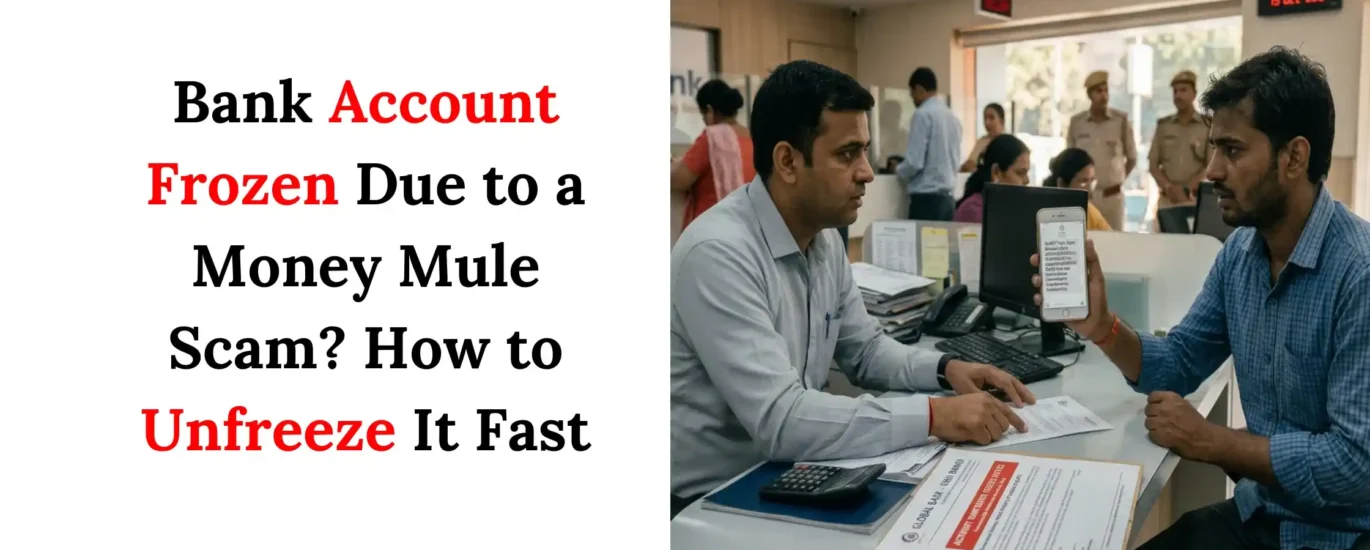
But when you tried to transfer funds — the transaction failed. You called your bank. The customer service executive told you: “Your account has been frozen by the Cyber Crime Cell.”
You have never committed any fraud. You have never participated in any scam. You don’t even know what a money mule is.
But your account — your salary account, your savings, your business current account — is completely frozen. And you have no idea how to get it unfrozen.
This happens to hundreds of innocent Indians every week. A fraudster used your account as a “pass-through” to move stolen money — sometimes with your knowledge, sometimes without. The cyber cell sees your account in the fraud chain and freezes it immediately. The fact that you may be entirely innocent doesn’t stop the freeze.
This guide explains exactly why it happened, what your legal rights are, and the fastest legitimate path to getting your account unfrozen.
Why Did the Cyber Cell Freeze Your Bank Account?
When a cyber fraud is reported — a UPI scam, a fake investment scheme, an OTP theft — the 1930 helpline and the investigating cyber cell trace the flow of stolen money through bank accounts. The money rarely sits in one account. It moves: from the victim’s account → Account A → Account B → Account C → potentially dozens of accounts before it is withdrawn or converted.
Every account in this chain gets flagged. Every account in this chain may get frozen — regardless of whether the account holder knew anything about the fraud.
Your account may have been frozen because:
- You are a suspected mule — you knowingly allowed your account to be used to pass through fraud proceeds in exchange for a commission
- You are an unwitting mule — your account details were stolen, or you received an unsolicited transfer that you didn’t question, and your account was used without your knowledge
- You are an innocent bystander — you received a legitimate payment from someone whose account was later found to be linked to fraud — two or three steps removed from you in the chain
In all three situations, the immediate action of the cyber cell is the same: freeze first, investigate later.
The legal basis for this freeze is Section 106 of the Bharatiya Nagarik Suraksha Sanhita, 2023 (BNSS) — which replaced Section 102 of the CrPC from July 1, 2024. Section 106 allows police to seize property (including funds in a bank account) during investigation.
But — and this is critical — the law does not allow a blanket freeze without limits. Courts across India have consistently held in 2025 and 2026 that Section 106 freezes must be proportionate, targeted, and subject to immediate judicial oversight. Your rights as an innocent account holder are strong. You just need to assert them correctly.
Difference Between an Unwitting Mule and a Complicit Mule
Understanding which category you fall into determines both your legal strategy and your realistic timeline for unfreezing.
Complicit Mule (Knowing Participant)
A complicit mule knowingly allows their account to be used as a pass-through for fraud proceeds — typically in exchange for a commission (often 1–3% of the amounts transferred). They may have responded to “easy money” advertisements on social media or WhatsApp asking for “account sharing” in exchange for payment.
Being a complicit mule is a criminal offence under Section 66C and 66D of the IT Act and potentially Section 318 BNS (cheating). The freeze in this case is legally grounded, and unfreezing requires either cooperation with the investigation, settlement with the original fraud victim, or successful legal challenge to the quantum of the freeze.
Unwitting Mule (Innocent Pass-Through)
An unwitting mule’s account was used without their knowledge — because:
- Their account details were stolen through phishing or SIM swap
- They received an unexpected transfer that they didn’t question and then transferred onwards in good faith
- Their account was opened fraudulently in their name by someone else
- They received payment from a client or employer whose account turned out to be linked to fraud
In these cases — the freeze is legally challengeable, and courts have consistently provided relief to innocent account holders who demonstrate they had no knowledge of or participation in the fraud.
The critical legal point: <cite index=”30-1″>A Mumbai court acquitted a Jharkhand resident in a cyber fraud case, ruling that mere credit of defrauded money into a bank account, without proof of criminal conspiracy with the main accused, cannot by itself amount to a criminal offence.</cite>
The presence of fraudulently obtained money in your account, without your knowledge and participation, is not sufficient for criminal liability — but it does not automatically prevent a temporary freeze during investigation.
Step-by-Step Guide to Unfreeze a Mule Bank Account
Step 1: Request the FIR and Freeze Notice from Your Bank
Your bank is legally required to have a copy of the written direction they received to freeze your account. <cite index=”34-1″>Banks must not freeze accounts without a lawful written order. A verbal communication or email from police is insufficient.</cite>
Go to your bank branch in person and request:
- The written freeze order or direction they received
- The name of the police station or cyber cell that issued it
- The FIR number (if provided in the freeze direction)
- The specific amount that is alleged to be linked to the fraud
This last point is crucial. <cite index=”31-1″>Freezing an entire bank account without specifying the amount allegedly linked to the offence is considered excessive. Courts have directed that only the suspected sum should be restrained, unless clear reasons justify a broader freeze.</cite>
If the freeze direction does not specify the exact linked amount — or if your entire account has been frozen when only a portion has any connection to the alleged fraud — this is grounds for immediate legal challenge.
Step 2: Contact the Investigating Cyber Crime Agency
Once you have the freeze direction and FIR number, contact the investigating cyber cell directly.
What to bring:
- Your identity documents
- Bank statements showing all transactions in the relevant period
- Any communication that explains the context of the suspicious transaction (e.g., payment received from an employer, business client, or known individual)
- Evidence that you are not the named accused in any FIR
What to request:
- A copy of the complaint or FIR that triggered the freeze
- Clarification of whether you are named as an accused, a witness, or a third party in the investigation
- Information on the specific amount linked to the alleged fraud
Many innocent account holders obtain voluntary relief at this stage — when they demonstrate to the investigating officer that their involvement was entirely incidental and they have no nexus to the primary fraud.
The MHA SOP 2026: <cite index=”34-1″>The Ministry of Home Affairs issued a Standard Operating Procedure in January 2026 specifically dealing with bank account freezing in cybercrime cases. This SOP emphasises proportional action (freeze only the disputed amount, not the whole account), mandates that full account freezes should be a last resort, introduces timelines for review and defreezing, and provides for the account holder’s right to be heard.</cite>
If the investigating agency is not following this SOP — specifically, if they have frozen your entire account when only a specific amount is under suspicion — that non-compliance is a direct ground for legal proceedings.
Step 3: File for a Cyber Cell NOC
If direct approach to the cyber cell does not produce results — file a formal application for a No Objection Certificate (NOC) or release of lien on the non-disputed portion of your account.
The formal application must contain:
- Your complete identity details
- Account details and freeze details
- A sworn affidavit stating your non-involvement in the fraud
- Bank statements showing the transaction history
- Any supporting documentation establishing the legitimate source of the disputed transaction
- A specific prayer for release of the undisputed balance and conversion of the full freeze to a specific lien on the disputed amount only
This is where a cyber crime lawyer’s letter makes the most significant difference. A formal legal application — citing Section 106 BNSS, the MHA SOP 2026, and the specific High Court judgments on proportionality — signals to the cyber cell that the matter will be escalated to court if not resolved administratively.
For immediate assistance with bank account unfreeze applications: Bank Account Freeze Lawyer Delhi — Global Vision Law Firm
Legal Protections: Section 106 BNSS and Only Freezing Disputed Amounts
This is the most important legal section of this guide — your rights under the current law as interpreted by India’s courts in 2025–26.
What Section 106 BNSS Actually Says
Section 106 of the BNSS gives police the power to seize property during investigation — property that is suspected to be stolen or found under circumstances suggesting an offence. This power replaced Section 102 CrPC from July 1, 2024.
The critical judicial clarification, established consistently by multiple High Courts: <cite index=”33-1″>the power to freeze accounts under Section 106 permits seizure of property for evidentiary purposes, not unrestricted freezing of accounts. Only specific amounts truly connected to disputed transactions may be placed on lien while leaving the rest accessible.</cite>
The Proportionality Principle — Courts Have Spoken Clearly
<cite index=”37-1″>Section 106 BNSS jurisprudence now firmly establishes: there must be a clear nexus between the account and the offence; suspicion must be founded on material; reporting to the Magistrate must be prompt; and freezing must be proportionate and confined to suspected amounts.</cite>
The key cases that define your rights in 2026:
Allahabad High Court — April 8, 2026 (the most recent and most directly applicable)
<cite index=”30-1″>In a landmark batch ruling, the Allahabad High Court held that while no prior notice is needed to freeze bank accounts suspected in cyber crimes, authorities cannot immobilize entire accounts — only the tainted amounts. The Court held that freezes without specifying the exact amount linked to the offence are impermissible and violative of proportionality.</cite>
Delhi High Court — Malabar Gold v. Union of India (January 16, 2026)
<cite index=”36-1″>The Delhi High Court held that the freezing of a company’s bank accounts based on transactions with a customer against whom third-party complaints had been filed — where no complaint, FIR or proceeding was registered against the petitioner itself — was disproportionate and subject to challenge.</cite>
Madras High Court — Mohammed Saifullah v. RBI (2024)
<cite index=”29-1″>The Madras High Court held that agencies cannot freeze an entire bank account without quantifying the suspected amount or period, as doing so violates fundamental rights. In this case, only ₹2,48,835 out of a total balance of ₹9,69,580 was suspected — the court held only that specific amount could be restricted.</cite>
Kerala High Court — Headstar Global (2025) and Bombay High Court — Kartik Yogeshwar Chatur (December 2025)
Both courts held that debit-freezing an entire account on a police email alone — without a Magistrate’s order under Section 107 BNSS — is impermissible. <cite index=”38-1″>Section 107 is the provision that allows attaching property suspected to be proceeds of crime — and that needs a Magistrate’s order, not just a police instruction.</cite>
The Magistrate Oversight Requirement
<cite index=”29-1″>Police must promptly report any seizure to the Magistrate as a mandatory safeguard. The Magistrate must review the necessity and proportionality of the freeze and may modify or lift it when appropriate.</cite>
If the cyber cell froze your account and has not reported this to the Magistrate — that procedural violation is grounds for relief.
What This Means for Your Case
If your entire account is frozen but only a specific amount is allegedly linked to fraud — you have strong legal grounds to demand:
- Conversion of the full freeze to a specific lien on the disputed amount only
- Immediate release of all funds beyond the specifically suspected amount
- Magistrate review of the freeze if not already done
- NOC for all amounts not linked to the disputed transaction
These are not discretionary requests. They are rights established by multiple High Courts in 2025–26 and supported by the MHA’s own SOP.
For our complete guide on bank account freeze and unfreeze: How to Unfreeze a Bank Account in India — Global Vision Law Firm
💼 How Global Vision Law Firm Helps Money Mule Bank Account Holders
Global Vision Law Firm has been handling bank account freeze matters — for both businesses and individuals whose accounts were frozen in cyber crime investigations — in Delhi since 2013.
What we do for frozen account clients:
- Immediate assessment of the freeze’s legal basis and its vulnerability to challenge
- Filing formal applications to the investigating cyber cell citing MHA SOP 2026 and Section 106 BNSS proportionality principles
- Applications before the Magistrate for review and modification of the freeze
- Writ Petitions before Delhi High Court where the freeze is blanket, lacks a Magistrate’s order, or violates established proportionality principles
- Representation in all subsequent proceedings
Our relevant practices:
📞 +91 9599801188 · +91-11-71522934 — Available for urgent bank freeze matters 📧 globalvisionlawoffice@gmail.com 📍 M-3 Gupta Tower, Azadpur, Delhi – 110033
👉 Contact Us — Bank Account Freeze Matters Handled Urgently
❓ Frequently Asked Questions
What happens if your bank account is frozen for money laundering?
When a bank account is frozen for suspected money laundering or cyber fraud involvement, the bank places a debit freeze — you cannot withdraw, transfer, or make payments from the account. Incoming credits may still be received in some cases. You are not automatically charged with any offence — the freeze is an investigative measure, not a conviction. You have the right to approach the investigating agency, the Magistrate, and if necessary the High Court to challenge the freeze or seek its modification to a proportionate lien on only the disputed amount.
How to get money back from a frozen mule account?
The process to get money back from a frozen account involves: (1) requesting the written freeze direction and FIR details from your bank; (2) approaching the investigating cyber cell with documentary evidence of your non-involvement; (3) filing a formal NOC application with supporting affidavit and bank statements; and (4) if the cyber cell does not cooperate, filing before the Magistrate for review of the freeze or a Writ Petition before the High Court citing the proportionality principles established in 2025–26 judgments. A cyber crime lawyer can accelerate each stage significantly.
Can police freeze your entire bank account for cyber fraud?
<cite index=”37-1″>Under current judicial interpretation of Section 106 BNSS, blanket freezing of an entire bank account is impermissible where the suspicion relates only to a specific amount. Police can only restrain the amount specifically linked to the alleged offence.</cite> Multiple High Courts — Allahabad, Delhi, Madras, Kerala, Bombay — have all held this in 2024–2026 rulings. If your entire account is frozen but only a portion has any connection to the alleged fraud, you have strong legal grounds to demand immediate modification of the freeze to a proportionate lien on the disputed amount only.
How long does a bank account stay frozen during investigation?
There is no fixed statutory maximum duration for a Section 106 BNSS freeze. In practice, accounts have remained frozen for months to over a year during extended cyber crime investigations. However, <cite index=”34-1″>the MHA SOP 2026 introduces timelines for review and defreezing</cite> — meaning the investigating agency is now obligated to review the freeze periodically. If the freeze has continued for an unreasonable period without active investigation progress, that is a ground to approach the Magistrate for release. Engaging a lawyer to formally monitor and escalate the matter significantly reduces the duration of freezes in practice.
What to do if your bank account is frozen by cyber crime?
Act immediately — the faster you respond, the faster the freeze is resolved. The steps are: (1) call your bank and get the written freeze direction; (2) identify the investigating cyber cell and FIR number; (3) engage a cyber crime lawyer who can assess the legal basis of the freeze and prepare the appropriate application; (4) file for NOC or Magistrate review; and (5) if the freeze is blanket and disproportionate, file a Writ Petition before the Delhi High Court citing the 2025–26 judgments on proportionality. Do not wait passively — the freeze does not automatically lift when the investigation concludes. You must actively pursue your rights.
💡 Final Thought
A money mule bank account freeze is not the end. It is a legally challengeable administrative action — one that courts across India have repeatedly held must be proportionate, targeted, and subject to judicial oversight.
If your entire account is frozen because a fraud investigation found some connection — however distant — to your account, you have strong, established legal rights to demand that only the disputed amount be restricted.
The law is on your side. The MHA SOP is on your side. Multiple High Courts are on your side.
But those rights only protect you if you assert them — formally, immediately, and with proper legal representation.
👉 Contact Global Vision Law Firm
📞 +91 9599801188 — Available 24/7 for urgent bank freeze matters