Last Updated: August 2026 | Global Vision Law Firm — New Delhi | ~5 min read
Six words. One constitutional principle.
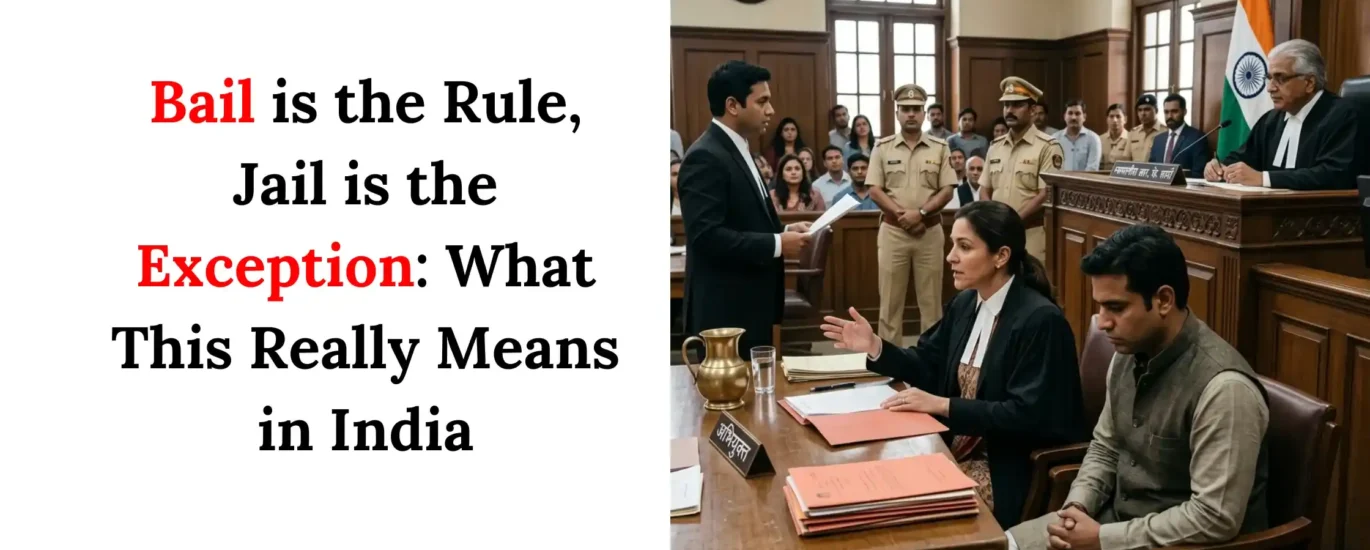
“Bail is the rule. Jail is the exception.”
Every criminal defence lawyer in India has said these words. Every accused person’s family has heard them. But what do they actually mean — legally, practically, and in the specific courtroom where the bail application is being heard right now?
Because the principle sounds simple. The reality is considerably more nuanced — and in 2026, it is more vigorously enforced by India’s Supreme Court than at any point in the last two decades.
This guide explains the constitutional foundation of bail, what the “rule and exception” principle actually requires courts to do, how it applies differently across offence categories, and why a bail application filed correctly — with this principle at its centre — succeeds where a generic application fails.
📌 Quick Answer
The principle that bail is the rule and jail is the exception derives from Article 21 of the Constitution (right to life and personal liberty) and the foundational criminal law presumption that every accused is innocent until proven guilty beyond reasonable doubt. Under the Bharatiya Nagarik Suraksha Sanhita, 2023 (BNSS), which replaced the CrPC from July 1, 2024, the bail framework is now governed by Sections 478–513. Courts must treat pre-trial detention as a last resort — not a default — balancing the accused’s constitutional rights against the interests of justice, investigation, and society. Global Vision Law Firm handles bail applications at all levels — Sessions Court, Delhi High Court, and Supreme Court. Contact us immediately.
⚖️ Part 1: The Constitutional Foundation — Where the Principle Comes From
Article 21 — The Right to Life and Personal Liberty
Article 21 of the Constitution of India provides that no person shall be deprived of their life or personal liberty except according to procedure established by law.
This is not merely a procedural guarantee. The Supreme Court has progressively expanded Article 21’s scope to require that any procedure depriving a person of liberty must be just, fair, and reasonable — not merely technically permissible.
Pre-trial detention — imprisonment before conviction — is a deprivation of personal liberty by definition. The question Article 21 demands courts answer before refusing bail: is this deprivation justified by facts specific to this accused, or is it merely assumed because an offence has been alleged?
Article 22 — Procedural Safeguards Against Arbitrary Detention
Article 22 provides specific procedural protections for arrested persons: the right to be informed of the grounds of arrest, the right to consult a lawyer, and the right to be produced before a magistrate within 24 hours.
These provisions exist because the Constitution’s framers understood that arrest and detention are among the most severe exercises of state power against an individual — and that power requires clear, enforceable limits.
The Presumption of Innocence
Beyond the Constitution, the presumption of innocence — that every accused is deemed innocent until proven guilty — is a foundational principle of criminal jurisprudence. This presumption has direct implications for bail: if an accused is presumed innocent, their pre-trial detention must be justified on specific grounds, not assumed from the nature of the allegation.
An FIR is an allegation. A chargesheet is a prosecution’s case. A conviction requires proof beyond reasonable doubt. At the bail stage — the earliest stage — none of these standards have been met. Denying bail treats an unproven allegation as grounds for punishment. The “bail is the rule” principle exists precisely to prevent this.
🏛️ Part 2: What the Supreme Court Has Said — A Living Doctrine
The “bail is the rule” principle is not a static statement. It has been developed, clarified, and increasingly enforced through decades of Supreme Court jurisprudence — and its most significant restatements have come in 2020–2026.
The Classic Foundation
The principle was stated clearly by the Supreme Court in State of Rajasthan v. Balchand (1977): the basic rule is bail, not jail, except where there are circumstances suggestive of the accused fleeing justice, thwarting the course of justice, or creating other hazards such as repeating offences or intimidating witnesses.
This formulation is important because of what it says about the exception: denial of bail requires specific, identified reasons tied to specific facts about the accused — not a general assumption based on the seriousness of the charge.
Sanjay Chandra v. CBI (2011) — Bail Is Not Punishment
The Supreme Court in Sanjay Chandra v. CBI (2011) reaffirmed that the object of bail is neither punitive nor preventive. Deprivation of liberty must be considered punishment — and punishment begins only after conviction.
Courts therefore owe the accused something beyond verbal respect for the presumption of innocence: they must examine whether specific, identified factors in the case justify the continued deprivation of a constitutionally guaranteed right.
Satender Kumar Antil v. CBI (2022) — The Modern Statement
In Satender Kumar Antil v. Union of India (2022) 10 SCC 51, the Supreme Court delivered its most comprehensive modern statement of bail jurisprudence — finding that India’s prisons are disproportionately filled with undertrials, that the bail system had drifted from its constitutional foundations, and that courts at all levels must actively apply the “rule and exception” framework rather than treating bail denial as the safer default.
The Court established a four-category framework for how bail should be approached depending on the offence type — and directed that bail applications in categories with lesser penalties should be disposed of without requiring the accused to surrender first in routine cases.
All India Judges Association v. Union of India (2025) — The 3-Year Practice Rule
This 2025 ruling, while principally about civil judge eligibility, reinforced the Supreme Court’s broader concern with the criminal justice system’s failure to protect personal liberty at the pre-trial stage — one of the most consistent themes running through the Court’s criminal law jurisprudence in this decade.
Sumit v. State of U.P. (2026 INSC 145) — The Most Recent Reaffirmation
In early 2026, the Supreme Court in Sumit v. State of U.P. once again held that anticipatory bail cannot be withheld merely because the police oppose it — courts must independently assess the threat to personal liberty and the genuineness of the allegation. This is the principle in live action.
📋 Part 3: The BNSS Framework — How Bail Works in 2026
From July 1, 2024, bail in India is governed by the Bharatiya Nagarik Suraksha Sanhita, 2023 (BNSS). The bail provisions are in Chapter XXXV (Sections 478–513). The fundamental framework is structurally similar to the CrPC, with some significant changes.
Bailable vs Non-Bailable Offences
Bailable offences (Section 478 BNSS): Bail is a right, not a discretion. The police or court must release the accused on bail. The accused cannot be denied bail on grounds of seriousness or public interest.
Non-bailable offences (Section 480 BNSS): Bail is discretionary — the court considers specific factors before deciding. This is where the “rule and exception” principle operates most actively, because denial requires justification while grant should be the default absent specific reasons to the contrary.
Anticipatory Bail (Section 482 BNSS)
Anticipatory bail — available before arrest — is the most powerful protective tool for persons apprehending arrest. The court can direct that in the event of arrest, the applicant shall be released on bail immediately.
The Supreme Court has consistently held that anticipatory bail should not be mechanically refused and that its grant is particularly important in cases where criminal proceedings appear to be motivated by a civil or commercial dispute rather than genuine criminal culpability.
Section 479 BNSS — Undertrial Relief: A Significant Change
One of the most significant new provisions in the BNSS is Section 479 — which provides that an undertrial who has served half the maximum sentence for the offence with which they are charged must be released on bail by the court.
This provision directly addresses the undertrial prison population crisis identified in Satender Kumar Antil — and gives courts a mandatory, time-based bail entitlement that did not exist in the CrPC in the same form.
Special Statutes — Where the “Rule” Has Exceptions
The BNSS framework applies to general criminal offences. Special statutes — PMLA, NDPS, UAPA, POCSO — have their own bail conditions that override the BNSS’s general framework. In these cases:
PMLA (Prevention of Money Laundering Act): The “twin conditions” under Section 45 require the court to be satisfied that there are reasonable grounds to believe the accused is not guilty and will not commit any offence on bail. This reverses the burden in a significant way — effectively making bail the exception for PMLA accused.
NDPS Act: Section 37 contains similar twin conditions for commercial quantities of narcotics.
UAPA (Unlawful Activities Prevention Act): Among the strictest bail conditions in Indian law — courts must find reasonable grounds that the charge is prima facie not true before granting bail.
POCSO Act: Special considerations apply, and courts proceed with additional scrutiny.
Understanding which statute applies and what its specific bail conditions require is essential — a bail application drafted for a general BNSS offence that does not address PMLA twin conditions will fail if PMLA is the operative statute.
🔑 Part 4: What Courts Actually Consider When Deciding Bail
The Eight Factors — From Prahlad Singh Bhati v. NCT Delhi
The Supreme Court in Prahlad Singh Bhati v. NCT, Delhi (2001) and State of U.P. v. Amarmani Tripathi (2005) identified the factors courts must weigh:
- Whether there is prima facie reasonable ground to believe the accused committed the offence
- The nature and gravity of the charge
- The severity of the punishment if convicted
- The danger of the accused absconding or fleeing if released
- The character, behaviour, means, position, and standing of the accused
- The likelihood of the offence being repeated
- The reasonable apprehension of witnesses being tampered with
- The danger of justice being thwarted by grant of bail
What this list makes clear: Each factor requires assessment of specific facts about this accused in this case — not generic assumptions about the category of offence. The seriousness of the charge is one of eight factors, not an independent ground for denial.
The Standard at Bail Stage — Not Evidence, But Reasonable Grounds
Courts at the bail stage are not conducting a trial. They are not assessing whether the prosecution can prove guilt beyond reasonable doubt. As the Supreme Court has made clear: the court satisfies itself whether there is a genuine case against the accused and whether the prosecution can produce prima facie evidence in support of the charge.
Evidence will be tested at trial. Bail is decided on reasonable grounds — a lower and deliberately preliminary standard designed to protect against punishing someone for an allegation before it has been proved.
What “Bail is the Rule” Requires the Court to Do
The principle is not merely aspirational. It has procedural implications that courts are bound to apply:
- The default presumption favours release — the prosecution bears the burden of establishing why the accused should be detained
- Denial requires specific, stated, fact-based reasons — not general reference to the seriousness of the offence
- The court must weigh the accused’s right to liberty against the identified specific risks
- Where no specific risk is identified — bail should follow automatically from the presumption
A bail order that simply says “the offence is serious, bail is denied” without identifying which specific factor among the eight provides the basis for denial, and on what specific facts, is legally vulnerable to challenge.
📊 Bail Framework — Quick Reference
| Category | Bail Type | Forum | Key Provision |
|---|---|---|---|
| Bailable offence | As of right | Police or any court | Section 478 BNSS |
| Non-bailable offence — general | Discretionary | Sessions Court / HC | Section 480 BNSS |
| Anticipatory bail — pre-arrest | Discretionary | Sessions Court / HC | Section 482 BNSS |
| Undertrial — served half sentence | Mandatory entitlement | Court trying the case | Section 479 BNSS |
| PMLA accused | Twin conditions must be met | Special Court | Section 45 PMLA |
| NDPS (commercial quantity) | Twin conditions must be met | Sessions Court / HC | Section 37 NDPS |
| HC bail after Sessions rejection | Fresh application | Delhi High Court | Article 226 / Section 480 BNSS |
| SC bail after HC rejection | SLP + bail application | Supreme Court | Article 136 |
⚠️ Why Bail Applications Fail — And How to Avoid It
Failure reason 1 — Not addressing the specific factor relied on for denial. If the prosecution’s primary objection is flight risk — address flight risk specifically, with concrete evidence of ties to the community, employment, family, property. A generic bail application that doesn’t engage with the specific objection fails.
Failure reason 2 — Not citing the correct legal framework. A bail application that cites CrPC provisions after July 1, 2024 is citing repealed law — the correct citations are BNSS provisions. This signals poor preparation to the court.
Failure reason 3 — Ignoring special statute twin conditions. If PMLA or NDPS commercial quantity provisions apply, a bail application that doesn’t directly address the twin conditions will fail regardless of how strong the general grounds are.
Failure reason 4 — Not seeking anticipatory bail early enough. Anticipatory bail is only available before arrest. Once arrested, only regular bail under Section 480 BNSS is available — a different and generally harder application. The earlier anticipatory bail is filed, the stronger the position.
Failure reason 5 — Not placing the “bail is the rule” principle front and centre. Courts must be reminded actively of this principle — its constitutional source in Article 21, its modern restatement in Satender Kumar Antil, and its specific application to the facts of the case. A bail application that doesn’t make this argument explicitly leaves the most powerful legal principle on the table.
💼 How Global Vision Law Firm Handles Bail Applications
Global Vision Law Firm has been handling bail applications — anticipatory bail, regular bail, default bail, and bail cancellation defence — at Sessions Courts, Delhi High Court, and the Supreme Court of India since 2013.
What distinguishes our bail practice:
Every bail application we file builds its argument on the constitutional foundation — Article 21, the presumption of innocence, and the “bail is the rule” principle from Satender Kumar Antil — before addressing the specific facts of the case. This is not a formality. Courts respond to arguments that correctly place personal liberty at the centre of the analysis.
We identify which of the eight factors the prosecution is relying on for denial — and address each with specific evidence and specific legal authority. We file simultaneously for anticipatory bail and for regular bail where the arrest timeline is uncertain. We handle PMLA, NDPS, POCSO, and UAPA bail applications with the specific twin-condition analysis these statutes require.
And for urgent matters — we file within hours, not days.
Our relevant practices:
- Litigation — Criminal Defence
- Criminal Lawyer in Delhi
- Complete Guide to Bail in India 2026
- Supreme Court Practice
- Dispute Resolution
📞 +91 9599801188 · +91-11-71522934 — Available 24/7 for bail emergencies 📧 globalvisionlawoffice@gmail.com 📍 M-3 Gupta Tower, Azadpur, Delhi – 110033
👉 Contact Us — Bail Applications Filed Urgently
❓ Quick FAQs
Q: Does “bail is the rule” mean bail must always be granted? A: No — it means that denial of bail is the exception that requires specific justification. The presumption favours release. The prosecution must establish, on specific facts, that one of the identified factors — flight risk, evidence tampering, witness influence, danger of repeat offence — applies to this accused in this case. Where no such specific factor is established, bail should follow.
Q: How has the BNSS 2023 changed bail law from the CrPC? A: The structural framework is similar. Key changes include Section 479 BNSS — which creates a mandatory bail entitlement for undertrials who have served half the maximum sentence — and updated terminological references throughout. For cases registered from July 1, 2024, the BNSS provisions apply; for older cases, the CrPC continues to apply in the transition period.
Q: Can bail be denied only because the alleged offence is serious? A: No — the severity of the potential punishment is one of eight factors courts must weigh. It cannot, by itself, be the sole basis for denial. The Supreme Court has repeatedly held that seriousness of the charge is not conclusive against bail — courts must identify specific facts that make detention necessary, not merely assume it from the offence category.
Q: What is the difference between anticipatory bail and regular bail? A: Anticipatory bail (Section 482 BNSS) is obtained before arrest — it directs that in the event of arrest, the person shall be released on bail immediately. Regular bail (Section 480 BNSS) is obtained after arrest — the person is already in custody and applies for release. Anticipatory bail is strategically preferable where possible because it prevents custody entirely.
Q: What happens if bail is denied by Sessions Court? A: Apply to the Delhi High Court for bail — which hears the application afresh, not as an appeal. The High Court independently evaluates the application on merits. If the High Court also denies bail, an SLP to the Supreme Court seeking bail is available under Article 136. Global Vision Law Firm handles all three levels.
💡 Final Thought
The principle that bail is the rule and jail is the exception is not legal jargon. It is a constitutional commitment — made by India’s Constitution through Article 21, honoured by six decades of Supreme Court jurisprudence, and most actively enforced in the 2020s than at any prior point.
It means that when someone stands accused of an offence — not convicted, not tried, merely accused — the default is that they remain free while the system processes the case. Detention is the exception that must be justified, not the default that must be overcome.
This principle, applied correctly in a bail application, is the most powerful argument any criminal defence lawyer can make. It doesn’t require extraordinary facts. It requires the correct legal framework, applied to the specific facts of the case, before the right court.
If you or someone you know needs a bail application — at any level, for any offence — Global Vision Law Firm files within hours.
📞 +91 9599801188 — Available 24/7