Last Updated: August 2026 | Global Vision Law Firm — New Delhi | ~6 min read
An FIR has been registered. An arrest has been made. Or an arrest is imminent.
The single most urgent legal question in every criminal matter — before any other consideration — is bail.
Not because the question of guilt or innocence doesn’t matter. It matters enormously. But bail determines whether the accused faces the entire legal process from the freedom of their home or from the confinement of a lock-up. It determines whether they can consult their lawyer properly, manage their family and business, and participate meaningfully in their own defence.
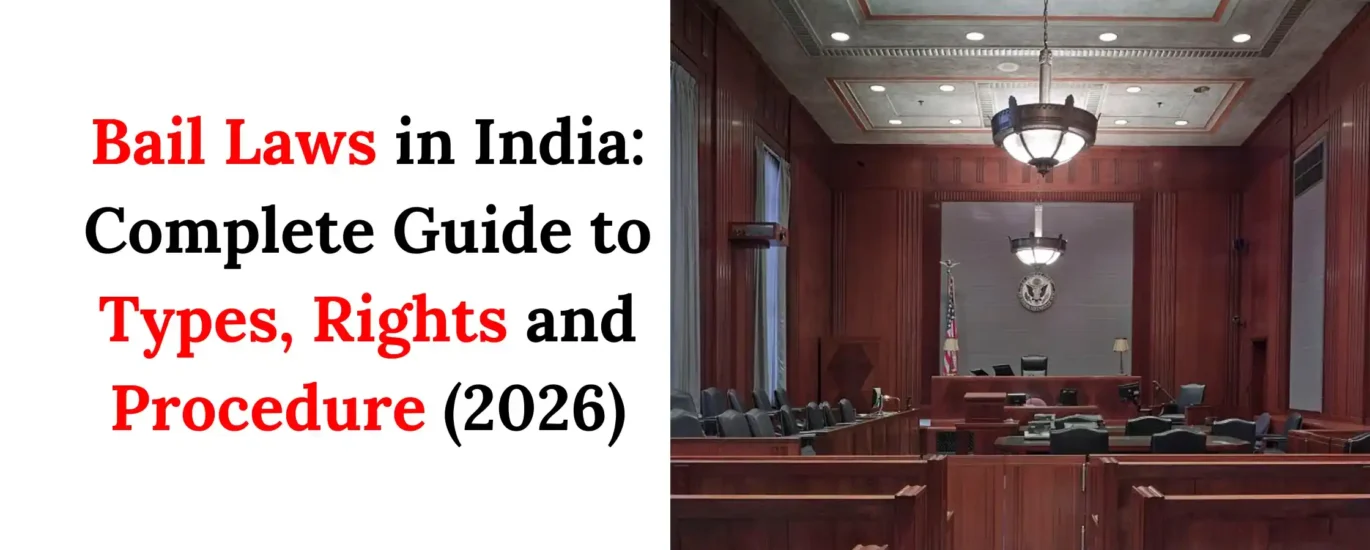
India’s bail law in 2026 is governed by the Bharatiya Nagarik Suraksha Sanhita, 2023 (BNSS) — which replaced the Code of Criminal Procedure (CrPC) from July 1, 2024. This guide covers every aspect of the bail framework under the new law — what bail is, the types available, the rights of the accused, the factors courts consider, and what happens when bail is refused.
📌 Quick Answer
Bail in India is the release of an accused person from custody on their undertaking — through a personal bond or surety — to appear before the court when required. Under the BNSS 2023, bail is governed by Sections 478–513. The foundational principle is that bail is the rule and jail is the exception — rooted in Article 21 of the Constitution. The three primary types are: bailable (bail as of right), non-bailable (bail at court’s discretion), and anticipatory bail (pre-arrest protection under Section 482 BNSS). Default bail is available if no chargesheet is filed within 60 or 90 days. Global Vision Law Firm handles bail applications at all levels — Sessions Court, Delhi High Court, and Supreme Court. Contact us immediately.
⚖️ Part 1: What Is Bail — The Legal Foundation
Definition
Bail is the release of a person from legal custody upon their furnishing a personal bond or surety bond — a guarantee to the court that they will appear before it when required and abide by the conditions imposed.
The word “bail” derives from the French word bailer — to deliver or hand over. The concept is that the surety takes delivery of the accused from the state, becoming responsible for their appearance before the court.
The Object of Bail
The object of bail is neither punitive nor preventive. This is one of the most consistently stated principles in Indian bail jurisprudence.
Pre-trial detention is not punishment — because punishment can only follow conviction, and conviction requires proof beyond reasonable doubt. At the bail stage, none of that has happened. The accused remains, legally, an innocent person.
The Supreme Court has held across decades of consistent jurisprudence that deprivation of liberty must be treated as a measure of last resort — deployed only when specific, identifiable factors make release genuinely dangerous to the administration of justice or to society.
Where no such factor exists — the accused should be free, pending trial.
The Constitutional Basis — Article 21
Article 21 of the Constitution of India provides that no person shall be deprived of their life or personal liberty except according to procedure established by law — and that procedure must be just, fair, and reasonable.
Pre-trial detention is, by definition, a deprivation of personal liberty. The Constitution therefore requires that every refusal of bail be justified by a procedure that is itself just, fair, and reasonable — not merely technically permissible.
The Supreme Court has consistently held that the presumption of innocence is embedded in Article 21 — that treating an unconvicted accused as a prisoner violates this guarantee unless specific circumstances make detention necessary.
For our complete guide on bail rights: Complete Guide to Bail in India 2026 — Global Vision Law Firm
🔑 Part 2: Types of Offences — Bailable and Non-Bailable
Bailable Offences
Under Section 478 of the BNSS, bailable offences are those classified as bailable in the First Schedule or made bailable by any other law. For bailable offences, bail is a matter of right — not a matter of discretion. The accused is entitled to bail upon furnishing a personal bond or surety, and neither the police nor the court can refuse it.
Bailable offences are generally those considered less serious by the legislature — carrying lower maximum sentences and involving lower public danger.
Non-Bailable Offences
Non-bailable offences are all offences not classified as bailable. For these, bail is not a matter of right — it is a matter of judicial discretion. The court exercises that discretion by weighing specific factors that we cover in detail below.
The critical point: non-bailable does not mean bail is unavailable. It means bail requires the court’s approval — and that approval must be granted or refused on the basis of specific, identified reasons. The presumption still favours release.
The BNSS First Schedule
The BNSS First Schedule classifies offences as bailable or non-bailable. For every offence a client faces, the first question our lawyers ask is: which column is this offence in? The answer determines the entire strategic approach to the bail application.
🛡️ Part 3: Anticipatory Bail — Pre-Arrest Protection
What Is Anticipatory Bail?
Anticipatory bail — now governed by Section 482 of the BNSS (replacing Section 438 CrPC) — allows a person who has reason to believe they may be arrested for a non-bailable offence to apply to the Sessions Court or High Court for a direction that, in the event of arrest, they shall be immediately released on bail.
It is called “anticipatory” because it is obtained in anticipation of arrest — before it happens. Its purpose is to prevent the trauma, stigma, and practical consequences of actual custody.
When Can Anticipatory Bail Be Filed?
A fundamental question: does an FIR need to be filed before anticipatory bail is sought?
The answer — established by a Constitution Bench of the Supreme Court — is no. An FIR is not a condition precedent. What is required is that the applicant has reason to believe they may be arrested for a non-bailable offence. This belief must be founded on concrete, reasonable grounds — not vague apprehension.
Anticipatory bail can also be filed after an FIR is registered — as long as the applicant has not yet been arrested.
Can Anticipatory Bail Last Until End of Trial?
A critically important question — particularly for clients apprehending long-drawn-out proceedings.
The Supreme Court’s Constitution Bench in Sushila Aggarwal v. State (NCT of Delhi) (2020) settled this definitively: the life of an anticipatory bail order does not automatically end when the accused is summoned or when charges are framed. It can continue until the end of the trial — unless the court specifically limits its duration when passing the order.
This means a properly obtained anticipatory bail can protect the accused through the entire trial — without requiring fresh applications at each procedural stage.
The 2026 Position — Sumit v. State of U.P. (2026 INSC 145)
The Supreme Court in early 2026 reiterated that anticipatory bail cannot be withheld merely because the police oppose it. Courts must independently assess the threat to personal liberty and the genuineness of the allegation — not defer mechanically to police objections.
Factors Courts Consider for Anticipatory Bail
Courts assess the following factors when deciding anticipatory bail applications:
- Nature and gravity of the allegations
- Genuineness of the accusations — is this a genuine criminal matter or a civil/commercial dispute framed as criminal?
- Prima facie grounds to believe the offence was committed
- Likelihood of the accused absconding or avoiding the legal process
- Criminal antecedents — is the accused a habitual offender?
- Potential for interference with investigation or tampering with evidence
- Risk of witnesses being threatened or intimidated
- Whether custodial interrogation is genuinely necessary
- Likelihood of the offence being repeated
- Whether the accused has cooperated with the investigation
What Is “Cooperation” with Investigation?
This is one of the most misunderstood concepts in bail proceedings. Many police objections to bail cite “failure to cooperate” — but the Supreme Court has clearly defined what cooperation requires and doesn’t require.
The Supreme Court in Santosh v. State of Maharashtra (2017) held that merely because an accused does not confess as the police want does not mean they are not cooperating with the investigation. Cooperation means responding to legitimate investigative queries — not capitulating to pressure or self-incrimination.
Police cannot compel answers through custodial interrogation beyond what the law allows. Courts must keep this clearly in mind when evaluating claims that an accused has “failed to cooperate.”
For our criminal defence practice: Criminal Lawyer in Delhi — Global Vision Law Firm
📋 Part 4: Regular Bail After Arrest
Filing Regular Bail Under Section 480 BNSS
Once arrested for a non-bailable offence, the accused can file for regular bail under Section 480 of the BNSS (replacing Section 437 CrPC) before a Magistrate or Sessions Court, or under Section 483 BNSS (replacing Section 439 CrPC) before the Sessions Court or High Court.
The factors courts consider for regular bail are substantially the same as those for anticipatory bail — the eight factors from Prahlad Singh Bhati v. NCT, Delhi (2001) and State of U.P. v. Amarmani Tripathi (2005):
- Whether there is prima facie or reasonable ground to believe the accused committed the offence
- Nature and gravity of the charge
- Severity of punishment if convicted
- Danger of the accused absconding or fleeing
- Character, behaviour, means, position, and standing of the accused
- Likelihood of the offence being repeated
- Reasonable apprehension of witnesses being tampered with
- Danger of justice being thwarted by grant of bail
No Trial Before Trial — The Bail Stage Standard
A critical principle the Supreme Court has repeatedly stated: at the bail stage, courts are not conducting a trial. They are not expected to examine evidence in detail or give elaborate reasons that might prejudice the accused.
The standard at bail stage is “reasonable grounds for believing” — not proof beyond reasonable doubt, not even a balance of probabilities. The court satisfies itself that a genuine case exists and that the prosecution can produce prima facie evidence — nothing more.
An overreaching bail order that effectively conducts a mini-trial is itself legally vulnerable.
Nature and Gravity — Not Conclusive
Even for grave and heinous offences — including serious economic offences — the Supreme Court in P. Chidambaram v. Directorate of Enforcement (2019) held that bail should not be denied if other factors favour the accused. The seriousness of the charge is one factor among eight — not an independent ground for automatic denial.
⏰ Part 5: Default Bail — Your Right When Chargesheet Is Delayed
What Is Default Bail?
Section 187(3) BNSS (replacing the proviso to Section 167(2) CrPC) provides one of the most powerful and most commonly overlooked rights in Indian criminal law: if the investigation agency has not filed a chargesheet within the prescribed period and the accused is in custody — the accused becomes entitled to bail as a matter of right.
This is called default bail or statutory bail.
The Timelines
| Maximum Sentence for Offence | Chargesheet Must Be Filed Within |
|---|---|
| Death, life imprisonment, or 10+ years | 90 days from arrest |
| Less than 10 years imprisonment | 60 days from arrest |
If the chargesheet is not filed within these periods, the accused can apply for default bail — and the court must grant it.
Important: The Application Must Be Made Before Chargesheet Is Filed
The Supreme Court in Rakesh Kumar Paul v. State of Assam (2017) held that the right to default bail accrues immediately on completion of the 60 or 90 day period. However, if the accused does not apply for default bail before the chargesheet is filed — even if filed late — the right lapses.
This is time-critical: monitor the chargesheet filing deadline carefully and file for default bail the moment the period expires.
🔄 Part 6: What Happens When Bail Is Refused
Approaching Higher Courts
If a bail application is refused by the Magistrate or Sessions Court, the accused can approach the next court in hierarchy:
- Magistrate refuses → Sessions Court
- Sessions Court refuses → Delhi High Court
- Delhi High Court refuses → Supreme Court of India (SLP under Article 136)
Each court hears the application afresh — not merely reviewing the lower court’s decision, but independently examining the merits of the bail application.
Subsequent Bail Applications Before the Same Court
If the accused wants to file another bail application before the same court that refused the first — they must show a material change of circumstances. The same grounds that were considered and rejected cannot be re-agitated without something new.
The Supreme Court in Kalyan Chandra Sarkar v. Rajesh Ranjan (2004) held that a court entertaining a subsequent bail application must record what fresh grounds exist — courts cannot simply ignore their own prior orders.
Forum Shopping — Strictly Prohibited
The Supreme Court has firmly held that bail applications should not be forum-shopped across different benches of the same court. If a bail application was refused by a specific judge and that judge is still available, the subsequent application must go before the same judge.
This judicial discipline preserves the integrity of the bail process and prevents the practice of approaching bench after bench until a favourable order is obtained.
📊 Bail Quick Reference — BNSS 2026
| Type of Bail | BNSS Provision | When Available | Forum |
|---|---|---|---|
| Bailable offence bail | Section 478 | As of right — mandatory | Police / Any Court |
| Regular bail (non-bailable) | Section 480 | After arrest, at court’s discretion | Magistrate / Sessions Court |
| Sessions Court / HC bail | Section 483 | After arrest | Sessions Court / HC |
| Anticipatory bail | Section 482 | Before arrest | Sessions Court / HC |
| Default bail | Section 187(3) | After 60/90 days without chargesheet | Court trying the case |
| Undertrial bail | Section 479 | After serving half maximum sentence | Court trying the case |
| SC bail after HC refusal | Article 136 | After HC refuses | Supreme Court |
⚠️ Special Statutes — Where Bail Is Harder
The BNSS general framework is modified by several special statutes that impose stricter conditions:
PMLA (Prevention of Money Laundering Act): Section 45 imposes “twin conditions” — the court must be satisfied that there are reasonable grounds to believe the accused is not guilty AND will not commit any offence on bail. This significantly raises the bar.
NDPS Act (commercial quantities): Section 37 imposes similar twin conditions for offences involving commercial quantities of narcotics.
UAPA (Unlawful Activities Prevention Act): Among the strictest bail conditions — courts must find the charge prima facie not true before bail can be granted.
POCSO Act: Special considerations for offences against children — additional scrutiny on risk of witness intimidation and repeat offence.
Understanding which statute applies and what its specific conditions require is essential — a bail application that doesn’t engage with the operative special statute provisions will fail regardless of how well it addresses the general BNSS framework.
💼 How Global Vision Law Firm Handles Bail Matters
Global Vision Law Firm has been handling bail applications — anticipatory bail, regular bail, default bail, and bail cancellation defence — since 2013, at all levels of Delhi’s court system.
Our approach:
Every bail application begins with the constitutional foundation — Article 21, the presumption of innocence, and the “bail is the rule” principle. We then address the specific factors the prosecution is likely to rely on with concrete, targeted evidence. We identify and engage with every applicable legal provision — BNSS sections, special statute conditions, and the relevant Supreme Court precedents.
We file urgently — bail applications cannot wait. If an arrest has happened or is imminent, we act the same day.
Our relevant practices:
- Criminal Lawyer in Delhi
- Complete Guide to Bail in India 2026
- Litigation — Criminal Defence
- Supreme Court Practice
- Dispute Resolution
📞 +91 9599801188 · +91-11-71522934 — Available 24/7 📧 globalvisionlawoffice@gmail.com 📍 M-3 Gupta Tower, Azadpur, Delhi – 110033
👉 Contact Us — Bail Applications Filed Urgently
❓ Quick FAQs
Q: What is the difference between bailable and non-bailable offences? A: In bailable offences, bail is a right — the accused is entitled to it on furnishing a bond or surety. In non-bailable offences, bail is discretionary — the court weighs specific factors before deciding. Non-bailable does not mean bail is unavailable; it means court approval is required.
Q: Can anticipatory bail be filed if no FIR has been registered? A: Yes. An FIR is not a condition precedent for anticipatory bail under Section 482 BNSS. What is required is that the applicant has reasonable grounds to believe they may be arrested for a non-bailable offence — not that an FIR has already been filed.
Q: What is default bail and when does it apply? A: Default bail is the right to bail when the investigation agency has not filed a chargesheet within 60 days (for offences with less than 10 years’ maximum sentence) or 90 days (for offences with 10+ years). The application must be made before the chargesheet is filed — even if the period has expired.
Q: My bail was refused by Sessions Court. What are my options? A: File a fresh bail application before the Delhi High Court — which hears it on its own merits, not merely reviewing the Sessions Court’s decision. If the High Court also refuses, an SLP to the Supreme Court is available under Article 136.
Q: Can the same bail application be filed again before the same court? A: Only if there is a material change of circumstances since the last refusal. The accused cannot simply re-agitate the same grounds before the same court without showing something new — a change in the stage of investigation, a change in health, or any other material development.
💡 Final Thought
Bail is not a technicality. It is a constitutional guarantee — the practical expression of the presumption of innocence in the space between an allegation and a verdict.
Understanding the framework — the types of bail, the factors courts weigh, the timelines that create rights, and the forums available when bail is refused — is the foundation of every effective bail strategy.
Global Vision Law Firm has been building that strategy for clients in Delhi’s courts since 2013. If you need bail — at any level, for any offence — call us immediately.
👉 Contact Global Vision Law Firm
📞 +91 9599801188 — Available 24/7 for bail emergencies