Last Updated: June 2026 | Global Vision Law Firm — New Delhi | ~4 min read
Someone copied your website content. A competitor is using your photographs without credit or permission. Your original software code appears in a rival product. Your written research is being republished without your name on it.
Your first instinct — a copyright notice — is correct. But most copyright notices drafted without legal guidance are either too vague to be enforceable, omit critical elements, or are served through channels that don’t carry the evidentiary weight needed for court proceedings.
This guide explains exactly how to draft a copyright notice in India that actually works — and what happens when it doesn’t.
📌 Quick Answer
A legal copyright notice in India is a formal written communication asserting ownership of original creative work and demanding the infringer cease use, remove the content, and pay compensation. It must be sent under the Copyright Act, 1957, cite the specific works infringed and the specific rights violated, demand specific relief within a fixed time, and be sent via registered post to the infringer’s correct legal address. Unlike trademark or patent, copyright in India is automatic — no registration is required for protection, but registration strengthens enforcement. Global Vision Law Firm drafts and sends copyright notices across India. Contact us for urgent IP matters.
💔 Meet Priya — Her Novel’s First Chapter Was Used in a Coaching Material Without Permission
Priya Sharma is an author based in Delhi. Her published novel — registered with the Copyright Office — had its first three chapters reproduced verbatim in a competitive exam coaching institute’s paid study material, sold to thousands of students.
The institute had lifted the content directly from the e-book format, removed her name, and rebranded it as their own original material.
Priya sent a WhatsApp message to the institute’s public number saying “this is my work, please remove it.” The institute ignored it.
She came to Global Vision Law Firm.
We sent a formal copyright notice within 48 hours:
- Citing Section 14 of the Copyright Act (exclusive rights of the author)
- Citing Section 51 (acts constituting infringement)
- Attaching her copyright registration certificate as primary evidence
- Demanding removal of all physical and digital copies within 7 days
- Demanding an accounting of all revenue earned from the infringing material
- Warning of a civil suit for damages under Section 55 and a criminal complaint under Section 63
The institute’s lawyer called within 5 days. Settlement: ₹4.8 lakh in damages, plus written public attribution.
One ignored WhatsApp. One properly drafted legal notice. ₹4.8 lakh in 5 days.
⚖️ Part 1: What Copyright Protects in India — Know What You Own
Before drafting a notice, confirm your work is actually protected under the Copyright Act, 1957.
What copyright protects:
- Literary works — books, articles, website content, blogs, academic papers, code, scripts
- Artistic works — photographs, illustrations, paintings, drawings, logos
- Musical works — compositions (separate from sound recordings)
- Cinematograph films — including video content, reels, documentaries
- Sound recordings — independently of the musical composition
- Computer programmes — specifically included as “literary works” under Section 2(o)
- Dramatic works — plays, screenplays, choreographic works
What copyright does NOT protect:
- Ideas, concepts, facts, news, methods, or systems — only the expression of these, not the underlying idea
- Titles, names, slogans — these may be protected under trademark law, not copyright
- Government works — works created by officers of the Government of India in the course of duty belong to the Government
Duration: Literary, dramatic, musical, and artistic works — lifetime of the author plus 60 years. Cinematograph films, sound recordings, and photographs — 60 years from the year of publication.
For our complete IP practice: Intellectual Property Rights — Global Vision Law Firm
🛠️ Part 2: How to Draft the Copyright Notice — The 8 Essential Elements
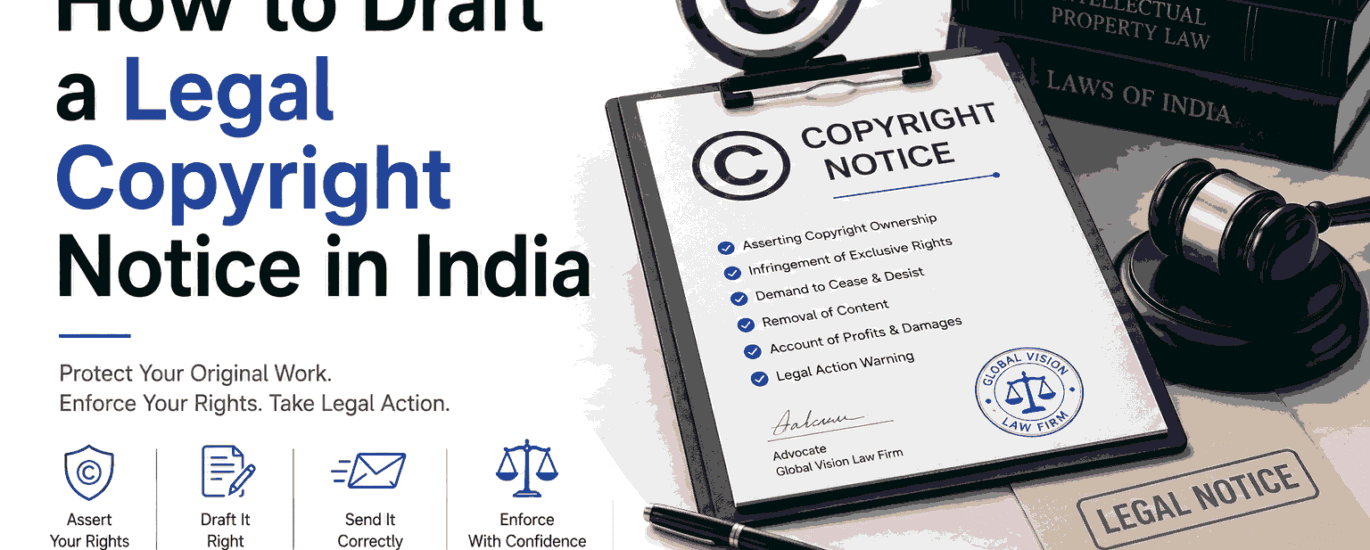
A properly drafted copyright notice for infringement must contain all of the following:
1. Your Full Identity and Contact Details
Full legal name (individual or company), address, email, and phone. If you’re a company — your CIN and registered office address.
2. Identification of the Work Infringed
Be specific. Not “my creative content” — but “the literary work titled [exact title], originally published on [exact date], by [your name], with ISBN/registration number [if applicable].”
Attach a copy of the original work, its publication date, and copyright registration certificate if you have one.
3. Evidence of Your Ownership
How do you own this copyright?
- You created it (primary author) — state this expressly
- You commissioned it under a written agreement that assigns copyright to you
- You acquired it by assignment or licence — attach the relevant document
4. Description of the Infringing Act
Exactly what the infringer did:
- Which specific parts of your work were copied or used
- Where the infringing material appears — URL, product name, platform, physical location
- When the infringement was first discovered
- How it is being used — commercial sale, distribution, display, reproduction
Attach screenshots, web archive links, product photographs — whatever documents the infringement at the time of sending.
5. Legal Provisions Violated
Cite the specific sections of the Copyright Act, 1957:
- Section 14 — the exclusive rights that belong to the copyright owner
- Section 51 — acts that constitute infringement (reproduction, communication to the public, adaptation without licence)
- Section 55 — civil remedies available (injunction, damages, account of profits)
- Section 63 — criminal liability (imprisonment up to 3 years and fine for knowing infringement)
Citing specific sections is what makes a notice a legal document rather than a personal complaint.
6. Specific Relief Demanded
State precisely what you want — not vaguely:
- Immediate takedown — “Remove all infringing copies from [specific platform/product] within [7/14/21 days] of receipt of this notice”
- Destruction of physical copies — if physical material exists
- Written confirmation of compliance — within the stated deadline
- Account of profits — a statement of all revenue earned using the infringed work
- Compensation — state either a specific amount or a statement that damages will be quantified in legal proceedings
7. Deadline and Consequences
Set a clear, firm deadline — 7 to 21 days is standard depending on the nature of the infringement and the remedy sought.
State the consequences explicitly:
- Civil suit before the appropriate court for damages under Section 55
- Application for urgent injunction to prevent further distribution
- Criminal complaint before the Magistrate under Section 63
- Complaint before the Copyright Board where applicable
8. Lawyer’s Signature and Stamp
A copyright notice sent by a lawyer carries qualitatively different weight than a personal communication — it demonstrates professional intent, signals that legal proceedings are genuinely imminent, and is properly formatted for court admissibility.
Have your lawyer sign the notice on their letterhead.
📮 Part 3: How to Send the Notice
Primary method: Registered Post with Acknowledgement Due (RPAD) to the infringer’s registered/principal business address — not just their customer service email or social media account.
Simultaneous email: Send via email with a read receipt to every known email address — marking the email “Legal Notice — Copyright Infringement.” Email delivery creates an additional evidentiary layer.
Platform takedown simultaneously: For online infringement — file a takedown notice with the platform (Google DMCA, Instagram/Facebook IP report, YouTube Content ID) at the same time as the legal notice. Platform takedowns happen faster than legal proceedings and create additional pressure.
Keep all proof of sending: RPAD receipts, postal tracking screenshots, email delivery confirmations, platform submission confirmations — these are your evidence that the notice was properly served if the matter goes to court.
⚠️ 4 Common Mistakes That Weaken Copyright Notices
Mistake 1 — No evidence attached A notice claiming infringement without attaching screenshots, URLs, or physical evidence of the infringing material is easily ignored and difficult to follow up on in court. Attach everything at the time of sending.
Mistake 2 — Wrong address Sending to a social media account, a marketing email, or a junior employee’s address may not constitute proper legal notice to the company. Always verify the infringer’s registered office or principal place of business — from MCA21 for companies or the business’s GST registration for others.
Mistake 3 — Vague demands “Stop using my work” is not a specific legal demand. A court enforcing a notice needs to know exactly what was demanded, when, and whether the infringer complied. Be specific about every relief item.
Mistake 4 — Sending without a copyright registration While registration is not required for copyright protection in India, it creates a legal presumption of ownership — significantly simplifying enforcement. If you haven’t registered, consider filing a copyright application simultaneously with your notice. It costs only ₹500 for literary and artistic works filed online and takes a few months for registration — but the filing date is the operative date.
💼 How Global Vision Law Firm Handles Copyright Notices and Infringement
Global Vision Law Firm has been handling intellectual property matters — copyright, trademark, and IP litigation — in India since 2013.
What we do for copyright clients:
- Draft and send copyright infringement notices within 24–48 hours
- File copyright registration applications simultaneously where not already done
- Apply for urgent injunctions before Delhi High Court where infringement is ongoing
- File civil suits under Section 55 for damages and account of profits
- File criminal complaints under Section 63 where knowing, commercial infringement is involved
- Advise on IP licensing structures to prevent future infringement
Our IP practice:
- Intellectual Property Rights
- IPR Litigation
- Trademarks
- IP Audits
- Data Privacy & Cybersecurity
- Litigation
📞 +91 9599801188 · +91-11-71522934 📧 globalvisionlawoffice@gmail.com 📍 M-3 Gupta Tower, Azadpur, Delhi – 110033
👉 Contact Us for IP Legal Assistance
❓ Quick FAQs
Q: Does copyright registration in India work automatically? A: Yes — copyright in India is automatic from the moment an original work is created and fixed in a tangible form. Registration is not required for protection. However, registration creates a legal presumption of ownership and significantly simplifies enforcement — making it strongly advisable.
Q: Can I send a copyright notice for content I posted on Instagram or a website? A: Yes — original content you create and post online is protected by copyright from the moment of creation. A copyright notice can be sent to anyone who copies it without permission, regardless of the platform.
Q: What if the infringer is based outside India? A: India is a signatory to the Berne Convention and other international copyright treaties — meaning Indian copyright is recognised in most countries. For cross-border infringement, the strategy involves both Indian legal proceedings (for infringement accessible in India) and platform-level DMCA or equivalent takedown notices in the relevant jurisdiction.
Q: How much can I claim in damages for copyright infringement? A: Under Section 55, courts can award: actual damages (proven financial loss), account of profits (the infringer’s gain from using your work), and in some cases, additional damages for flagrant infringement. There is no statutory cap — the amount is determined by the court on evidence.
Q: How quickly can Global Vision Law Firm send a copyright notice? A: For urgent infringement matters, we can draft and dispatch a properly formatted notice within 24–48 hours of receiving your instructions, documentation, and evidence of infringement.
💡 Final Thought
A copyright notice is not just a complaint letter. Drafted correctly, it is a formal legal document — one that can produce a ₹4.8 lakh settlement in 5 days, or form the foundation of a successful court proceeding.
The difference between the WhatsApp message Priya sent first and the lawyer’s notice that followed is not just tone. It is specificity, legal citation, evidentiary attachment, and the credible threat of consequences.
Your original work is protected by law. A properly drafted notice is how you enforce that protection.
👉 Contact Global Vision Law Firm
📞 +91 9599801188
Meta Title: How to Draft a Legal Copyright Notice in India (2026) | Global Vision Law Firm Meta Description: Step-by-step guide to drafting a copyright infringement notice in India — 8 essential elements, how to send it, what laws to cite & what happens if ignored. Global Vision Law Firm — IP lawyers Delhi since 2013. Focus Keyword: how to draft legal copyright notice India Secondary Keywords: copyright notice India 2026, copyright infringement notice format, Copyright Act 1957 notice, IP infringement notice India URL Slug: /how-to-draft-legal-copyright-notice-india/