Breaking Legal Update — August 2026 | Global Vision Law Firm — New Delhi | ~5 min read
India’s foundational MSME law just got its most significant overhaul in 20 years.
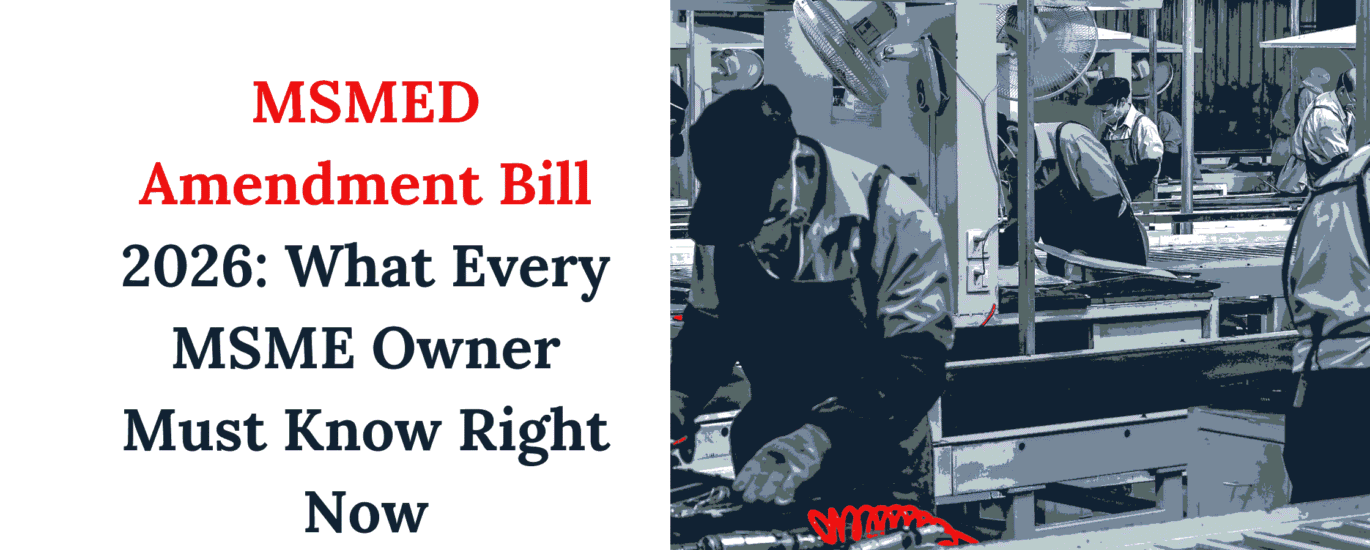
The Micro, Small and Medium Enterprises Development (Amendment) Bill, 2026 was passed by the Lok Sabha on 7th August 2026, following the Rajya Sabha’s approval on 3rd August 2026. It awaits the President’s assent — but the direction is clear, the law is passed, and MSMEs across India need to understand what has changed and what it means for them right now.
The MSMED Act was originally notified in 2006. In 20 years, India’s MSME landscape transformed beyond recognition — <cite index=”28-1″>the number of MSMEs registered on Udyam increased from 1.65 crore in April 2023 to 9.16 crore now, with the sector providing employment to over 40 crore people.</cite> The 2026 amendment brings the law into step with this transformed reality.
This blog covers every key change — in plain language — and explains what it means practically for MSME owners, their buyers, and the legal proceedings that affect them.
📌 Quick Answer
The MSMED Amendment Bill 2026 introduces seven major changes: permanent digital Udyam registration, faster MSEFC dispute resolution with strict timelines (90+30+90 days), mandatory 50% payment even during appeal of an award, recovery of dues as land revenue through District Collectors, mandatory TReDS for all CPSEs, flexible MSEFC composition to create more councils, and decriminalisation of most MSMED Act violations. Global Vision Law Firm handles MSME payment recovery, MSEFC proceedings, and MSME commercial litigation in Delhi. Contact us for an immediate assessment.
💔 The Problem This Amendment Is Solving
Before understanding the changes, understand the problem they are addressing.
An MSME supplier delivered goods worth ₹45 lakh to a large buyer in 2023. The buyer didn’t pay beyond the MSMED Act’s 45-day limit. The MSME filed before the MSEFC (Micro and Small Enterprises Facilitation Council). The MSEFC took 14 months to complete its proceedings. The award was passed. The buyer filed an application to set aside the award — and because no payment was required pending that challenge, continued using the MSME’s ₹45 lakh interest-free for another 18 months of court proceedings.
Total time from unpaid invoice to any recovery: nearly 3 years.
The 2026 amendment attacks this exact problem — specifically, at each stage where delay was possible. Here is what changed and how.
⚖️ Change 1: Permanent Udyam Registration Portal — Classification Codified in Law
The Udyam Registration Portal has been given statutory permanence under the amended Act. This means MSME registration now has a clear legislative foundation — not just an administrative order.
More significantly, the twin-criterion classification — Investment in Plant and Machinery AND Turnover — is now explicitly incorporated into the statutory text of the MSMED Act itself. Previously, this classification existed through government notifications; now it is part of the parent Act.
What this means practically:
- MSME status is more clearly defined and harder to dispute
- The Udyam portal is now a permanent, legislatively recognised platform — any challenges to its authority or processes are now significantly weaker
- Registration remains voluntary — no MSME is penalised for not registering, though registering unlocks statutory protections including delayed payment rights
For MSME owners: If you haven’t registered on Udyam, the 2026 amendment reinforces why you should. Without registration, you cannot access MSEFC proceedings, delayed payment protections, or TReDS benefits.
⚡ Change 2: Strict Timelines for MSEFC Proceedings — The Most Important Reform
This is the reform that will change the ground reality for MSME delayed payment recovery the most.
<cite index=”28-1″>The amendment introduces timelines to ensure faster adjudication of delayed payment disputes. The MSEFCs or mediation service provider is required to complete mediation within 90 days from the date fixed for first appearance. Thereafter, the MSEFCs are required to refer the matter for arbitration within 30 days from the date of termination of mediation. Subsequently, the MSEFCs or any ADR institution is required to make the award within 90 days from the date of completion of pleadings.</cite>
The 90 + 30 + 90 Day Framework:
| Stage | Maximum Timeline |
|---|---|
| Mediation completion | 90 days from first appearance |
| Referral to arbitration | 30 days from mediation termination |
| Arbitral award | 90 days from completion of pleadings |
| Total maximum | ~210 days (~7 months) |
Compare this to the pre-amendment reality where MSEFC proceedings routinely ran 12–24 months with no statutory deadline.
For MSME owners: This is the most operationally significant change. Your delayed payment claim now has a legislative guarantee of a 7-month maximum timeline from first appearance to award — rather than open-ended proceedings that buyers could delay through procedural tactics.
For buyers: You can no longer use MSEFC procedural delay as a strategy. The clock is now mandated by statute.
💰 Change 3: Mandatory 50% Payment During Award Challenge — The Game-Changer
This is the most powerful new provision for MSME creditors — and the one that directly addresses the “I’ll appeal forever” strategy that buyers have historically used.
<cite index=”28-1″>The amendment mandates the courts to order payment of at least 50% of the awarded amount to the micro and small enterprises suppliers, if the application to set aside decree, award or order is pending for more than six months.</cite>
What this means:
Under the pre-amendment law, a buyer who lost an MSEFC award could file a set-aside application and the MSME would get nothing while the challenge was pending — which could stretch for years. The Section 19 MSMED Act pre-deposit requirement existed but was subject to various judicial interpretations.
Under the 2026 amendment — if a set-aside application has been pending for more than 6 months — the court must direct the buyer to pay at least 50% of the award amount to the MSME. This payment is not contingent on the outcome of the challenge.
For MSME owners: Even if the buyer challenges your award, you now receive at least half your money within 6 months of the challenge being filed. This eliminates the buyer’s primary incentive for filing dilatory challenges — because the interest-free use of your money disappears.
For buyers: Filing a set-aside application after 6 months means paying 50% regardless. The economic calculus of frivolous appeals has fundamentally changed.
🏛️ Change 4: Recovery as Land Revenue Through District Collector — Enforcement Revolution
This is arguably the most enforcement-significant change in the entire amendment.
<cite index=”28-1″>Under the amended Act, any mediated settlement agreement or arbitral award made by the Facilitation Council, or through a mediation service provider or any alternative dispute resolution institution under Section 18, can be recovered as an ‘arrear of land revenue’ through the District Collector, Deputy Commissioner, or any notified authority in the jurisdiction where the buyer’s assets are located.</cite>
What this means:
Previously, an MSEFC award had to be executed through civil courts — a process that could itself take months to years. The land revenue recovery mechanism is categorically different: it is an executive (not judicial) process, where the District Collector has coercive powers including attachment and sale of property, without requiring lengthy court proceedings.
For MSME owners: Your MSEFC award is now effectively as powerful as a government revenue demand. The District Collector in the buyer’s district can move against their assets — this is a dramatically faster and more powerful enforcement tool than the previous civil court execution route.
💳 Change 5: Mandatory TReDS for All CPSEs — Liquidity for MSMEs
<cite index=”28-1″>All Central Public Sector Enterprises (CPSEs) must route the settlement of invoices through a Trade Receivables Discounting System Platform (TReDS) for procurement of goods and services from MSMEs.</cite>
TReDS is a platform that allows MSMEs to discount their receivables — essentially, to get paid early by financial institutions who then collect from the CPSE buyer at the due date. The volume of invoice discounting on TReDS has grown dramatically.
What this means:
For MSMEs supplying to CPSEs — power generation companies, defence PSUs, oil companies, railways-related CPSEs — invoice payment timelines are now legislatively protected through the TReDS mechanism. This is a direct liquidity boost.
For private sector buyers: The amendment also creates an enabling mechanism for state governments to push their own PSEs toward TReDS. Wider TReDS adoption is the direction of travel.
🏗️ Change 6: Flexible MSEFC Composition — More Councils, Faster Disposal
<cite index=”28-1″>The composition of MSEFCs has been rationalized to enable State governments to establish multiple MSEFCs for faster disposal of disputes regarding payments due to MSEs. The amendment also empowers the State Governments to make rules for MSEFCs.</cite>
What this means:
Currently, many states have very few MSEFCs — sometimes just one per state — leading to massive backlogs. The 2026 amendment allows states to establish multiple MSEFCs and gives states flexibility in structuring their composition. This directly addresses the capacity constraint that has historically slowed dispute resolution.
✅ Change 7: Decriminalisation — Trust-Based Regulation
<cite index=”28-1″>The amendment provides for decriminalisation and replaces conviction-based fines with graded civil penalties. Earlier, under the MSMED Act, non-filing of registration or non-supply of information was penalised with conviction and a fine. Now, the penal provisions have been decriminalised.</cite>
The new graded penalty framework:
| Violation | First Instance | Second Instance | Third Instance |
|---|---|---|---|
| Furnishing wrong information | Warning only | Penalty | Penalty (higher) |
| Non-disclosure of unpaid amounts in annual accounts | Warning only | Penalty | Fine (criminal) |
| Non-filing of registration | No criminal liability | Civil penalty | Civil penalty |
What this means:
MSMEs and their promoters no longer face criminal conviction risk for regulatory non-compliance under the MSMED Act. The shift to civil penalties and warning-first approach aligns MSMED enforcement with modern regulatory philosophy and removes the chilling effect of criminal prosecution on MSME operations and promoter decisions.
📊 MSMED Amendment 2026 — Before vs After Summary
| Issue | Before Amendment | After Amendment |
|---|---|---|
| Udyam Portal | Administrative order | Permanent statutory platform |
| MSEFC timeline | No statutory limit (12–24 months typical) | 90+30+90 days mandatory |
| Payment during appeal | Full amount withheld during challenge | 50% mandatory after 6 months |
| Award enforcement | Civil court execution (slow) | District Collector — land revenue recovery |
| CPSE invoice settlement | Voluntary | Mandatory TReDS routing |
| MSEFC numbers | One per state typically | Multiple MSEFCs permitted per state |
| Violations | Criminal conviction + fine | Warning → civil penalty → fine |
⚠️ What MSME Owners Must Do Right Now
Action 1 — Register on Udyam if you haven’t. The 2026 amendment strengthens Udyam’s legal foundation. Without Udyam registration, you cannot access any of the enhanced protections — the 90-day MSEFC timeline, the 50% mandatory payment, or the land revenue recovery mechanism.
Action 2 — Review all outstanding MSEFC proceedings. If you have a pending MSEFC matter, the new timelines may apply to proceedings initiated or continuing under the amended Act once it receives Presidential assent and comes into force. Consult a lawyer to assess how the amendments affect your specific pending matter.
Action 3 — Check your buyer’s status for TReDS. If your buyer is a CPSE, the mandatory TReDS routing requirement now applies. This is a significant liquidity improvement — but you need to register on TReDS to access it.
Action 4 — Review your buyer’s annual accounts. The amended non-disclosure penalty regime (warning → penalty → fine) creates a new disclosure obligation for buyers. If your buyer has not disclosed outstanding MSME dues in their annual accounts, that is now a specifically penalised violation under the amended Act.
💼 How Global Vision Law Firm Helps MSMEs Under the 2026 Amendment
Global Vision Law Firm has been representing MSMEs in payment recovery proceedings, MSEFC matters, and MSME commercial litigation in Delhi since 2013.
What we do for MSME clients under the 2026 amendment:
- MSEFC proceedings — filing, appearing, and enforcing MSEFC awards under the amended timelines
- Enforcement of MSEFC awards — using the new District Collector land revenue recovery mechanism
- 50% payment enforcement — applying to courts for mandatory 50% payment when buyers file dilatory set-aside challenges
- Udyam registration guidance — ensuring MSME clients are properly registered to access all 2026 protections
- TReDS advisory — for MSME suppliers to CPSEs
Our relevant practice pages:
- MSME Case — Global Vision Law Firm
- MSME Payment Recovery Lawyers India
- Dispute Resolution
- Arbitration
- Litigation
📞 +91 9599801188 · +91-11-71522934 📧 globalvisionlawoffice@gmail.com 📍 M-3 Gupta Tower, Azadpur, Delhi – 110033
👉 Contact Us for MSME Legal Assistance
❓ Quick FAQs — What MSME Owners Are Searching Right Now
Q: When does the MSMED Amendment Bill 2026 come into force? A: The Bill has been passed by both Houses of Parliament as of 7th August 2026 and awaits Presidential assent. It will come into force from the date of Presidential assent, or such date as the Central Government may notify. Most provisions are expected to come into force shortly after assent.
Q: Does the 90-day MSEFC timeline apply to pending cases? A: The applicability of new timelines to pending proceedings will depend on the transitional provisions in the amendment and how courts and MSEFCs interpret them. Consult a lawyer for advice on your specific pending matter.
Q: Does registration on Udyam become compulsory under the 2026 amendment? A: No — registration remains voluntary under the amended Act. However, only registered MSMEs can access the statutory protections including MSEFC proceedings, delayed payment rights, and TReDS.
Q: What is the 50% mandatory payment rule and when does it apply? A: Under the 2026 amendment, if a buyer files an application to set aside an MSEFC award and that application is pending for more than 6 months, the court must direct the buyer to pay at least 50% of the award amount to the MSME supplier. This applies regardless of the outcome of the set-aside challenge.
Q: Can MSME awards now be recovered through the District Collector? A: Yes — this is one of the most significant enforcement changes. MSEFC awards and mediated settlement agreements can now be recovered as arrears of land revenue through the District Collector or equivalent authority in the buyer’s jurisdiction. This is significantly faster than civil court execution.
Q: Is the MSMED Amendment 2026 good or bad for buyers? A: The amendment significantly strengthens the position of MSME suppliers relative to buyers on delayed payments. Buyers now face mandatory timelines, mandatory partial payments during appeals, and the possibility of District Collector enforcement against their assets. Buyers who were using procedural delay as a strategy will find that significantly harder under the new framework.
💡 Final Thought
The MSMED Amendment Bill 2026 is the most significant legal improvement for MSME payment recovery in the 20-year history of the MSMED Act.
The three changes that matter most: the mandatory 90-day MSEFC timeline, the 50% payment rule during appeal, and the District Collector land revenue recovery mechanism. Together, these three provisions eliminate the three most commonly exploited delay tactics in MSME payment recovery proceedings.
For the 9.16 crore registered MSMEs in India — and the many millions more who will now have stronger reasons to register on Udyam — the 2026 amendment is a genuine, structural improvement in their legal position.
But laws protect only those who use them. Registration, timely filing, and proper legal representation remain essential.
If your MSME is dealing with unpaid dues, pending MSEFC proceedings, or buyers who have been dragging their feet — the legal ground has shifted significantly in your favour as of August 2026.
👉 Contact Global Vision Law Firm
📞 +91 9599801188