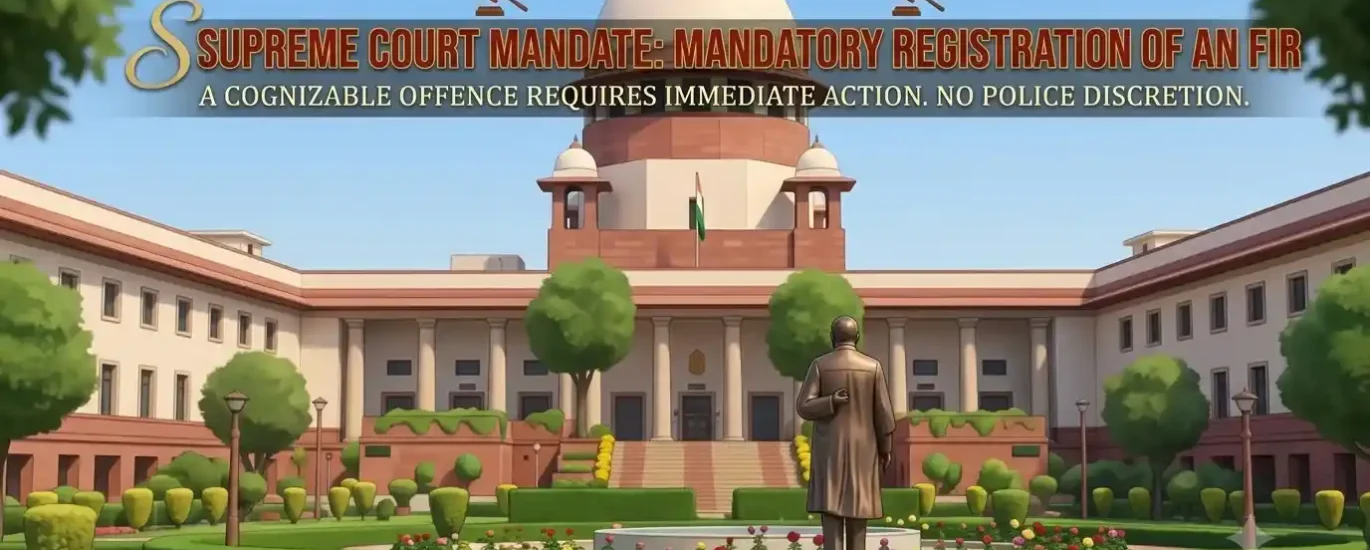
When a crime is committed, filing a First Information Report (FIR) is the crucial first step to triggering the criminal justice system in India. However, citizens frequently face situations where police officers refuse to record their complaints or insist on conducting informal “preliminary inquiries” before registering an FIR.
The Supreme Court of India has repeatedly tackled this issue, establishing that the police are under a statutory and constitutional obligation to register an FIR whenever information reveals a cognizable offence.
This comprehensive guide analyzes the landmark ruling in Lalita Kumari v. Govt. of U.P., recent legislative updates under the Bharatiya Nagarik Suraksha Sanhita (BNSS), 2023, the scope of preliminary inquiries, and the legal remedies available when the police refuse to register your complaint.
The Landmark Mandate: Lalita Kumari v. Govt. of U.P.
The definitive judicial authority on FIR registration was established by a five-judge Constitution Bench of the Supreme Court in the historic ruling of Lalita Kumari v. Government of Uttar Pradesh (2014) 2 SCC 1.
The Apex Court settled decades of conflicting High Court views by declaring that the registration of an FIR is mandatory if the information discloses the commission of a cognizable offence.
Key Takeaways from the Lalita Kumari Judgment:
- Discretion Eliminated: A police officer has no discretion to refuse registration of an FIR if a cognizable offence is prima facie disclosed. The word “shall” in the statutory provision leaves no room for police discretion.
- Truthfulness Is Not Tested Pre-FIR: The officer cannot refuse to register an FIR on the grounds that the information appears unverified, improbable, or lacks credibility. Credibility can only be tested during the post-registration investigation.
- Protection Under Article 21: Prompt FIR registration ensures procedural compliance and safeguards the fundamental rights of victims under Article 21 of the Constitution.
Statutory Codification Under BNSS, 2023 (Section 173)
With the implementation of the Bharatiya Nagarik Suraksha Sanhita (BNSS), 2023 (which replaced the Code of Criminal Procedure, 1973), Parliament formally codified the Supreme Court’s principles while introducing structured procedural frameworks under Section 173 BNSS:
                     [Complainant Submits Information]
                                     │
                                     ▼
                   Is it a Cognizable Offence?
                  ┌──────────────────┴──────────────────┐
                  │                                     │
                 YES                                    NO
                  │                                     │
   Check Penalty Criteria                       Non-Cognizable Report
                  │                              (Recorded in Diary)
        ┌─────────┴───────────────────────┐
        │                                 │
Offence Penalty > 7 Yrs            Offence Penalty 3–7 Yrs
OR Sexual/Gender Crimes            (Section 173(3) BNSS)
        │                                 │
        ▼                                 ▼
   MANDATORY                             Preliminary Enquiry
  IMMEDIATE FIR                        (Max 14 days, DSP approval)
(No Inquiry Permitted)                    │
                                ┌─────────┴─────────┐
                                │                   │
                         Prima Facie Case     No Case Found
                                │                   │
                                ▼                   ▼
                             Register           Informant
                               FIR              Notified
1. Mandatory Zero FIR & E-FIR (Section 173(1) BNSS)
Under Section 173(1) BNSS, every information relating to a cognizable offence—regardless of the geographic jurisdiction where the crime occurred—must be recorded. This makes Zero FIR a statutory right, forcing police stations to register the FIR and transfer it to the jurisdictional station within 15 days. It also permits electronic filing (e-FIR), provided the informant signs it within 3 days.
2. Preliminary Inquiry Framework (Section 173(3) BNSS)
While Lalita Kumari permitted preliminary inquiries in a narrow set of exceptions (such as matrimonial disputes, commercial offences, medical negligence, and corruption), Section 173(3) of the BNSS established a statutory mechanism:
- Scope: Applies specifically to offences punishable with imprisonment between 3 years and 7 years.
- Mandatory Oversight: The police officer must obtain prior permission from an officer of the rank of Deputy Superintendent of Police (DSP).
- Strict Time Limit: The preliminary inquiry must be completed within 14 days to ascertain whether a prima facie case exists.
- Zero Discretion Cases: For offences punishable by 7 years or more or sexual offences against women and children, no preliminary inquiry is allowed—immediate FIR registration remains mandatory.
CrPC vs. BNSS: FIR Registration Overview
| Parameter | Code of Criminal Procedure (CrPC, 1973) | Bharatiya Nagarik Suraksha Sanhita (BNSS, 2023) |
| Primary Statutory Provision | Section 154 CrPC | Section 173 BNSS |
| Zero FIR Provision | Judicial mandate (Lalita Kumari) | Statutory Right under Section 173(1) |
| Electronic FIR (e-FIR) | Allowed via state-specific rules | Codified Nationally with 3-day signature rule |
| Preliminary Inquiry Limits | Judicial guidelines (7-day cap under Lalita Kumari) | Statutory 14-day limit for 3–7 year offences with DSP approval |
| Penalty for Police Refusal | Departmental action / Contempt | Punishable under Section 173(5) BNSS & Section 199 BNS |
Legal Remedies When the Police Refuse to Register an FIR
If a police station refuses or delays recording a cognizable complaint, the law provides a clear hierarchy of statutory remedies:
- Approach the Superintendent of Police (Section 173(4) BNSS / Sec 154(3) CrPC): Submit a written complaint by registered post or in person to the Superintendent of Police (SP) or Commissioner of Police. If satisfied that a cognizable offence is disclosed, the SP must either investigate or direct a subordinate officer to register the FIR.
- Application Before the Judicial Magistrate (Section 175(3) BNSS / Sec 156(3) CrPC): If the higher police authorities fail to act, the complainant can file an application before the Judicial Magistrate having jurisdiction. The Magistrate can order the police to immediately register an FIR and commence an investigation.
- Writ Petition in the High Court (Article 226 of the Constitution): In cases of severe police inaction, gross abuse of power, or non-compliance with the Supreme Court’s Lalita Kumari directives, an aggrieved person can approach the High Court seeking a Writ of Mandamus or contempt proceedings against the erring police officials.
Recommended Meta Tags for SEO
- Meta Title:
Supreme Court Mandatory FIR Registration | Section 173 BNSS Guide - Meta Description:
Is FIR registration mandatory by police in India? Explore the Supreme Court's Lalita Kumari ruling, Section 173 BNSS rules, and legal remedies for police refusal.
Facing Police Inaction or Refusal to Register an FIR?
When police authorities fail to act on a genuine complaint, timely legal intervention is essential to secure your rights, prevent the destruction of evidence, and enforce statutory compliance.
At Global Vision Law Firm, our senior criminal defense advocates and litigation team specialize in drafting police complaints, moving urgent petitions under Section 175(3) BNSS before Judicial Magistrates, and filing High Court Writ Petitions to enforce mandatory FIR registration across Delhi NCR and India.
Protect Your Rights & Secure Immediate Legal Intervention
Global Vision Law Firm