Last Updated: June 2026 | Global Vision Law Firm — New Delhi | ~5 min read
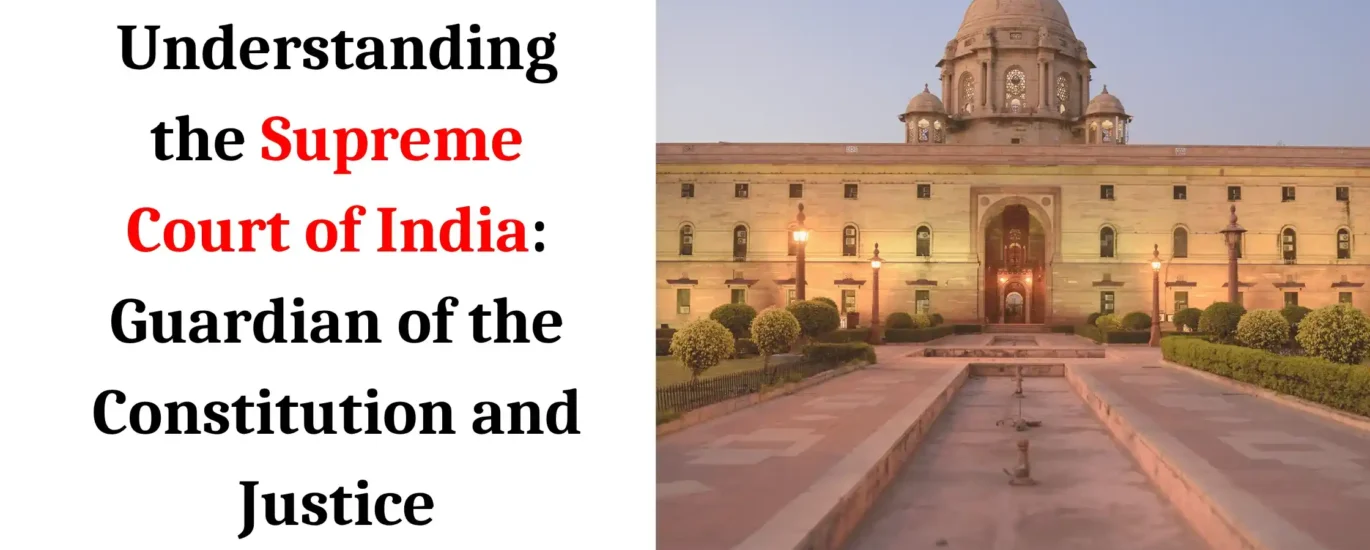
At the apex of India’s entire judicial hierarchy sits one institution — the Supreme Court of India.
It is the final court of appeal. The guardian of the Constitution. The ultimate protector of fundamental rights. And the forum of last resort for every citizen, every company, and every government that has exhausted every other option.
Understanding what the Supreme Court actually does, how it works, and when it becomes the relevant forum for your legal matter — is essential for any person or business navigating serious litigation in India.
This guide explains it all — the Court’s structure, its jurisdiction, its landmark constitutional role, and when you need the best supreme court lawyers in Delhi by your side.
📌 Quick Answer
The Supreme Court of India is established under Article 124 of the Constitution. It has original jurisdiction (Article 32 — fundamental rights), appellate jurisdiction (Articles 132–136 — civil, criminal, and constitutional appeals), advisory jurisdiction (Article 143 — President’s reference), and supervisory jurisdiction over all courts and tribunals in India. It consists of the Chief Justice of India and up to 33 other judges. Only Advocates-on-Record (AOR) can file matters before it. Global Vision Law Firm has been representing clients before the Supreme Court since 2013. Contact us for an immediate consultation.
🏛️ Part 1: Establishment and Composition
The Supreme Court of India was established on January 28, 1950 — two days after the Constitution came into force on January 26, 1950. It sits in New Delhi and is the only court in India with pan-national jurisdiction — its orders and judgments bind every court, tribunal, and authority across all 28 states and 8 Union Territories.
Composition:
The Court consists of the Chief Justice of India (CJI) and up to 33 other judges — making it a bench of 34 at full strength, though it rarely operates with all judges sitting together. Most matters are heard by benches of 2–5 judges. Constitutional benches — which decide questions of constitutional importance — consist of at least 5 judges.
The CJI is appointed by the President of India on the convention of seniority. Other judges are appointed by the President based on the collegium recommendation — a process where the CJI and senior judges collectively recommend appointments, a system developed through the landmark Second and Third Judges Cases (1993 and 1998).
⚖️ Part 2: Jurisdiction — What the Supreme Court Hears
Understanding jurisdiction is the foundation of knowing when the Supreme Court is the right forum.
1. Original Jurisdiction (Articles 131 and 32)
Article 131 — Inter-state and Centre-State disputes. When one state sues another state, or a state sues the Union of India, or the Union sues a state — the Supreme Court has exclusive original jurisdiction. No other court can hear these matters.
Article 32 — Writs for enforcement of fundamental rights. Any citizen whose fundamental right has been violated by the state can directly approach the Supreme Court for a writ — mandamus, certiorari, habeas corpus, quo warranto, or prohibition. This is the constitutional basis of Public Interest Litigation (PIL), one of India’s most distinctive contributions to constitutional jurisprudence.
The Supreme Court has described its Article 32 jurisdiction as a fundamental right in itself — meaning Parliament cannot take it away.
2. Appellate Jurisdiction (Articles 132–136)
This is the most commonly invoked jurisdiction in practice.
Article 132 — Appeals involving a substantial question of constitutional interpretation, where the High Court has issued a certificate of fitness.
Article 133 — Civil appeals from High Courts involving a substantial question of law of general importance.
Article 134 — Criminal appeals where the High Court has reversed an acquittal and sentenced the accused to death, or has awarded death penalty.
Article 136 — Special Leave Petition (SLP) — The broadest and most frequently used appellate route. The Supreme Court may, in its discretion, grant special leave to appeal from any judgment, decree, determination, sentence, or order passed or made by any court or tribunal in India. An SLP can be filed against a High Court order, a tribunal order (NCLAT, SAT, TDSAT, etc.), or even a session court order in appropriate cases. This is the route most litigants take — and it requires the best supreme court lawyers in Delhi to frame the question of law correctly and argue the admission hearing effectively within the narrow window courts provide.
3. Advisory Jurisdiction (Article 143)
The President of India can refer questions of law or fact of public importance to the Supreme Court for its opinion. The Court may give its opinion, though such opinions are advisory — not binding in the strict sense. The Court has exercised this jurisdiction on questions ranging from the validity of religious practices to constitutional amendments.
4. Supervisory Jurisdiction (Article 227 equivalent — read with the Constitution)
The Supreme Court has inherent supervisory jurisdiction over all courts and tribunals in India — it can correct jurisdictional errors, procedural illegalities, and ensure that inferior courts don’t exceed or abdicate their lawful authority.
🏗️ Part 3: How the Supreme Court Actually Works
Benches
The Supreme Court does not hear all matters with all 34 judges sitting together. Cases are allocated to benches:
- Division Bench — 2 judges: most regular civil and criminal appeals
- Three-Judge Bench — 3 judges: matters of some complexity or where a Division Bench is divided
- Constitutional Bench — minimum 5 judges: matters involving substantial questions of constitutional interpretation
- Larger Benches — 7, 9, or 11 judges: reserved for the most significant constitutional questions (e.g., the Kesavananda Bharati case was heard by 13 judges — the largest constitutional bench in Indian history)
The Advocate-on-Record (AOR) Requirement
No matter can be filed, numbered, listed, or formally argued before the Supreme Court unless an Advocate-on-Record (AOR) is on record. AOR is a distinct qualification — separate from regular High Court or trial court enrollment — requiring a specific examination conducted by the Supreme Court.
This is why litigants from across India — regardless of how accomplished their local lawyers are — must engage Delhi-based AOR-qualified counsel to access the Supreme Court. Firms with in-house AOR infrastructure, like Global Vision Law Firm, eliminate the coordination gaps that delay urgent matters.
The Two-Minute Admission Hearing
At the admission stage of an SLP, the Supreme Court bench may spend very little time on each matter. Counsel often have a narrow window to:
- Identify the substantial question of law
- Distinguish the case from settled precedent
- Establish urgency for interim relief
This is the moment that separates elite Supreme Court advocates from general litigators — the ability to present a complex case’s legal question with precision, speed, and clarity that commands the bench’s attention in the admission window.
🌟 Part 4: The Supreme Court as Guardian of the Constitution
Judicial Review
The Supreme Court’s power of judicial review — the power to strike down legislation or executive action that violates the Constitution — is the cornerstone of constitutional governance in India.
Unlike the United States where judicial review is a judge-made doctrine, India’s judicial review is constitutionally embedded — Articles 13, 32, and 226 together ensure that no law can survive if it violates fundamental rights, and the Supreme Court is the ultimate arbiter of that question.
The Basic Structure Doctrine — India’s most significant contribution to constitutional law globally — was developed by the Supreme Court in Kesavananda Bharati v. State of Kerala (1973). The Court held that while Parliament can amend the Constitution under Article 368, it cannot alter its “basic structure” — including separation of powers, judicial review, federalism, secularism, and democracy. This doctrine has no parallel in most other constitutional systems and places the Supreme Court in a unique position as the keeper of constitutional identity itself.
Public Interest Litigation — Access to Justice
PIL was developed in the late 1970s and early 1980s — primarily through the work of Justice P.N. Bhagwati and Justice V.R. Krishna Iyer — to give access to the Supreme Court to those who could not normally afford or access the legal system. A PIL can be filed by any citizen on behalf of another person or a public interest, with minimal formality.
Through PIL, the Supreme Court has:
- Directed the release of undertrial prisoners held beyond their maximum sentence
- Addressed air pollution in Delhi-NCR through comprehensive directions
- Regulated bonded labour practices
- Protected the rights of children in difficult circumstances
- Directed cleaning of the Ganga and Yamuna rivers
Landmark Judgments That Shaped India
| Judgment | Year | What It Established |
|---|---|---|
| Kesavananda Bharati v. State of Kerala | 1973 | Basic Structure Doctrine — Parliament cannot destroy the Constitution’s basic framework |
| Maneka Gandhi v. Union of India | 1978 | Article 21 right to life includes right to live with dignity — expanded reading of fundamental rights |
| S.P. Gupta v. Union of India | 1981 | Established locus standi for PILs — any person can file on public interest grounds |
| Vishaka v. State of Rajasthan | 1997 | Laid down guidelines for prevention of sexual harassment at workplace — the precursor to the POSH Act |
| I.R. Coelho v. State of Tamil Nadu | 2007 | Ninth Schedule laws are subject to basic structure review |
| K.S. Puttaswamy v. Union of India | 2017 | Privacy is a fundamental right under Article 21 |
| Joseph Shine v. Union of India | 2018 | Struck down Section 497 IPC — adultery decriminalised |
🚨 Part 5: When Do You Need the Supreme Court?
The Supreme Court is the correct forum in these situations:
When a High Court has ruled against you — and the High Court order involves a substantial question of law, a constitutional question, or a gross miscarriage of justice. File an SLP under Article 136 within 90 days (civil) or 60 days (criminal).
When a tribunal order needs to be challenged — NCLAT orders in insolvency matters, SAT orders in securities cases, and other statutory appellate tribunal orders can be challenged before the Supreme Court on questions of law.
When a fundamental right has been violated — directly approach under Article 32 without needing to go to the High Court first.
When the same matter is pending in multiple High Courts — file a Transfer Petition to consolidate proceedings before one court.
When a High Court contempt order has been passed — appeals lie before the Supreme Court.
Each of these situations requires careful, experienced Supreme Court advocacy — which is exactly what Global Vision Law Firm’s dedicated Supreme Court practice delivers as the best supreme court lawyers in Delhi for complex commercial, constitutional, and criminal matters.
For our complete Supreme Court practice: Supreme Court Advocate India — Global Vision Law Firm
For Article 32 petitions and constitutional matters: Article 32 Petition — Constitutional Remedies
For top law firms handling Supreme Court appeals: Top Law Firms for Supreme Court Appeals
For corporate litigation at apex court level: Supreme Court Lawyers in Delhi: Managing Corporate Litigation
💼 Global Vision Law Firm — Supreme Court Practice
Global Vision Law Firm has been appearing before the Supreme Court of India since 2013 — with in-house Advocate-on-Record infrastructure, experienced appellate counsel, and a track record of securing urgent interim relief at the admission stage in commercial, constitutional, and criminal matters.
Our Supreme Court practice covers:
- Special Leave Petitions (civil and criminal) under Article 136
- Article 32 Constitutional Writ Petitions
- NCLAT statutory appeals — Bankruptcy & Insolvency
- Transfer Petitions and Contempt Petitions
- Urgent ad-interim stay applications
- Arbitration and International Arbitration appeals
📞 +91 9599801188 · +91-11-71522934 📧 globalvisionlawoffice@gmail.com 📍 M-3 Gupta Tower, Azadpur, Delhi – 110033
👉 Contact Our Supreme Court Team 👉 About Global Vision Law Firm
❓ Quick FAQs
Q: What is the difference between the Supreme Court and a High Court? A: The High Court is the highest court within a state — it hears appeals from subordinate courts and exercises original jurisdiction in some matters. The Supreme Court is the highest court in India — it hears appeals from all High Courts and tribunals, and has exclusive original jurisdiction in inter-state and Centre-State disputes. Every High Court judgment can ultimately be appealed to the Supreme Court.
Q: Can anyone file a PIL in the Supreme Court? A: Yes. Under Article 32, any person can file a PIL on behalf of a person or class of persons whose rights have been violated, or in public interest. The petitioner need not personally be the victim. Courts do, however, filter out frivolous or politically motivated PILs.
Q: How many cases does the Supreme Court hear? A: The Supreme Court receives tens of thousands of new cases each year. As of 2026, there are approximately 80,000+ pending cases. This volume is why admission hearings move quickly and why having experienced, AOR-qualified Supreme Court counsel — who can present the case’s legal question effectively in a brief window — is so important.
Q: What is the time limit to file an SLP? A: 90 days from the High Court’s judgment for civil matters; 60 days for criminal matters. Delay beyond these periods requires a Condonation of Delay application with specific reasons for each day of delay.
Q: Is the Supreme Court’s order binding on all courts in India? A: Yes. Under Article 141, the law declared by the Supreme Court is binding on all courts within the territory of India — including all 25 High Courts and every subordinate court and tribunal.
💡 Final Thought
The Supreme Court of India is not just the final court of appeal. It is the living guardian of the Constitution — the institution that decides, ultimately, what India’s fundamental law means and whether it has been honoured.
Understanding it — its jurisdiction, its procedure, its constitutional role — is not academic knowledge for most litigants. It is practical knowledge that determines whether and how a legal matter can be taken to its final stage.
When that stage arrives — whether through an SLP, an Article 32 petition, or a tribunal appeal — you need the best supreme court lawyers in Delhi who combine constitutional knowledge, procedural precision, and the advocacy skills the apex court’s fast-moving hearings demand.
Global Vision Law Firm has been providing exactly that since 2013.
📞 +91 9599801188