Last Updated: May 2026 | Global Vision Law Firm — New Delhi | ~5 min read
You’ve just realised you’ve been scammed, hacked, or harassed online — and the first instinct is to find the nearest police station.
Here’s what most people don’t know: for the vast majority of cybercrimes in India, you don’t need to physically go anywhere first. The National Cyber Crime Reporting Portal lets you register a complaint from your phone, right now, and it is specifically designed to work alongside — not instead of — your local Cyber Cell.
This guide walks through exactly how to register a cyber crime complaint in 2026, what happens after you submit it, and the procedural details most explanations leave out — including a fairly recent change that significantly speeds up serious financial fraud cases.
📌 Quick Answer
To register a cyber crime complaint in India, visit cybercrime.gov.in (the National Cyber Crime Reporting Portal, or NCRP), select the relevant complaint category, register with your mobile number and OTP, and fill in incident, suspect, and complainant details before submitting. You will receive a 14-digit acknowledgement number to track your complaint. For urgent financial fraud, call 1930 (the National Cyber Crime Helpline) first — within the first hour if possible — as this is the fastest route to freezing a fraudulent transaction. For losses above ₹10 lakh, the portal now automatically triggers registration of a Zero FIR. Global Vision Law Firm assists complainants with both portal filing and the follow-through legal action that often determines whether money is actually recovered. Contact us for support with your complaint.
🚨 Step 0: If Money Has Been Lost — Call 1930 Before Anything Else
If your complaint involves an unauthorised financial transaction — UPI fraud, a fake investment platform, a card transaction you didn’t make — the single most time-sensitive action is calling 1930, the National Cyber Crime Helpline, before you even open the portal.
1930 connects directly to a system that can flag the receiving bank account in real time, increasing the chance the money is frozen before it moves further down a chain of mule accounts. Industry-wide data through late 2025 showed that a meaningful share of reported fraud amounts have been intercepted this way — though the share actually returned to victims remains far lower, which is exactly why speed of reporting matters so much.
Once you’ve called 1930, you’ll typically receive an SMS with a complaint reference — and you’ll then complete the full details on the portal, described below.
🛠️ Step-by-Step: Registering a Complaint on cybercrime.gov.in
Step 1 — Choose Your Complaint Category
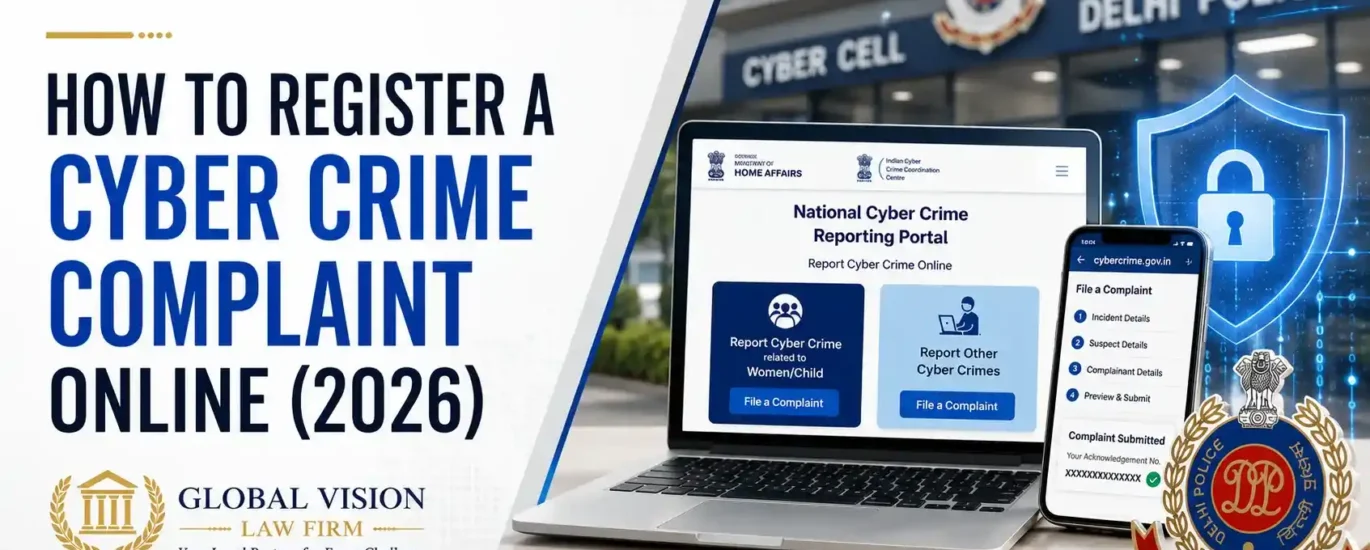
On the homepage, you’ll generally see two main paths:
- Report Cyber Crime related to Women/Child — for content like child sexual abuse material or crimes targeting women, which can in some cases be reported anonymously
- Report Other Cyber Crimes — covering financial fraud, hacking, social media crimes, identity theft, ransomware, data theft, and most other categories
Selecting the right category at the outset matters — it determines which form fields you’ll be asked to complete and which government unit eventually reviews your complaint.
Step 2 — Register as a New User
Click through to “File a Complaint,” accept the terms, and select the option for new users. You’ll need to:
- Enter your mobile number and request an OTP
- Enter the OTP and complete a captcha verification
- Fill in your personal details — name, email, state, and contact information
Step 3 — Complete the Four-Part Complaint Form
The actual complaint typically has four parts:
Incident Details — what happened, when, and how. Be as specific as possible with dates, amounts, and platforms involved.
Suspect Details — any information you have about the perpetrator: phone number, email address, UPI ID, bank account, social media handle, or website used. Even partial information helps investigators.
Complainant Details — your own identity and contact information, confirmed from your registration.
Preview and Submit — review everything carefully before final submission, since corrections after submission can be more cumbersome than getting it right the first time.
Step 4 — Upload Supporting Evidence
Attach everything relevant: transaction screenshots, bank statements showing the disputed transaction, chat or email correspondence with the suspect, screenshots of fraudulent websites or apps, and any other documentary proof. Complaints with strong, organised evidence are processed and acted upon far more effectively than vague descriptions alone.
Step 5 — Receive Your Acknowledgement Number
On successful submission, you’ll receive a 14-digit acknowledgement number, generally delivered via SMS with a header identifying your state. This number is your reference for tracking the complaint’s status going forward — keep it safe and don’t lose it.
⚡ The Zero FIR Change Every Fraud Victim Should Know About
This is a relatively recent development that significantly changes outcomes for serious financial fraud cases.
For complaints involving financial loss above ₹10 lakh, the system is now designed to automatically trigger registration of a Zero FIR with the relevant cyber police station — without requiring the victim to separately visit a station and convince an officer to register one. A Zero FIR can be registered regardless of jurisdiction and is later transferred to the appropriate police station for investigation.
This matters because, historically, one of the biggest practical obstacles cyber fraud victims faced wasn’t the law itself — it was simply getting a police station to take the complaint seriously and register it promptly. For high-value cases, this barrier has been substantially reduced.
For complaints below this threshold, you may still need to follow up — either visiting your local Cyber Cell in person, or ensuring the portal complaint is being actively progressed.
🏢 Filing Directly at a Cyber Cell — When and How
You can also walk into any Cyber Cell or police station and report a cybercrime in person — and under the IT Act framework, jurisdiction for cyber offences is effectively national, meaning you are not restricted to filing only where the crime technically occurred.
What to bring:
- Government-issued photo ID
- All documentary evidence (printed or on a device/USB)
- Your NCRP acknowledgement number, if you’ve already filed online
- A written, dated account of the incident
An authorised officer will typically upload the complaint into the relevant tracking system and take further legal steps, including registering an FIR where warranted — running in parallel with, not as a replacement for, the portal-based process.
If your bank account itself has been frozen as a consequence of a cybercrime investigation — even where you are an innocent party caught in a transaction chain — that requires a distinct legal response. See our complete guide: How to Unfreeze a Bank Account in India
📋 Documents and Information to Gather Before You Start
| Category | What to Collect |
|---|---|
| Identity | Aadhaar, PAN, or passport |
| Transaction proof | Bank statement, UPI transaction ID, payment confirmation |
| Communication evidence | Screenshots of chats, emails, call logs with the suspect |
| Platform evidence | Screenshots of the fraudulent app, website, or social media profile |
| Suspect details | Any phone number, email, UPI ID, or account number you have |
| Prior reports | Bank fraud complaint acknowledgement, 1930 reference number |
⚠️ Common Mistakes That Slow Down a Complaint
Submitting vague incident descriptions. “I lost money to fraud” gives investigators almost nothing to act on. Specific dates, amounts, and platform names make the difference between a complaint that gets traction and one that sits unreviewed.
Not calling 1930 first for financial fraud. The portal complaint matters, but for money already in transit, the helpline’s real-time freeze mechanism is the only tool with a realistic chance of stopping the transaction before it’s too late.
Losing the acknowledgement number. Without it, tracking your complaint’s status becomes significantly harder. Save it in multiple places immediately.
Treating the portal complaint as the end of the process. Particularly for amounts below the Zero FIR threshold, or where the suspect needs to be formally identified through court-ordered disclosure, registering the complaint is the start of the legal process — not its conclusion.
For the complete picture on recovering money after a cyber fraud, beyond just reporting it: How to Recover Money from Cyber Scams in India
💼 How Global Vision Law Firm Helps Beyond the Complaint
Registering a complaint on the portal is an essential first step — but it is not, by itself, a legal strategy for recovering your money or holding a perpetrator accountable. That typically requires follow-up legal action: pressing for FIR registration and investigation progress, applying for court-ordered disclosure of anonymous account holders, and where appropriate, pursuing civil recovery alongside the criminal complaint.
Global Vision Law Firm has been assisting cyber crime victims in Delhi with exactly this follow-through since 2013 — from the initial portal complaint through to civil recovery proceedings.
Related practice areas:
📞 +91 9599801188 · +91-11-71522934 📧 globalvisionlawoffice@gmail.com 📍 M-3 Gupta Tower, Azadpur, Delhi – 110033
👉 Contact Us for Assistance With Your Complaint
❓ Quick FAQs
Q: Is there a fee to register a complaint on cybercrime.gov.in? A: No, registering a complaint on the National Cyber Crime Reporting Portal is free.
Q: Can I file a complaint anonymously? A: For certain categories — particularly content involving women and children — limited anonymous reporting options exist. For financial fraud and most other categories, your identity and contact details are generally required to process the complaint and any eventual investigation.
Q: Do I need to file at a Cyber Cell physically if I’ve already filed on the portal? A: Not always, but for significant cases, following up in person — or ensuring an FIR has actually been registered — strengthens the chance of active investigation, particularly below the ₹10 lakh Zero FIR threshold.
Q: What if I don’t know the perpetrator’s identity at all? A: You can still file — provide whatever partial information you have (even just a UPI ID or phone number). For identifying a completely anonymous attacker, courts can issue disclosure orders directing banks, platforms, or telecom providers to reveal account holder information.
Q: Can Global Vision Law Firm help me file or follow up on a cyber crime complaint? A: Yes. Contact us at globalvisionlawfirm.com/contact-us-global-vision-law-firm or call +91 9599801188 for assistance with filing, following up, and pursuing recovery.
💡 Final Thought
The procedure to register a cyber crime complaint in India has become significantly more accessible in recent years — a complaint can be filed from your phone, without visiting a police station, and for serious financial fraud, the system increasingly works to register an FIR automatically rather than leaving that to chance.
But registering the complaint is the beginning of the process, not the end of it. What happens next — how quickly you act, how complete your evidence is, and whether you follow through with proper legal support — is usually what determines whether the matter actually resolves in your favour.
👉 Contact Global Vision Law Firm
📞 +91 9599801188