Last Updated: May 2026 | Global Vision Law Firm — New Delhi | ~5 min read
In India, owning a firearm is a legal right — but one that comes with strict conditions, a detailed application process, and serious criminal consequences if the process is bypassed.
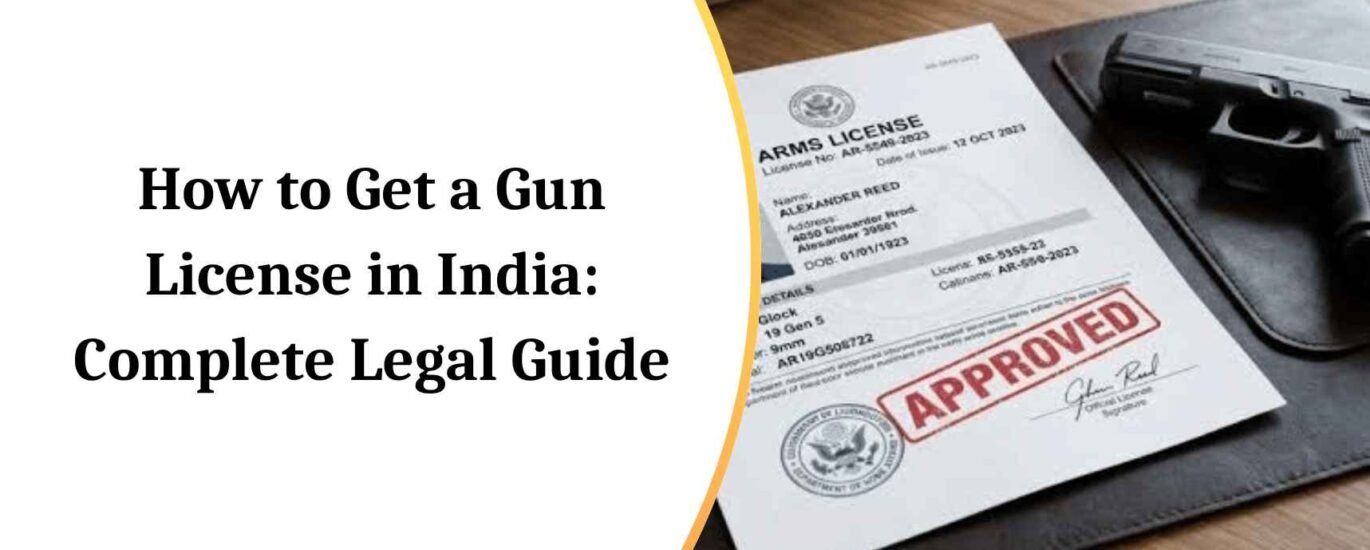
The law governing civilian firearms is the Arms Act, 1959, significantly updated by the Arms Rules, 2016 and the Arms (Amendment) Act, 2019 — the most recent and most consequential overhaul of gun licensing in India. If you are considering applying for a firearms licence, understanding what changed in 2019, what the current eligibility requirements are, and exactly what the application process looks like in 2026 is essential before you take any step.
This guide covers all of it — clearly and accurately.
📌 Quick Answer
To get a gun licence in India, you must be a citizen aged 21 or above with no criminal record, apply through the NDAL-ALIS portal (ndal-alis.gov.in) or your District Magistrate’s office with the prescribed forms and supporting documents, complete mandatory firearms safety training, pass police verification, and satisfy the licensing authority that you have a genuine reason to own a firearm. The licensing authority must decide within 60 days of a complete application. Post the 2019 amendment, civilians can hold a maximum of two firearms — reduced from three. Global Vision Law Firm assists clients with challenging refused or cancelled arms licences and navigating the licensing process. Contact us for a consultation.
📜 Part 1: The Legal Framework — What Governs Gun Licensing in India
Three pieces of legislation form the current framework:
Arms Act, 1959 — the foundational statute. Governs the manufacture, sale, possession, use, import, and export of firearms and ammunition. Without a licence under this Act, possessing a firearm is a criminal offence.
Arms Rules, 2016 — replaced the earlier 1962 Rules. Introduced mandatory firearms safety training, prescribed specific forms (A-1 to A-14), required medical fitness certificates, established the NDAL-ALIS digital portal, and set a 60-day timeline for licensing authorities to decide applications.
Arms (Amendment) Act, 2019 — the most significant recent change. Reduced the maximum number of firearms a civilian may hold from three to two (or one, depending on the licence category and authority’s discretion). Substantially increased penalties for illegal possession and rash/negligent use. Made celebratory gunfire (firing in the air at weddings and public events) a specific punishable offence.
For any matter involving criminal consequences under the Arms Act — illegal possession, licence cancellation, arms-related FIRs — see our Litigation practice.
🔫 Part 2: Types of Firearms Licences — Prohibited Bore vs Non-Prohibited Bore
Indian law divides civilian-accessible firearms into two categories:
Non-Prohibited Bore (NPB) — firearms whose calibre/bore is not exclusively used by the military, special forces, or police on a continuous basis. These are the category available to ordinary civilians. Examples: revolvers, pistols of specified calibres, shotguns, and certain rifles.
Prohibited Bore (PB) — firearms of calibres exclusively associated with defence and law enforcement use, such as 9mm pistols, .303 rifles, and .38 calibre handguns. These are generally restricted to defence forces and law enforcement, with very limited exceptions for persons with documented threat-to-life situations. After the 2008 Mumbai terrorist attack, PB licences became available in narrow exceptional circumstances — active threat to life, government officials at risk due to the nature of their duties, or persons associated with anti-terrorism programs.
For most applicants, the relevant category is NPB. PB licence applications are handled at the central government level and are significantly harder to obtain.
✅ Part 3: Eligibility — Who Can Apply
The Arms Act and Rules set out the following requirements for a civilian NPB firearms licence:
Age: Minimum 21 years. (Exception: 12–18 years for supervised sports shooting, but this is a distinct regime.)
Citizenship: Indian citizen or lawful resident.
Criminal record: No criminal conviction and no pending proceedings for offences that would disqualify a person under the Arms Act.
Mental and physical fitness: A medical fitness certificate (Form S-3 under the 2016 Rules) is required confirming the applicant is in sound mental and physical health.
Genuine reason: The licensing authority must be satisfied that there is a genuine and legitimate reason for requiring a firearm — self-defence, protection of life/property in a documented threat situation, licensed profession (security, etc.), or sports shooting.
Safety training: Completion of mandatory firearms safety training from an authorised institution, producing a certificate of completion.
No Arms Act prohibition: Not previously declared ineligible under Section 14 of the Arms Act.
🛠️ Part 4: The Application Process — Step by Step
Step 1 — Choose the Correct Authority
Who grants NPB licences:
- District Magistrate (DM)/Additional District Magistrate — for most rural and semi-urban applications
- Commissioner of Police — in metropolitan/commissionerate areas (Delhi, Mumbai, Chennai, etc.)
- State Government — for certain categories
For Delhi-based applicants, the Commissioner of Police, Delhi (through the Arms Licensing Unit) is the relevant authority.
Step 2 — Complete Mandatory Firearms Safety Training
Before filing your application, attend a mandatory firearms safety training programme from an authorised institution. You will receive a training completion certificate which must be attached to your application. This was introduced by the Arms Rules, 2016 and is a firm prerequisite — not a formality to complete after the licence is issued.
Step 3 — Apply on the NDAL-ALIS Portal
The National Database of Arms Licences – Arms Licence Information System (NDAL-ALIS) at ndal-alis.gov.in is India’s centralised, digital arms licensing portal, now the primary route for most applications.
Create an account, fill in the relevant form (typically Form A-1 for fresh NPB licence applications), and upload supporting documents. You receive a unique application reference number for tracking.
Where physical filing is required or preferred, applications are submitted to the relevant DM/Commissioner’s office.
Step 4 — Submit Documents
Required documents for a standard NPB firearms licence application:
| Document | Details |
|---|---|
| Identity proof | Aadhaar card, PAN card, or passport |
| Address proof | Aadhaar, utility bills, or registered lease agreement |
| Age proof | Birth certificate, Aadhaar, or passport |
| Photographs | Passport-sized, as prescribed |
| Medical fitness certificate | Form S-3, from a government or approved doctor |
| Safety training certificate | From an authorised training institution |
| Reason/justification statement | Written explanation of the genuine need for the firearm |
| Affidavit of no criminal record | Notarised declaration |
| Character reference/NOC | From local authority or employer where applicable |
Additional documents may be required depending on the authority and the specific nature of the application.
Step 5 — Police Verification
After filing, the police conduct a thorough background check and local verification — confirming identity, address, criminal antecedents, character references, and the genuineness of the stated reason for requiring a firearm.
This is typically the longest-running part of the process. Police verification reports vary in timeline depending on the jurisdiction and the complexity of the background check.
Step 6 — Decision Within 60 Days
Under the Arms Rules, 2016, the licensing authority must communicate a decision within 60 days of receipt of a complete application. If refused, the applicant must be given reasons and has a right to appeal.
Step 7 — Acquire the Firearm Within 2 Years
Once licensed, the firearm must be acquired within 2 years of the licence being issued — failing which the licence lapses for that purpose. The vendor endorses the licence on acquisition. After acquiring, the firearm must be reported to the licensing authority.
💰 Part 5: Fees
The Arms Rules, 2016 set central government fees. State-level administrative charges may vary:
| Licence Type / Stage | Fee (Approximate) |
|---|---|
| Fresh NPB licence (individual) | ₹500 – ₹1,000 |
| Renewal | ₹500 – ₹1,000 |
| Late renewal penalty | ₹1,500 – ₹3,000 (depending on delay duration) |
Additional costs include mandatory safety training fees, medical examination charges, and notarisation expenses — these vary by provider and location.
📋 Part 6: The 2019 Amendment — Key Changes You Must Know
The Arms (Amendment) Act, 2019 introduced changes that directly affect existing and prospective licence holders:
Firearm limit reduced to two: The maximum number of firearms a civilian may hold was reduced from three to two (in practice, many licences are for one firearm at the authority’s discretion). Existing holders of three firearms were given one year from the Amendment’s commencement to deposit the extra firearm at the nearest police station or a licensed dealer.
Enhanced penalties for illegal possession: Under the amended Section 25, illegal possession of a firearm (without a valid licence) is now punishable with imprisonment of a minimum of two years, which may extend to seven years, plus fine — significantly higher than the pre-amendment maximum.
Celebratory gunfire made a specific offence: Firing a weapon in public places, religious gatherings, marriage parties, or other public functions — regardless of whether anyone is actually harmed — is now a specific offence punishable with up to two years of imprisonment and a fine of up to ₹1 lakh.
Manufacturing illegal arms: Life imprisonment added for manufacturing unlicensed weapons — a major escalation of the earlier penalty structure.
⚠️ What Can Get Your Licence Cancelled or Suspended
Under Section 17 of the Arms Act, the licensing authority can suspend or revoke a licence in writing if:
- The licence holder has been convicted of a cognizable offence
- The holder is found to be using the firearm in a manner dangerous to public safety
- There are reasonable grounds to believe the firearm is likely to be used for an unlawful purpose
- The holder fails to comply with conditions of the licence
- The holder fails to surrender the licence when directed
Challenging cancellation or refusal: Both refusal to grant a licence and cancellation of an existing licence are subject to challenge — through an appeal to the prescribed appellate authority, and if necessary, through a Writ Petition before the Delhi High Court or relevant High Court challenging the administrative decision.
If your arms licence has been refused or cancelled and you believe the decision is wrong, Global Vision Law Firm can assess the grounds and represent you before the appropriate authority or court.
For our litigation practice: Litigation — Global Vision Law Firm
For High Court and Supreme Court challenges: Supreme Court Practice — Global Vision Law Firm
📌 Part 7: Carrying Rules Under Arms Rules 2016
A valid licence does not mean unlimited freedom to carry. Under the Arms Rules, 2016:
- A firearm must be carried in a properly designed holder when in a public place — completely covered and under effective control at all times
- Brandishing a firearm in public is strictly prohibited
- Discharging or blank-firing in public places is an offence
- Firearm-free zones must be respected — including courts, government offices, and areas notified by the authority
- Loss or theft of a firearm must be reported within 24 hours to the licensing authority and local police
Violations can lead to licence revocation, seizure of the firearm, and criminal prosecution — in addition to the penalty under the specific Arms Act provision.
💼 How Global Vision Law Firm Can Help
Getting a gun licence in India is a legally complex process — with discretion exercised by authorities at multiple stages. Rejection rates in urban areas (particularly Delhi, where the Commissioner of Police has stricter scrutiny than many district-level authorities) are significant, and many rejections are based on inadequate documentation or an insufficiently established justification.
More commonly, Global Vision Law Firm assists clients in:
- Challenging refused or cancelled arms licences — through the prescribed appeal process and, where necessary, High Court Writ Petitions against arbitrary administrative decisions
- Advising on Arms Act violations — clients facing FIRs or charges under the Arms Act, particularly the post-2019 enhanced penalty provisions
- Licence renewal disputes — where authorities are delaying or refusing renewal without proper grounds
- Inheritance of firearms — where a family member has inherited a firearm from a deceased licence holder and requires guidance on the legal process for transfer or deposit
Our relevant practices:
📞 +91 9599801188 · +91-11-71522934 📧 globalvisionlawoffice@gmail.com 📍 M-3 Gupta Tower, Azadpur, Delhi – 110033
👉 Contact Us for Arms Licence Legal Assistance
❓ Quick FAQs
Q: Can I carry my licensed firearm anywhere in India? A: No. Your licence will specify the area within which it is valid. Carrying a firearm outside your licensed area requires either an all-India endorsement or a separate licence for the other state/area. Always check the territorial conditions on your specific licence.
Q: What is the validity period of an arms licence? A: Under the Arms Rules, 2016, NPB licences are typically valid for 3 years (renewable). Renewal should be applied for at least 60 days before expiry — holding a firearm after licence expiry is illegal.
Q: Can I inherit my father’s gun after his death? A: The firearm must be deposited with the nearest police station or licensed dealer immediately on the death of the licence holder. An heir wishing to retain the firearm must apply for a fresh licence in their own name. An existing licence cannot simply be “transferred” to an heir without a fresh licensing process.
Q: Is it legal to fire a gun at a wedding in India? A: No. The Arms (Amendment) Act, 2019 specifically made “celebratory gunfire” — firing a weapon at wedding functions, religious gatherings, or any public event — a criminal offence, even if no one is harmed. Penalty: up to 2 years imprisonment and a fine of up to ₹1 lakh.
Q: Can a refusal to grant an arms licence be challenged? A: Yes. Refusal must be communicated in writing with reasons. An appeal lies to the prescribed appellate authority. Where the refusal is arbitrary or disproportionate, a Writ Petition before the Delhi High Court is also available. Global Vision Law Firm handles such challenges.
Q: What happens if I possess a firearm without a valid licence? A: Under the Arms Act as amended in 2019, illegal possession is punishable with a minimum of 2 years imprisonment, extendable to 7 years, plus fine. This is a non-bailable offence and is taken seriously by courts.
💡 Final Thought
Getting a gun licence in India is not impossible — but it is a deliberate, scrutinised process that rewards applicants who are genuinely prepared: the right documentation, a clearly articulated legitimate reason, completed safety training, and a clean police verification.
The process has also become genuinely more accessible since the digitisation through NDAL-ALIS — most of it can now be tracked and managed online without repeated visits to government offices.
Where the process goes wrong — refusals, delays, or cancellations — the legal remedies are real and available. But they need to be pursued correctly and promptly.
If you are navigating the arms licensing process, or if a licence has been refused or cancelled and you believe that decision is wrong, Global Vision Law Firm is here to help.
📞 +91 9599801188