Last Updated: June 2026 | Global Vision Law Firm — New Delhi | ~5 min read
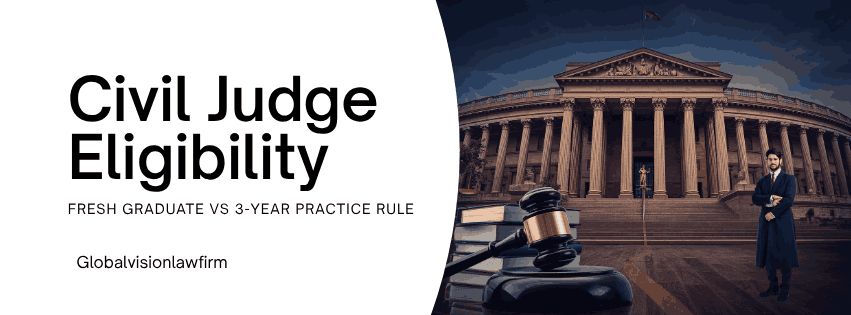
If you planned your entire judiciary career path around appearing for the Civil Judge (Junior Division) examination straight after your LLB — the landscape changed significantly on 20 May 2025.
On that date, a Supreme Court bench comprising Chief Justice B.R. Gavai and Justices A.G. Masih and K. Vinod Chandran delivered a ruling in All India Judges Association v. Union of India (2025 INSC 735) that reinstated something the Court had abolished in 2002: a minimum three years of practice as an advocate is now a mandatory eligibility condition for Civil Judge (Junior Division) posts across India.
This guide explains exactly what changed, how the rule is counted and applied, what states have done with it, where exceptions and review proceedings stand as of mid-2026, and what this means practically for your career timeline.
📌 Quick Answer
As of mid-2026, <cite index=”1-1″>a fresh law graduate cannot directly become a civil judge for recruitment processes initiated after 20 May 2025; they must first complete three years of practice</cite>. <cite index=”1-1″>The three years are counted from the date of provisional enrolment with the State Bar Council, not from the date of clearing the All India Bar Examination. Service as a law clerk to a judge counts toward this requirement</cite>. Review petitions are pending before the Supreme Court, but the Court has signalled the practice condition itself will remain — only modalities of implementation are under consideration. For recruitment cycles announced before 20 May 2025, the old rules continue to apply.
📜 Part 1: The Judgment — What the Supreme Court Actually Said
The All India Judges Association v. Union of India case has been running since 1989 — a decades-long litigation over the service conditions and recruitment standards of the district judiciary. The May 2025 ruling is the latest, and most consequential, instalment.
The Court’s primary concern, as reflected in its reasoning, was that allowing fresh graduates without courtroom experience into entry-level judicial posts had produced appointments where judges were deciding questions of life, liberty, property, and reputation on their first day without any first-hand understanding of how the court system actually functions. <cite index=”10-1″>The Court observed that the recruitment of “raw graduates” as judicial officers without any training or background of lawyering had not proved to be a successful experiment, noting that from the first day of assuming office, a judge has to decide, among others, questions of life, liberty, property and reputation of the litigants.</cite>
The Court accordingly directed that all states write the three-year minimum practice requirement into their service rules — making it a national floor, not a state-by-state option.
Historical context: The three-year requirement was originally introduced in the judiciary’s early institutional framework, removed in 2002 on the recommendation of the Shetty Commission (which argued that the requirement was deterring bright young graduates from judicial careers), and has now been reinstated. The pendulum has swung three times in thirty years.
🧮 Part 2: How the Three Years Is Counted — The Four Key Points
1. It starts from provisional Bar Council enrolment, not AIBE.
The clock begins running from the date of provisional registration with your State Bar Council under Section 24 of the Advocates Act, 1961 — not from the date you cleared the All India Bar Examination. For most candidates, provisional enrolment precedes AIBE clearance by several months to a year, which means the practice clock is generally already running before many candidates even formally complete AIBE.
2. Law clerk service counts.
<cite index=”1-1″>The Supreme Court expressly held that service as a law clerk to a judge counts toward the three-year practice requirement.</cite> This is an important qualification — many young advocates who take up clerkships to learn judicial functioning do not lose that period from their eligibility clock.
3. Active practice matters — enrolment alone is not sufficient.
Several states, including Gujarat, have made clear that mere enrolment with the Bar Council without demonstrable active practice may not be accepted as satisfying the requirement. Candidates should maintain and be prepared to produce practice certificates or records of actual court appearances.
4. Recruitment cycles announced before 20 May 2025 are exempt.
<cite index=”1-1″>The three-year rule applies to recruitment processes started after 20 May 2025; cycles already initiated before that date are exempt.</cite> A small window of existing recruitment notifications — including Gujarat’s 212-vacancy announcement — fall under the old rules and remain accessible to fresh graduates and those without three years of practice.
🗺️ Part 3: State by State — Where Things Stand in Mid-2026
The national minimum established by the Supreme Court sets the floor. States retain authority over their specific age limits, language requirements, and how they verify and certify the practice period. Here is a snapshot of the major states:
Delhi
<cite index=”7-1″>The Delhi High Court administers the judiciary exam for Civil Judges in Delhi. The age limit is 21 to 32 years (candidates must not exceed 32 years on 1st January of the application year). An LLB degree from a recognised university and enrolment as an Advocate are required.</cite>
Delhi’s 2026 notification had not been released as of the time of this publication. Based on previous patterns and the Supreme Court’s national ruling, post-May 2025 recruitment cycles in Delhi will apply the three-year practice requirement. Delhi is also notable for having no upper-age relaxation specifically for OBC candidates — its age cap of 32 is among the stricter ones in the country for the General category.
Uttar Pradesh
<cite index=”6-1″>The general age limit is 21 to 35 years.</cite> UP’s judicial service rules are in the process of being updated to incorporate the Supreme Court’s May 2025 directions. <cite index=”2-1″>Madhya Pradesh has already moved to make a minimum of 3 years of continuous practice as an advocate mandatory on the last date of application submission.</cite>
Rajasthan
<cite index=”6-1″>The age limit is 23 to 35 years for Rajasthan. An LLB degree from a recognised university is required, along with knowledge of Hindi in Devanagari script.</cite> Rajasthan was historically among the states that already maintained a practice requirement even before the 2025 ruling — making its transition to the post-judgment framework relatively straightforward.
Haryana
<cite index=”6-1″>The Haryana Public Service Commission conducts the Haryana Judiciary Exam. The age limit is 21 to 42 years — among the most generous in the country. Knowledge of Hindi or Sanskrit is mandatory.</cite> Haryana’s higher age ceiling gives candidates more runway to complete the three-year practice period without aging out of the eligibility window.
Gujarat
<cite index=”4-1″>Gujarat has announced 212 vacancies for Civil Judge posts under the old eligibility criteria — notified before the three-year practice rule’s implementation date. This means candidates who recently completed their LLB and do not yet have three years of practice can still apply for this particular cycle.</cite> Future Gujarat recruitment cycles announced after 20 May 2025 will incorporate the three-year requirement.
Madhya Pradesh
MP was among the first states to implement the three-year practice requirement proactively, even before the May 2025 ruling formalised it nationally. Candidates must demonstrate three years of continuous practice as an advocate as of the last date of application — making early enrolment and active court practice particularly critical for MP aspirants.
Bihar
Bihar’s eligibility structure follows a similar broad framework — LLB degree, enrolment as an advocate, age generally 22 to 35 — with the post-judgment practice requirement now applicable to new recruitment cycles.
West Bengal
<cite index=”5-1″>West Bengal requires Indian citizenship and an LLB degree from a recognised institution.</cite> Its judicial service recruitment has historically been managed through the High Court, with its own specific notification-based requirements.
Karnataka
Karnataka’s judiciary examination, managed by the Karnataka High Court, similarly requires LLB plus enrolment, with the age limit broadly between 21 and 35 years for the General category, with standard reservations for SC/ST/OBC. Post-May 2025 cycles will apply the national three-year floor.
⚖️ Part 4: What Is Still Pending — Review Petitions in 2026
The May 2025 ruling has not ended the controversy. Review petitions challenging the three-year requirement are pending before the Supreme Court, filed primarily by candidates who had structured their career timelines around the pre-judgment eligibility framework.
<cite index=”3-1″>Review petitions are pending before the Supreme Court, but the Court has indicated the practice condition itself will remain — only the modalities of implementation are under consideration.</cite>
<cite index=”8-1″>The Court expressed concern that the rule has “demoralized” young law graduates and hinted that any variations or relaxations, if granted, will likely apply universally to maintain recruitment standards.</cite>
The practical takeaway: aspiring judicial officers cannot prudently build their timelines around the assumption that the three-year requirement will be relaxed. The Court’s own language suggests the principle is settled even if precise implementation details are still being finalised. Planning for three years of genuine practice, starting from Bar Council enrolment, remains the prudent approach.
📊 State-by-State Quick Reference Table
| State | Age Limit (General) | Language Req. | Pre-2025 Practice Rule | Post-May 2025 |
|---|---|---|---|---|
| Delhi | Up to 32 | English/Hindi | None | 3 years (new cycles) |
| Uttar Pradesh | 21–35 | Hindi | None | 3 years (new cycles) |
| Rajasthan | 23–35 | Hindi (Devanagari) | Already required | 3 years confirmed |
| Haryana | 21–42 | Hindi/Sanskrit | None | 3 years (new cycles) |
| Madhya Pradesh | 21–35 | Hindi | Already required | 3 years confirmed |
| Gujarat | 21–35 | Gujarati | None | 3 years (post-May 2026 cycles) |
| Bihar | 22–35 | Hindi | None | 3 years (new cycles) |
| West Bengal | 21–35 | Bengali/English | None | 3 years (new cycles) |
| Karnataka | 21–35 | Kannada | None | 3 years (new cycles) |
| Chhattisgarh | 21–35 | Hindi | None | 3 years (new cycles) |
Age limits are approximate; always verify against the current official notification for your state.
💡 Part 5: What This Means Practically for Aspiring Judicial Officers
If you enrolled with your State Bar Council before May 20, 2022: You likely already have (or will soon have) three years of enrolment-based practice. Focus on ensuring your practice is demonstrable and documentable — maintain records of appearances, cases handled, and any clerkship service.
If you enrolled after May 20, 2022: Your three-year clock is still running. Use this period deliberately — not just to accumulate time, but to build the genuine courtroom experience the Supreme Court’s reasoning was pointing at. High Court clerkships, district court appearances, civil and criminal matters at the trial court level — all of these both satisfy the requirement and build the practical foundation you will need as a junior civil judge.
If you are a final-year LLB student in 2026: Enrol as early as possible after your degree. The clock starts at enrolment, not at AIBE — every month of delay is a month added to your wait before you can appear for the civil judge examination.
For AIBE: While AIBE clearance is not the start of the practice clock, it remains a required qualification for formal enrolment as a “full” advocate. Both things are important — just not for the same deadline calculation.
💼 How Global Vision Law Firm Can Help
Civil Judge service rule disputes — including challenges to rejection of candidacy, age relaxation disputes, reservation-related grievances, and service rule interpretation matters — are legal proceedings before High Courts and the Supreme Court.
If you or your Bar Association is navigating questions arising from the implementation of the May 2025 ruling — whether regarding counting of the practice period, certification requirements, or eligibility in a specific state’s recruitment cycle — Global Vision Law Firm provides experienced legal guidance and representation.
Our relevant practices:
📞 +91 9599801188 · +91-11-71522934 📧 globalvisionlawoffice@gmail.com 📍 M-3 Gupta Tower, Azadpur, Delhi – 110033
❓ Quick FAQs
Q: Does the three-year practice rule apply to recruitment cycles announced in 2024? A: No. Recruitment processes initiated before 20 May 2025 continue under their original eligibility conditions. Only cycles initiated after that date are subject to the three-year requirement.
Q: I cleared AIBE last month — does that start my three-year clock? A: No. The clock starts from your date of provisional enrolment with your State Bar Council — which typically happens before AIBE. Check your Bar Council enrolment certificate for the date.
Q: Does the three-year rule apply to Higher Judicial Services (District Judge direct recruitment) as well? A: Higher Judicial Services (District Judge) already required a minimum of seven years of practice — that requirement is unchanged. The May 2025 ruling specifically addressed Civil Judge (Junior Division) entry-level eligibility.
Q: What if my state’s notification still says “no practice required” — can I rely on that? A: The Supreme Court’s ruling creates a national floor that overrides state-level rules. If your state’s notification predates 20 May 2025, the old rule applies. For post-May 2025 notifications that haven’t yet been updated, you should seek specific legal advice before relying on a potentially superseded notification.
Q: Can I challenge a rejection on practice-period grounds if my enrolment date was before the three-year window? A: This depends entirely on the specific facts — the enrolment date, the recruitment cycle’s notification date, and whether the counting method used by the authority was correct. Global Vision Law Firm can assess the specific grounds for challenge in your case.
💡 Final Thought
The May 2025 ruling did not make judicial service impossible for fresh graduates — it made it a three-year-away aspiration rather than an immediate one.
For the large majority of LLB graduates who enrol promptly and actively practice during those three years, the pathway remains entirely accessible. What the ruling does change is that the three years can no longer be spent purely on written examination preparation in isolation from actual practice — the requirement now, by design, demands real courtroom exposure.
The Supreme Court’s observation that theoretical knowledge and pre-service training cannot fully substitute for first-hand experience of the court system is as relevant to understanding the ruling as it is to responding to it.
👉 Contact Global Vision Law Firm
📞 +91 9599801188