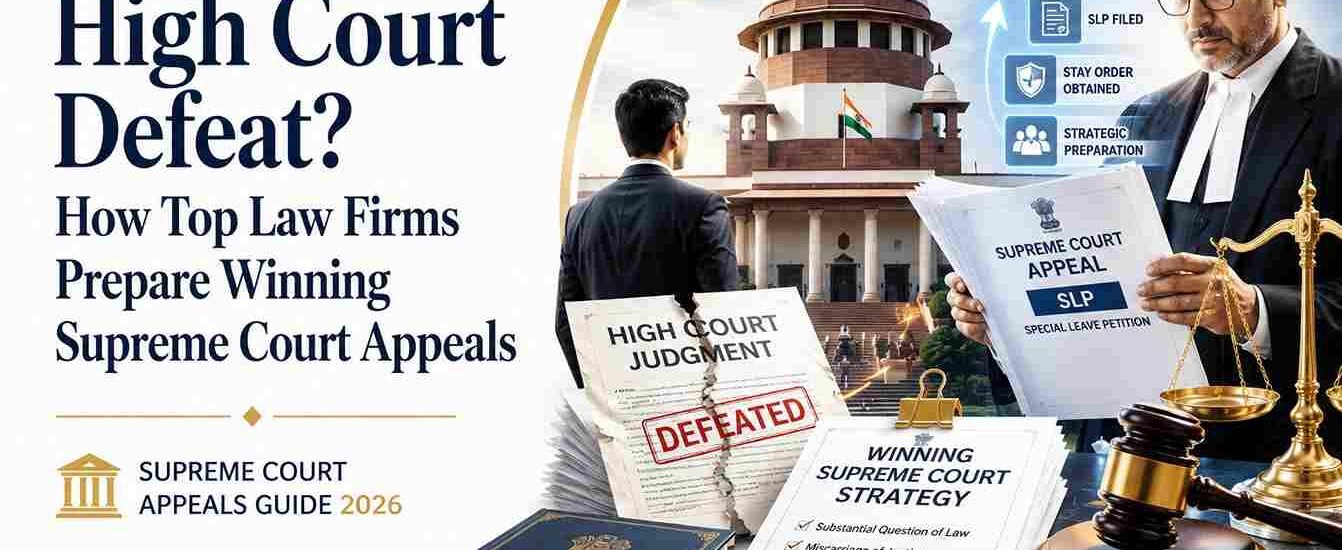
Last Updated: May 2026 | Global Vision Law Firm — New Delhi | ~6 min read
The High Court judgment just came in.
Against you.
You read the order twice. Three times. Something is clearly wrong — a misapplied precedent, a jurisdictional overreach, a statutory provision completely ignored by the bench.
Your trial lawyer says — “We tried our best. That’s the end of the road.”
It is not the end.
The Supreme Court of India exists precisely for this moment. And the right appellate strategy — built by the right Delhi team — can reverse what feels like a final defeat.
But here is what most litigants don’t understand: the Supreme Court is not a higher version of the High Court. It is a completely different battlefield. The rules, the language, the strategy, the advocacy — everything changes the moment your case crosses into apex court territory.
This guide explains exactly how top law firms for Supreme Court appeals prepare winning Special Leave Petitions — and how Global Vision Law Firm turns High Court setbacks into Supreme Court victories.
📌 Quick Answer
A High Court defeat is not final. Under Article 136 of the Constitution of India, any person aggrieved by a High Court order can file a Special Leave Petition (SLP) before the Supreme Court — within 90 days for civil matters and 60 days for criminal matters. The Supreme Court grants leave only when there is a substantial question of law, a gross miscarriage of justice, or a constitutional question. The first hearing is everything — secure a stay, and your position is protected while the case is decided. Global Vision Law Firm has been preparing winning Supreme Court appeals since 2013.
💔 Meet Ramesh — His Company Was One Step Away from Liquidation
Ramesh Gupta is the promoter of a construction company in Pune. A contractual dispute with a government authority over a road project — ₹6.2 crore in claims — had gone against him at the Bombay High Court.
The High Court upheld the government’s termination of contract and ordered Ramesh’s company to refund ₹1.8 crore of advance payment within 30 days. The company’s bank accounts were about to be attached.
His Pune-based advocate said the matter was over.
Ramesh wasn’t ready to accept that. He came to Global Vision Law Firm.
Our team spent 72 hours doing what we call a Legal Audit of the High Court judgment.
We found three critical errors:
First — the High Court had applied a precedent that had been specifically distinguished in a later Supreme Court judgment for identical facts. The bench didn’t notice. The advocate didn’t point it out.
Second — the court had made a finding of fact on a disputed point — whether Ramesh’s company had been given notice before termination — without calling for the actual government file. The finding was based entirely on the government’s affidavit.
Third — the limitation period for the government’s counterclaim had not been properly examined. The High Court had assumed it was within time. It wasn’t.
These weren’t minor quibbles. These were substantial questions of law — the exact currency the Supreme Court accepts.
We filed the SLP within 18 days. At the first admission hearing — we obtained a complete stay of the refund order and the bank attachment. Ramesh’s company continued operating. The matter was fully heard 14 months later. The Supreme Court set aside the High Court order and remanded the matter for fresh consideration.
A case that felt completely over — wasn’t.
⚖️ The Anatomy of a Winning Special Leave Petition
The Special Leave Petition (SLP) is the most common — and most misunderstood — route to the Supreme Court.
Most SLPs are dismissed. The Supreme Court is not shy about this. At the admission stage, benches move fast. Counsel have very limited time. And the standard for admission is precise.
Understanding what makes an SLP succeed — and what gets it dismissed in under two minutes — is the core skill that separates top law firms for Supreme Court appeals from general litigators.
Here is the framework Global Vision Law Firm applies to every SLP:
[High Court Adverse Order]
           ↓
[Global Vision Legal Audit]
    ↓               ↓
[Errors of Law]  [Jurisdiction Gaps]
           ↓
[Drafting the Perfect SLP]
    ↓               ↓
[Substantial       [Constitutional
Question of Law]    Questions]
           ↓
[Admission Hearing]
    ↓               ↓
[Secure Stay]    [Leave Granted]
Pillar 1 — Formulating the Substantial Question of Law
This is the most critical element of any SLP — and the one most general advocates get wrong.
The Supreme Court will not re-examine facts. It will not retry the case. It will not replace the High Court judge’s assessment of evidence with its own.
What it will do — is correct errors of law.
A substantial question of law means: the High Court applied the wrong legal principle. Or applied the right principle to the wrong facts. Or ignored a binding precedent. Or decided a novel question of law that needs authoritative resolution.
Formulating this question requires your Delhi counsel to:
- Read the entire trial record — not just the High Court order
- Identify every legal proposition relied upon by the court
- Test each proposition against Supreme Court precedent
- Find the gap — where the court went wrong in law
- Frame that gap as a precise, answerable question of law
In Ramesh’s case — the gap was clear: the High Court applied an outdated precedent without noticing that the Supreme Court had distinguished it. That was a substantial question. It was framed precisely. The bench admitted it immediately.
Pillar 2 — Demonstrating Gross Miscarriage of Justice
Where a clear legal error cannot be identified — the second threshold is gross miscarriage of justice.
This means: the lower court’s ruling is so fundamentally wrong — violates natural justice, misapplies facts to law in a perverse manner, ignores vital statutory provisions — that upholding it would be a travesty.
This standard is higher and harder to meet. But it exists. And top appellate firms know when to rely on it and how to frame it in language the bench responds to.
Pillar 3 — Absolute Adherence to Limitation Timelines
Time is the most unforgiving element of Supreme Court litigation.
Civil matters: 90 days from the date of the High Court judgment. Criminal matters: 60 days from the date of the High Court judgment. If a certificate of fitness to appeal is refused by the High Court: 60 days from the date of refusal.
The court takes delay seriously. Every day beyond the limitation period requires a Condonation of Delay application — with detailed, specific reasons for each day’s delay. Vague explanations are rejected. Strong, documented reasons are accepted.
Top law firms for Supreme Court appeals mobilise their drafting teams within 48 hours of a High Court judgment — ensuring no deadlines are missed and no condonation applications are needed.
For a complete overview of how Supreme Court filings work — including SLPs, Article 32 petitions, and transfer petitions — read our detailed guide: How to File a Case in the Supreme Court of India
🏆 What Sets Top Law Firms for Supreme Court Appeals Apart
Many litigants make a critical, expensive mistake: they send their trial lawyer — the advocate who handled the High Court matter — to file and argue before the Supreme Court.
The trial lawyer knows the facts. But the Supreme Court doesn’t want facts. It wants law.
The operational blueprint for apex court litigation is completely different from trial court or High Court litigation.
The Global Vision Strategic Advantage
1. Deconstructing the Lower Court Record
We don’t simply copy previous arguments. Our legal analysts perform an exhaustive audit of the entire trial history — the original suit record, all interlocutory orders, the High Court judgment, and every precedent cited.
The goal: find the legal error that the High Court made — and that the losing party’s trial advocate may have failed to argue or preserve.
This audit regularly uncovers overlooked jurisdictional errors, procedural gaps in how evidence was admitted, and conflicting judicial precedents that the court relied upon without acknowledging the conflict.
2. In-House Advocate-on-Record (AOR) Infrastructure
Under Order IV of the Supreme Court Rules, no appeal before the Supreme Court can be filed or listed without an Advocate-on-Record (AOR) — a specially qualified advocate who has passed the AOR examination and is enrolled with the Supreme Court Bar Association.
This is not a formality. It is a structural requirement.
Global Vision Law Firm integrates a dedicated in-house AOR wing. This means:
- No external AOR coordination delays
- Error-free paper-book compilation from Day 1
- Registry defects identified and cured before filing — not after
- Listing accelerated through the AOR’s direct registry relationships
- Court fee calculations handled correctly from the first filing
An out-of-state litigant working with a firm without an in-house AOR faces communication silos and processing delays that cost critical days in urgent matters.
3. Mastery of the Two-Minute Admission Window
This is the skill that separates elite appellate advocates from everyone else.
Admission hearings before a Supreme Court bench move at extraordinary speed. In many cases, counsel have less than two to three minutes to persuade the bench that the matter deserves admission.
In those two minutes — the advocate must immediately identify the legal error, frame the question of law, invoke the relevant precedent that was misapplied, and signal to the bench that this is a matter worth their time.
Everything else — background, facts, trial history — comes later. The first impression is the legal error. State it immediately. State it precisely. State it in the bench’s language.
Our advocates are trained specifically for this. It is a different skill from trial advocacy or High Court arguing. It requires years of Supreme Court-specific experience to develop.
For our full litigation practice and dispute resolution services, see our practice pages.
🚨 Securing Urgent Interim Relief — The Priority at Every Admission Hearing
In commercial, property, and corporate disputes — a final judgment can take 12 to 36 months after admission.
If the High Court order is being implemented during that period:
- Corporate bank accounts are frozen or debited
- Performance guarantees are encashed — money permanently gone
- Properties are demolished or transferred
- Regulatory licences are suspended
- Government contracts are re-tendered to competitors
By the time the Supreme Court decides the case — the damage may be completely irreversible. Winning on the merits means nothing if the company no longer exists.
This is why the primary objective at every admission hearing is securing ad-interim ex-parte stay orders — before the respondent is even served.
The Interim Relief Toolkit
| Type of Remedy | Strategic Objective | Business Impact Protected |
|---|---|---|
| Stay of Operation | Freezes execution of adverse HC order | Prevents asset liquidation, penalties, decree execution |
| Status Quo Orders | Both parties maintain current positions | Protects shareholding, real estate, management control |
| Ad-Interim Injunctions | Restricts third-party rights or guarantee encashment | Preserves cash flow and business continuity |
| Restraining Orders | Prevents state/bank action while matter is sub-judice | Stops coercive enforcement during pendency |
Building the Winning Interim Relief Application
Top Delhi firms treat the Application for Interim Relief as a primary document — not an attachment to the SLP.
A winning interim relief application establishes four elements simultaneously:
Prima Facie Case — the SLP discloses an arguable question of law. Not that you will definitely win — but that the case is arguable.
Irreparable Injury — money cannot adequately compensate for the damage that will occur if the stay is not granted. Once a bank guarantee is encashed, it cannot be undone. Once a property is demolished, it cannot be rebuilt. Once a contract is re-tendered, the business opportunity is gone.
Balance of Convenience — granting the stay causes no real harm to the respondent; refusing it causes catastrophic harm to the applicant.
Financial Impact Assessment — a quantified, document-supported statement of the exact, immediate monetary damage if relief is not granted. Courts respond to numbers. Vague claims of hardship don’t move benches. Specific, documented financial impact does.
At Global Vision Law Firm, our interim relief applications are always supported by financial impact statements, comparative prejudice analysis, and binding Supreme Court precedent on the specific type of relief sought.
For our arbitration practice — including interim relief under Section 9 of the Arbitration and Conciliation Act — and our international arbitration services, see our practice pages.
🔬 Special Leave Petition vs Other Supreme Court Routes — When to Use Which
Not every High Court defeat is best challenged through an SLP. Part of what top law firms for Supreme Court appeals do is identify the correct procedural route before drafting begins.
| Situation | Correct Route | Why |
|---|---|---|
| High Court civil judgment | SLP under Article 136 | Most common route for all civil matters |
| High Court criminal judgment | SLP under Article 136 | Criminal matters — 60-day timeline |
| HC refuses certificate of fitness | SLP under Article 136 | Certificate refusal is itself the trigger |
| Fundamental right violated by state | Article 32 Writ Petition | Direct SC jurisdiction — no HC needed |
| NCLAT / SAT / CCI tribunal order | Statutory direct appeal | Tribunal-specific legislation governs |
| Same matter in two different HCs | Transfer Petition | Consolidate proceedings |
| HC contempt order | SLP or Article 136 | Depending on nature of contempt |
For matters involving insolvency and NCLAT orders: Bankruptcy & Insolvency
For corporate and regulatory matters including CCI appeals: Corporate & Commercial
⚠️ 5 Mistakes That Get SLPs Dismissed at Admission Stage
1. Re-arguing facts instead of identifying legal error The single most common reason for SLP dismissal at admission. The bench signals its discomfort immediately — “We are not going into facts.” If your SLP reads like a re-trial, it will be dismissed in under two minutes.
2. Vague question of law “Whether the High Court was right in deciding as it did” is not a question of law. A precise, specific, answerable legal question — citing the specific provision misapplied — is. The question must be framed with surgical precision.
3. Filing beyond limitation without a proper condonation A condonation of delay application with vague reasons — “the matter was under consideration” or “we were gathering documents” — is dismissed routinely. Every day’s delay needs a specific, documented reason.
4. No interim relief application Filing an SLP without a simultaneous Application for Interim Relief means the adverse order continues being implemented while your case waits for a hearing. Always file both together.
5. Paper-book defects at the registry Wrong margins, missing certified copies, incorrect court fee, wrong cause title, pagination errors — each defect returns the filing and costs days. Elite firms file correctly the first time, every time.
💼 Partner With Global Vision Law Firm for Your Supreme Court Appeal
A setback at the High Court does not end your legal journey. It changes the battlefield.
The Supreme Court of India is the final guardian of justice — and it is accessible to every litigant with a genuine legal question. But accessing it successfully requires exceptional technical precision, deep procedural knowledge, and commanding courtroom presentation in a very specific style.
Global Vision Law Firm is one of Delhi’s top law firms for Supreme Court appeals — serving corporate entities, out-of-state promoters, multinational companies, and individual litigants since 2013.
Our appellate practice covers:
- SLP drafting and filing — Article 136 civil and criminal
- Urgent interim stay applications — same-day filing capability
- Advocate-on-Record (AOR) in-house infrastructure
- NCLAT, SAT, CCI direct statutory appeals
- Article 32 constitutional writ petitions
- Transfer petitions — multi-state matters
- Contempt petitions before the Supreme Court
- Arbitration and International Arbitration appeal strategy
- White-collar and enforcement matters linked to commercial disputes
Explore our complete practice:
- Supreme Court — Hire an Advocate
- Litigation
- Dispute Resolution
- Bankruptcy & Insolvency
- Corporate & Commercial
- Arbitration Services
- International Arbitration
- Banking & Finance
- IPR Litigation
📞 +91 9599801188 · +91-11-71522934 📧 globalvisionlawoffice@gmail.com 📍 M-3 Gupta Tower, Azadpur, Delhi – 110033
👉 Contact Our Supreme Court Appellate Division 👉 About Global Vision Law Firm
❓ FAQs — Supreme Court Appeals and SLP India
Q: What is a Special Leave Petition (SLP) in India? A: An SLP under Article 136 of the Constitution is an application seeking the Supreme Court’s permission (leave) to appeal against any judgment, decree, order, or sentence passed by any court or tribunal in India. It is the most common route to the Supreme Court. The court has absolute discretion to grant or refuse leave — it grants leave only when there is a substantial question of law or a gross miscarriage of justice.
Q: What is the time limit to file an SLP? A: 90 days from the date of the High Court judgment for civil matters. 60 days for criminal matters. 60 days from the date a certificate of fitness to appeal is refused by the High Court. Delay beyond these periods requires a Condonation of Delay application with specific, documented reasons for each day of delay.
Q: Does filing an SLP automatically stay the High Court order? A: No. A stay must be specifically applied for and granted. The court will grant a stay only if the applicant establishes a prima facie case, irreparable injury if stay is refused, and balance of convenience in their favour. Always file an Application for Interim Relief simultaneously with the SLP.
Q: What is an Advocate-on-Record (AOR) and why is it mandatory? A: An AOR is an advocate who has cleared the Supreme Court’s AOR examination and is enrolled with the Supreme Court Bar Association. Under Order IV of the Supreme Court Rules, no matter can be filed or argued before the Supreme Court without an AOR. Global Vision Law Firm has a dedicated in-house AOR wing — see our Supreme Court practice page.
Q: Can I file an SLP even if the High Court refused a certificate of fitness to appeal? A: Yes. Refusal of a certificate of fitness by the High Court does not bar an SLP. You can still approach the Supreme Court under Article 136 — the court has independent, discretionary power to grant special leave regardless of the High Court’s view. The 60-day limitation period runs from the date of the certificate refusal.
Q: What is the difference between an SLP and an Appeal as of Right? A: An SLP requires the Supreme Court’s permission (leave) — it is discretionary. An appeal as of right under Articles 132, 133, or 134 lies automatically when the High Court certifies that the case involves a substantial question of law as to the interpretation of the Constitution or other specified matters. Appeals as of right do not need the Court’s permission to be heard.
Q: How long does it take for an SLP to be decided? A: At admission stage — weeks to a few months. After admission (when it becomes a full Civil or Criminal Appeal) — months to years depending on complexity. Urgent matters can be listed within days. This is why securing an interim stay at the first hearing is so critical — it protects your position during the entire pendency.
Q: Can Global Vision Law Firm handle both the Supreme Court appeal and related arbitration or corporate matters simultaneously? A: Yes. We handle all parallel proceedings simultaneously — Supreme Court SLP, arbitration, regulatory enforcement defence, and insolvency matters. Consistent legal strategy across all forums is one of our core strengths. See our Arbitration and Corporate & Commercial pages.
💡 Final Thought
A High Court defeat is not the end of your legal journey.
It is the beginning of a different — and potentially more powerful — one.
The Supreme Court of India corrects errors of law. It protects fundamental rights. It prevents gross miscarriages of justice. It is available to every litigant with a genuine, arguable legal question.
But it rewards preparation. It rewards precision. And it rewards the advocates who speak its specific language — questions of law, constitutional principles, binding precedent.
Ramesh’s company should have ended. It didn’t. Because three legal errors in the High Court judgment were identified, framed precisely, and placed before the right bench at the right time.
Your High Court defeat may contain the same errors.
The question is whether your legal team is equipped to find them — and argue them — at the apex court level.
Global Vision Law Firm is.
👉 Contact us today → globalvisionlawfirm.com/contact-us-global-vision-law-firm