Published by Global Vision Law Firm | New Delhi June 2026 | Reading Time: ~7 minutes
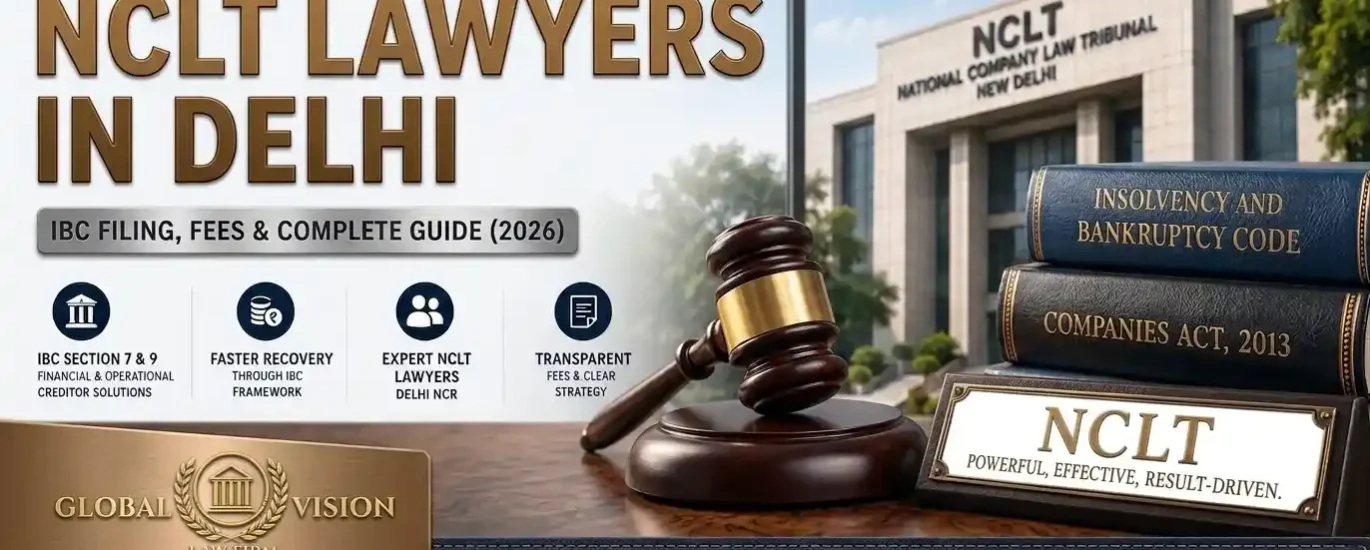
If a company owes you money — or if your company is facing insolvency — the National Company Law Tribunal (NCLT) is the most powerful legal forum available in India today. Whether you are a bank with an NPA, a supplier who hasn’t been paid in months, or a minority shareholder facing oppression, NCLT can deliver faster, more decisive results than any civil court.
This guide covers everything you need to know about NCLT lawyers in Delhi, how to file under the IBC, what it costs, and why choosing the right NCLT law firm in Delhi NCR is one of the most important decisions you will make in a corporate dispute.
What is NCLT — and Why Does Delhi Matter?
The National Company Law Tribunal (NCLT) is a quasi-judicial body constituted under Section 408 of the Companies Act, 2013. It handles:
- Corporate insolvency under the IBC 2016 (Sections 7, 9, 10)
- Winding up of companies (Sections 271–275)
- Oppression and mismanagement petitions (Sections 241–242)
- Mergers, demergers and amalgamations (Sections 230–232)
- Other company law disputes
Delhi is uniquely important: the NCLT Principal Bench and the NCLT Delhi Bench are both located at CGO Complex, Lodhi Road, New Delhi. Additionally, the National Company Law Appellate Tribunal (NCLAT) — which hears appeals against all NCLT orders across India — is also based in New Delhi. This makes Delhi the nerve centre of corporate insolvency law in India.
The IBC Threshold: What Qualifies for NCLT?
Before filing at NCLT, the most critical requirement is the minimum default amount: Rs 1 crore (revised in 2020 from Rs 1 lakh).
If the amount a company owes you is less than Rs 1 crore, an NCLT insolvency petition is not available. You would need to consider other forums such as civil courts, DRT (for banks), or arbitration. If the amount is Rs 1 crore or more, NCLT becomes your most powerful option — and, in many cases, the demand notice alone is enough to trigger payment.
Section 7 vs Section 9: Which Petition Do You Need?
This is the question every client asks first — and the answer depends entirely on your relationship with the defaulting company.
IBC Section 7 — Financial Creditors
Who files: Banks, NBFCs, debenture holders, bond holders, home buyers (under RERA-linked IBC amendments), and anyone to whom a financial debt (money lent against the time value of money) is owed.
Key advantage: No prior demand notice required. File directly on proof of default above Rs 1 crore.
Under the IBC Amendment Act 2026, once a financial creditor establishes default through prescribed evidentiary thresholds (NeSL records or equivalent documentary proof), NCLT is now required to mandatorily admit the petition — limiting the bench’s discretion to defer admission where the conditions are clearly met. This is the single most significant procedural change for financial creditors in 2026.
IBC Section 9 — Operational Creditors
Who files: Suppliers, vendors, contractors, service providers, and employees owed money for goods, services, or employment.
The mandatory first step — Section 8 Demand Notice: Before filing a Section 9 petition, an operational creditor must send a formal demand notice under Section 8 of the IBC, giving the corporate debtor 10 days to either pay or raise a bona fide pre-existing dispute. If neither happens within 10 days, the petition can be filed at NCLT.
The power of the demand notice: A well-drafted Section 8 notice — sent by a qualified NCLT lawyer — resolves a significant number of matters before any petition is filed. The prospect of CIRP, loss of management control and public scrutiny is enough to make most debtors pay within the 10-day window.
What Happens After NCLT Admits the Petition?
Once NCLT admits an insolvency petition, three things happen simultaneously:
- Moratorium is declared — no suits, proceedings, execution or recovery actions can be initiated or continued against the corporate debtor.
- Board of Directors is suspended — management control passes to an Interim Resolution Professional (IRP) appointed by the NCLT.
- CIRP commences — the Corporate Insolvency Resolution Process begins, with a statutory 180-day timeline (extendable to 330 days).
The suspension of the Board is the game-changing consequence. Most promoters and directors would rather pay a creditor immediately than lose control of their company — which is exactly why NCLT is so effective as a recovery tool, often without even needing to complete the CIRP.
NCLT Filing Fees in Delhi — What You Will Actually Pay
One area where most law firm websites are vague — so here is a clear breakdown.
Official NCLT Court Fees (Fixed by NCLT Rules, 2016)
These fees are payable directly at the NCLT Registry and do not change regardless of which lawyer you engage:
| Petition / Application | Court Fee |
|---|---|
| IBC Section 7 or Section 9 petition | Rs 2,000 |
| Oppression & Mismanagement (Sec. 241) | Rs 10,000 |
| Merger / Winding Up / Conversion | Rs 5,000 |
| Other Applications (Companies Act) | Rs 1,000 |
| Certified Copy of Order (per page) | Rs 5/page |
Lawyer Professional Fees (Indicative Range — Global Vision Law Firm)
| Service | Indicative Fee |
|---|---|
| Section 8 IBC Demand Notice (drafting + sending) | Rs 5,000 – Rs 15,000 |
| Section 7 or Section 9 Petition Filing + Admission | Rs 25,000 – Rs 75,000 |
| Full CIRP Representation | Rs 1 lakh onwards |
| Winding Up / Oppression & Mismanagement | Quoted separately |
| NCLAT Appeal | Quoted separately |
Important: The above lawyer fees are indicative ranges for Delhi NCR matters. A written quote is always provided after a free initial consultation — before any work begins.
How to Choose the Best NCLT Lawyer in Delhi NCR
Not every corporate lawyer is an NCLT specialist. NCLT practice requires:
1. Bench Familiarity: The NCLT Delhi Bench has its own procedural preferences, filing formats and admission timelines. A lawyer who appears regularly before this specific bench knows these nuances — and avoids registry defects that delay cases by weeks.
2. IBC + Companies Act Dual Knowledge: NCLT handles both insolvency (IBC) and company law (Companies Act 2013). A lawyer who is strong in only one of these areas may miss opportunities or make errors in matters that span both.
3. Updated Knowledge of 2026 Amendments: The IBC Amendment Act 2026 introduced mandatory admission provisions, strengthened avoidance transaction scrutiny, and modified the Section 12A settlement framework. Your NCLT lawyer must be current on these developments.
4. Transparency on Fees: Ask for a written fee estimate before you engage. Vague “depends on the case” answers without a range are a red flag. Good NCLT law firms provide written quotes.
5. Realistic Success Assessment: A credible NCLT lawyer will tell you honestly whether your matter has strong admission prospects, or whether there are risks (disputed debt, limitation issues, jurisdiction challenges). Avoid lawyers who guarantee outcomes.
Why NCLT is Better Than Civil Court for Recovery Above Rs 1 Crore
This comparison comes up repeatedly — and the answer is almost always the same:
| Parameter | NCLT (IBC) | Civil Court |
|---|---|---|
| Minimum Threshold | Rs 1 crore | No minimum |
| Timeline | 180 days statutory (CIRP) | 5–10+ years typical |
| Management Impact | Board suspended on admission | No management impact |
| Settlement Pressure | Extremely high (pre-filing) | Low until judgment |
| Recovery Rate | Higher — secured by IBC framework | Lower |
The combination of statutory timeline, management suspension and the moratorium makes NCLT the most effective debt recovery tool in Indian law for creditors above the Rs 1 crore threshold.
Global Vision Law Firm — NCLT Lawyers in Delhi NCR
Global Vision Law Firm is among the best NCLT lawyers in Delhi NCR and an expert NCLT law firm in Delhi NCR, with over 12 years of practice before the NCLT Principal Bench, NCLT Delhi Bench, and NCLAT. Our team handles:
- IBC Section 7 & 9 petitions — from demand notice to CIRP
- Winding up, oppression & mismanagement, mergers
- NCLAT appeals and Supreme Court coordination
- Transparent, written fee quotes — starting from Rs 5,000 for demand notices
📞 Call: +91 9599801188 (24/7 for urgent matters) 📧 Email: globalvisionlawoffice@gmail.com 📍 Office: New Delhi — near NCLT, CGO Complex, Lodhi Road
👉 Free consultation → NCLT Lawyers in Delhi NCR — Global Vision Law Firm
Disclaimer: This article is published for general legal information purposes only and does not constitute legal advice. For advice on your specific matter, consult a qualified NCLT lawyer.