Last Updated: June 2026 | Global Vision Law Firm | ~5 Min Read
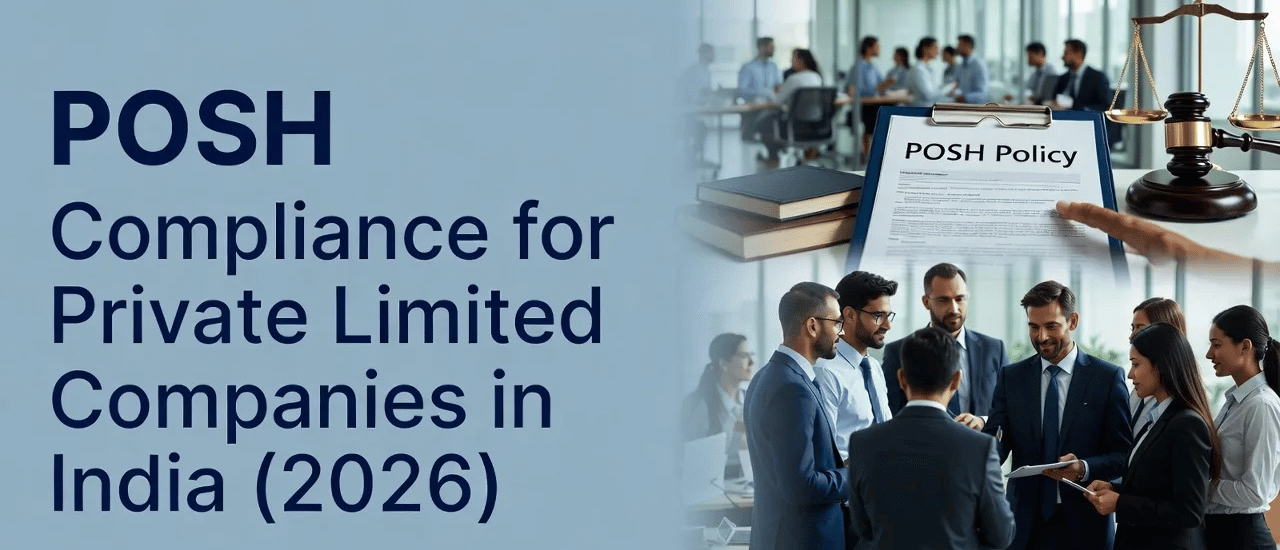
POSH Compliance Is Not Optional for Private Limited Companies
Many startup founders and business owners assume that the Sexual Harassment of Women at Workplace (Prevention, Prohibition and Redressal) Act, 2013 (“POSH Act”) applies only to large corporations.
That assumption is wrong.
The POSH Act applies to private limited companies across India and imposes legal obligations on employers to create a safe workplace for women and establish an effective mechanism for addressing sexual harassment complaints.
Failure to comply can lead to monetary penalties, reputational damage, regulatory scrutiny, and even cancellation of business licenses in repeated cases.
At Global Vision Law Firm, we advise companies, startups, SMEs, multinational corporations, HR teams, and directors on POSH compliance, Internal Committee constitution, policy drafting, investigations, and defence in complex workplace harassment matters.
Does the POSH Act Apply to Private Limited Companies?
Yes.
The POSH Act applies to every workplace in India, including:
- Private Limited Companies
- Startups
- LLPs
- Partnership Firms
- Multinational Companies
- IT Companies
- Manufacturing Units
- Consulting Firms
- Educational Institutions
The law covers not only permanent employees but also:
- Contractual staff
- Temporary employees
- Consultants
- Interns
- Apprentices
- Trainees
- Remote workers
- Work-from-home employees
When Is an Internal Committee (IC) Mandatory?
If a company employs 10 or more employees, it must constitute an Internal Committee (IC).
The committee generally includes:
- A senior female employee as Presiding Officer
- At least two employee members
- One external member with legal, social work, or POSH expertise
Failure to constitute an Internal Committee is one of the most common POSH violations committed by businesses.
For assistance with IC formation and compliance, visit:
POSH Policy & Compliance Services
https://globalvisionlawfirm.com/posh-policy-compliance-services-in-delhi/
Mandatory POSH Compliance Requirements for Companies
1. POSH Policy
Every employer should maintain a written POSH Policy that:
- Defines sexual harassment
- Explains reporting procedures
- Describes inquiry mechanisms
- Sets disciplinary consequences
- Protects confidentiality
A professionally drafted POSH policy reduces legal exposure and ensures procedural compliance.
2. Internal Committee Constitution
Companies with 10 or more employees must establish a legally compliant Internal Committee.
Improper committee formation can invalidate the entire inquiry process.
3. Employee Awareness Training
Employers should regularly conduct:
- POSH awareness workshops
- Employee sensitization sessions
- Manager training programs
- Internal Committee training
Training is one of the strongest indicators of genuine compliance.
4. Complaint Redressal Mechanism
The employer must maintain a structured process for:
- Complaint filing
- Investigation
- Witness examination
- Recommendations
- Final action
5. Annual Reporting Obligations
Companies are required to maintain records and make disclosures relating to POSH compliance.
The Internal Committee must prepare annual reports containing:
- Number of complaints received
- Number resolved
- Pending complaints
- Awareness programs conducted
What Constitutes Sexual Harassment Under the POSH Act?
Sexual harassment may include:
- Unwelcome physical contact
- Sexually coloured remarks
- Repeated inappropriate messages
- Requests for sexual favours
- Offensive jokes or comments
- Display of inappropriate material
- Workplace stalking
- Hostile work environment
Each case depends on facts and must be assessed carefully.
What Happens After a Complaint Is Filed?
Generally, the process involves:
Step 1: Complaint Submission
The aggrieved woman files a written complaint.
Step 2: Preliminary Review
The Internal Committee reviews the complaint and initiates proceedings.
Step 3: Inquiry
Evidence is examined, witnesses are interviewed, and both parties are given an opportunity to present their case.
Step 4: Findings
The Internal Committee submits recommendations.
Step 5: Employer Action
Appropriate disciplinary action may include:
- Written warning
- Suspension
- Demotion
- Termination
- Compensation recommendations
What About False POSH Complaints?
False complaint allegations are highly sensitive and must be handled carefully.
Merely because a complaint is not proved does not automatically make it false.
However, where evidence demonstrates deliberate fabrication or malicious intent, legal remedies may be available.
Global Vision Law Firm regularly advises employers, HR departments, executives, and employees facing complex POSH disputes, including false complaint defence.
Learn more:
POSH Lawyer Delhi – ICC Proceedings & False Complaint Defence
https://globalvisionlawfirm.com/posh-lawyer-delhi-sexual-harassment-at-workplace-lawyer-icc-false-complaint-defense-global-vision-law-firm/
Penalties for Non-Compliance
Employers may face penalties of up to ₹50,000 for:
- Failure to constitute an Internal Committee
- Failure to comply with POSH obligations
- Failure to act on recommendations
- Failure to maintain required records
Repeated violations may lead to:
- Enhanced penalties
- Regulatory action
- Suspension or cancellation of licenses
- Significant reputational harm
Why Professional POSH Compliance Matters
Most organizations make mistakes in one of three areas:
- Incorrect Internal Committee constitution
- Defective inquiry procedures
- Poor documentation and reporting
Even genuine investigations can be challenged if statutory procedures are not followed correctly.
Legal guidance helps ensure that the rights of all parties are protected while maintaining compliance with the POSH Act.
How Global Vision Law Firm Can Help
Our POSH practice assists businesses across Delhi and India with:
- POSH Policy Drafting
- Internal Committee Constitution
- External Member Services
- POSH Training Programs
- Workplace Investigations
- ICC Proceedings
- Employer Advisory
- False Complaint Defence
- Compliance Audits
- Director & HR Advisory
Final Thoughts
POSH compliance is no longer merely an HR function—it is a legal and governance requirement.
Whether you are a startup, growing private limited company, or established corporate, implementing a legally compliant POSH framework protects employees, reduces risk, and demonstrates responsible corporate governance.
If your organization requires POSH policy drafting, Internal Committee support, training, investigations, or legal representation in workplace harassment matters, Global Vision Law Firm can assist.
Contact Global Vision Law Firm today for POSH compliance and workplace investigation support.
Related Resources
- POSH Lawyer Delhi – Sexual Harassment & ICC Defence
https://globalvisionlawfirm.com/posh-lawyer-delhi-sexual-harassment-at-workplace-lawyer-icc-false-complaint-defense-global-vision-law-firm/ - POSH Policy Compliance Services in Delhi
https://globalvisionlawfirm.com/posh-policy-compliance-services-in-delhi/